
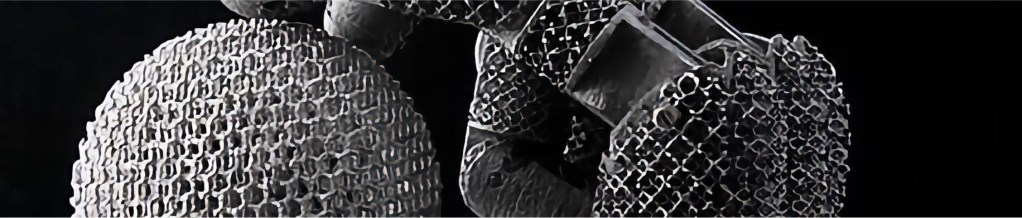
3D Printing – Additive Sculpting of just about anything, in the 21st Century
Although commonly associated with the novelty of plastic toys and other trinkets or parts that you can custom make from digital code in a desktop machine, 3D Printing truly has the promise to become one of the most transformative methods of sculpting, engineering and making in the 21st century.
As the medium is maturing, machine parts or entire cars are 3D printed from molten metal in the car industry or in engineering, concrete structures are robotically built layer after layer in the construction industry, — allowing for new types of shapes and forms — and many types of plastic are added into 3D objects and visualizations of any conceivable form in smaller 3D printing devices by hobbyists, engineers, scientists, or art students.

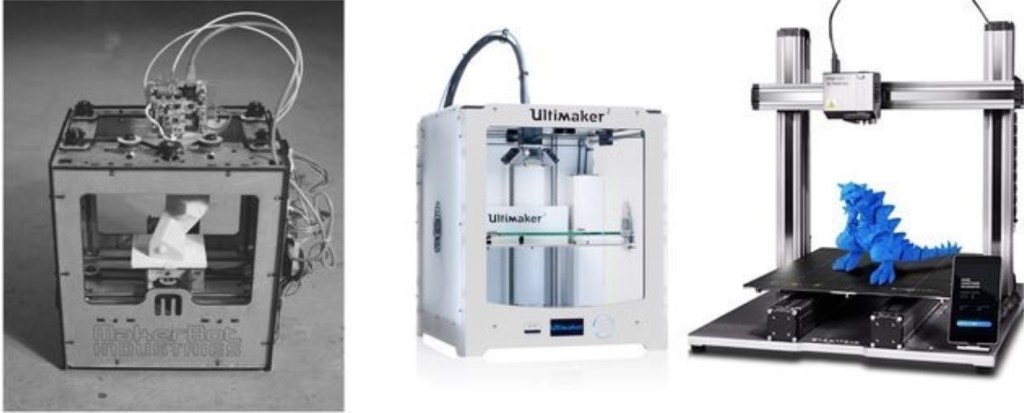
The molten plastics-type of machines are now very affordable and have become ubiquitous among hobbyists and machines can cost from as little as $ 150 upwards.
Most types of plastic filament used for molten 3D addition in these devices are bound to produce fume emissions there anything from irritant to very toxic and harmful, depending on the polymer chemistry used.
Accordingly, with the cheapest 3D plastic printers that use an open construction, fume extraction and respiratory protection are essential in order to have a safe process.

Larger, more expensive devices often use an enclosure, and ideally that should also have a vented extraction system built in to shield users from toxic emissions.
Many plastic filament printers may emit styrene which is a powerful carcinogen.
CDC 3D printer safety advice
Breathing in harmful materials: 3D printing can release particulates and other harmful chemicals into the air. Skin contact with harmful materials: Users can get hazardous materials, such as metal powders, solvents and other chemicals, on their skin.
Static, fire and explosion: Some materials used can be flammable or combustible. High temperatures from
some printers can cause burns.
Ways to Protect Workers from 3D Printing Hazards
NIOSH has studied multiple ways to reduce exposure to 3D printing hazards. Some options include
Limiting equipment access to trained or authorized personnel.
Using enclosures for 3D printers and ventilation to capture chemical emissions.
Using materials with lower emissions
Reducing time spent near the printer while it is running.
Training workers on potential hazards and how to protect themselves.
Wearing appropriate personal protective equipment, such as safety glasses, gloves, or lab coats
Citation
NIOSH [2020].

Wikipedia
every user of 3D plastic printers should refer to copy of this well researched fact sheet published by the CDC for best practices and safe usage.
3D printing with filaments: Health and safety questions to ask. By Glassford E, Dunn KL, Dunn KH, Hammond D, Tyrawski J. Cincinnati, OH: U.S. Department of Health and Human Services, Centers for Disease Control and Prevention, National Institute for Occupational Safety and Health, DHHS (NIOSH) Publication No. 2020-115, https://doi.org/10.26616/NIOSHPUB2020115 external icon
WIKIPEDIA
Fused filament fabrication (FFF), also known as fused deposition modeling (with the trademarked acronym FDM), or filament freeform fabrication, is a 3D printing process that uses a continuous filament of a thermoplastic material.[1] Filament is fed from a large spool through a moving, heated printer extruder head, and is deposited on the growing work. The print head is moved under computer control to define the printed shape. Usually the head moves in two dimensions to deposit one horizontal plane, or layer, at a time; the work or the print head is then moved vertically by a small amount to begin a new layer. The speed of the extruder head may also be controlled to stop and start deposition and form an interrupted plane without stringing or dribbling between sections. “Fused filament fabrication” was coined by the members of the RepRap project to give an acronym (FFF) that would be legally unconstrained in its use.[2]

Fused filament printing is now the most popular process (by number of machines) for hobbyist-grade 3D printing.[3] Other techniques such as photopolymerisation and powder sintering may offer better results, but they are much more costly.
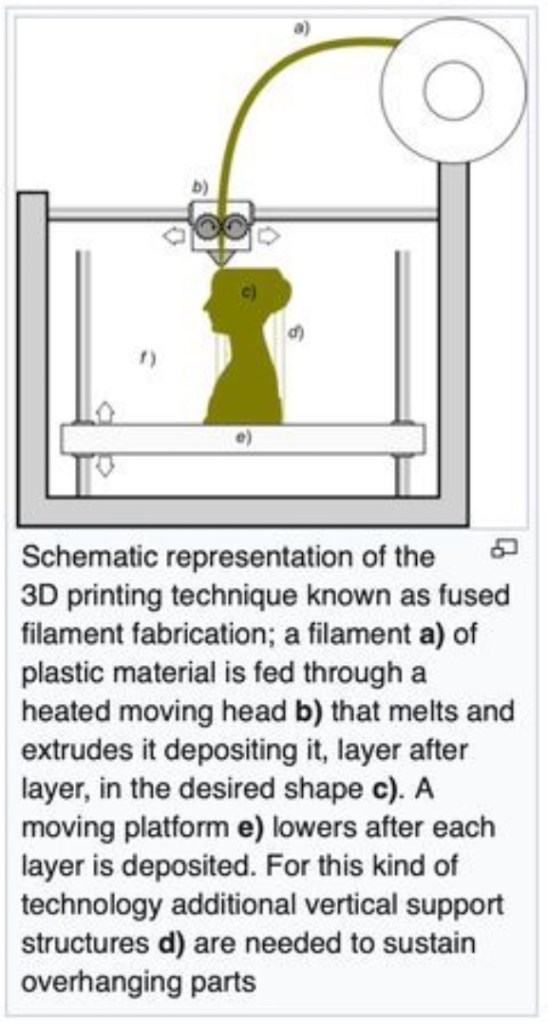
Illustration of a direct drive extruder which shows the name of parts. The 3D printer head or 3D printer extruder is a part in material extrusion additive manufacturing responsible for raw material melting or softening and forming it into a continuous profile. A wide variety of filament materials are extruded, including thermoplastics such as acrylonitrile butadiene styrene (ABS),[4] polylactic acid (PLA), polyethylene terephthalate glycol (PETG), polyethylene terephthalate (PET), high-impact polystyrene (HIPS), thermoplastic polyurethane (TPU) and aliphatic polyamides (nylon).[5]
Full Site Map: a l l p a g e s / t o p i c s
© art-well.org | the authors, 2024