
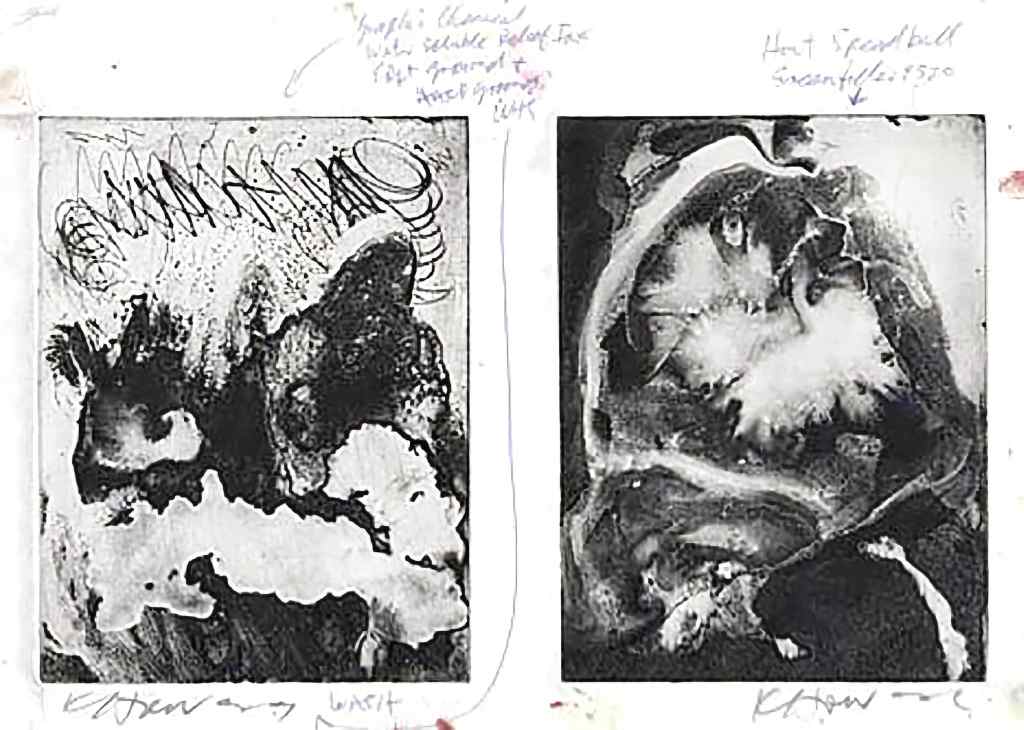
Wash Techniques
Washes and reticulations
Continuous tone wash
Reticulated and experimental washes
Carborundum wash
Washes and reticulations
Many artists are intrigued if not completely baffled when introduced to the painterly mark making potential offered by acrylic resist etching. In the past, wash effects could only be achieved in intaglio printmaking with great difficulty. Now that the etch resists are based on an acrylic chemistry, washes and other painterly effects have become an integral part ofetching. The aesthetic introduced by these methods resembles those produced through lithography and wash painting but with a distinctly intaglio character.
The globular nature of acrylic emulsion has made this development possible. If acrylics are used in their neat form – as in stop-out varnish – they become perfect mordant resists by forming tough polymer chains. If however the neat acrylic is diluted with water it will turn into what is known as a permeable resist. This term is given to substances which have some initial etch resistance, but as the etching process progresses the ground is weakened so that gradually more and more of the metal surface is exposed to the corrosive action. Tonal and textural effects can result from this in two ways: the diluted varnish can create intricate reticulations and dot patterns during drying; or a ground can acquire a fine textured effect with the impact of the corrosive, producing a mark resembling the resistant cover of a stopped-out area which gradually turns into something as permeable as an aquatint. In most cases the resulting tonal area is not flat as with a uniform aquatint, but rich and varied in tone and texture as with an ink wash.
Continuous tone wash (Also known as Destruction Ground, see Keith Howard’s NEW TERMINOLOGY.)
A direct wash technique that produces flowing brush marks of great delicacy and tonal range can be created using Hunt Speedball screenfiller. The wash is used most frequently to produce watery or cloudy flow marks. Owing to the unique permeable properties of acrylics the intersections between tonal areas are not stepped but perfectly continuous. On a copper plate the marks will be surrounded by blank open bite areas, or on a self-texturing plate such as steel, by a grainy area. Where the wash is applied in an opaque layer it functions as a stop-out resist, which will produce white areas on the print. The more the wash medium is diluted with water the darker the resulting tone will be. The darkest tones or black occurs when a 1:6 solution is used and the plate has been etched for a sufficient length of time. Areas diluted further than 1:6 are likely to result in open bite. Experience shows that this technique works best if a lot of metal is still shining through the Speedball wash after application. If the overall thickness of the ground is too great only a few thin areas of the plate will produce a tone. A degree of randomness is in the nature of this playful process.
MATERIALS
Products and equipment needed for continuous tone wash:
can of Hunt Speedball screenfiller
fresh water in various jars
selection of soft brushes
METHOD
Apply continuous tone wash as follows:
1. Fill one jar with a mix of one part Speedball to six parts water to produce the Speedball wash medium. The permeable properties of the Speedball acrylic are most pronounced when this diluted wash medium is used.
2. Paint directly onto the plate with the brushes creating areas of varying concentration or dilution.
3. Carefully place the plate in a drying cabinet and leave for several hours to ensure that the acrylic surface is fully cured.
If etching a wash plate in Edinburgh Etch the best results are usually obtained with fairly long biting times – even up to several hours – to guarantee that the ground has been immersed in the mordant long enough for it to go beyond its threshold of permeability. After around 1 hour in an aerated dip tank, the brushmarks on a copper plate painted with the medium will be clearly etched into the metal. This will in turn produce black brush strokes on the print. The tonality of the stroke will resemble an aquatinted area but its very fine dot structure is much less discernible than a typical aquatint.
Contrast can be enhanced by applying an aquatint prior to printing.
Polishing the plate prior to printing can improve the reproductive quality.
The permeable properties that facilitate a continuous tone wash are not unique to Speedball but can be found in many of the acrylic varnishes when diluted with water, especially in the stop-out mixes described previously.
Reticulated and experimental washes
An ideal medium for reticulated washes is based on the graphic chemical relief ink introduced previously as a soft ground. When diluted with water this waterbased ink flakes out into very pronounced reticulations which closely resemble those previously only achievable in lithography. This represents another extension of the pictorial possibilities for etching using the acrylic system.
MATERIALS
Products and equipment needed for reticulated wash:
Graphic Chemical relief ink
water
brushes
METHOD
Apply reticulated wash as follows:
1. Dispense a small amount of Graphic Chemical relief ink onto a saucer.
2. Using a brush, mix water into the ink
3. Some acrylic binder such as Lascaux No 2060 may also be added for extra mordant resistance, especially on zinc or steel.
4. The mix is ready to be used on the degreased plate as soon as reticulations have formed within the liquid. Marks can be manipulated with the brush and by adding more concentrated ink or water.
5. The relief ink needs to be allowed to dry for a long period – preferably overnight – before it is etched.
For a fainter reticulated wash (e.g. for a background) the plate is best aquatinted then bitten for just a few minutes.
A reasonably long bite will bring out rugged and contrasting intaglio structure.
If Graphic Chemical Black No. 1699 is used the reticulations will be fairly coarse – very similar to lithographic tousche.
If Graphic Chemical Crimson Red No. 1661 is used the reticulation patterns will be much finer.
Carborundum wash
This tonal method, pioneered in Orono, not only facilitates particularly dramatic reticulated effects but also gives a great degree of creative control.
MATERIALS
Products and equipment needed for carborundum wash:
Lascaux Black Acrylic No. 526
Carborundum grit
METHOD
Apply carborundum wash as follows:
1. Create a stock mixture of the wash by mixing fairly equal volumes of Lascaux Black
Acrylic No. 526 and Carborandum grit. The grit size varies from 120-300 and it determines the kind of grainy effect obtained in the wash.
2. Dilute with water to make the wash permeable. The water content should be between 2 to 5 parts water to 1 part carborundum mix. Adding a drop of detergent can help make application more controllable.
3. Use the same drawing methods as in the Speedball wash process.
The quality and darkness of the resulting strokes will be determined by the dilution, the grit size and the biting time.
If this wash is applied to metals other than copper, the acrylic paint content is best supported with a stronger binder such as acrylic floor varnish, for the gritty particles. The process is literally self-aquatinting: the drying acrylic collects around the carborundum particles to form etch resistant dots while the spaces between them become exposed to corrosion in the mordant. This also opens up the possibility of a paint-on aquatint in which the diluted carborundum mix is used to paint a design directly onto a copper plate.
Artists interested in using a vocabulary of washes may wish to set up their own laboratory to more fully explore the tonal and textural potential of acrylics. Other options to be considered are mixing Speedball and relief ink for a wash that has great tonality as well as reticulations, or experimenting by sprinkling droplets of water/ diluted alcohol/ particles etc. on to the wet wash drawing while wet.