
The electrifying art practices of Margorzata Oakes
by Friedhard Kiekeben
It is a pleasure to share some observations on the multi-faceted art practices of the interdisciplinary artist Malgorzata Oakes whose internationally shown work seamlessly bridges art and science, modern art and classical art while presenting art objects in a social and context specific framework, rather than merely as an aesthetic commodity for the art market.
Polish born and educated, the artist has been deeply embedded in Western and North American art and culture since her relocation to the USA in 2001. While making etchings, paintings, drawings, screen prints and installations the artist often seeks a context that connects with family or personal history from Eastern Europe, or with the histories, stories and contexts of others, wherever she visits.
The artist says: “I vigorously work on collective projects with Indigenous Communities, European artists, students, and educators.” Often this search for connections also involves a strong desire to work with methods and materials that can make life and art more sustainable, and less damaging to the natural environment.
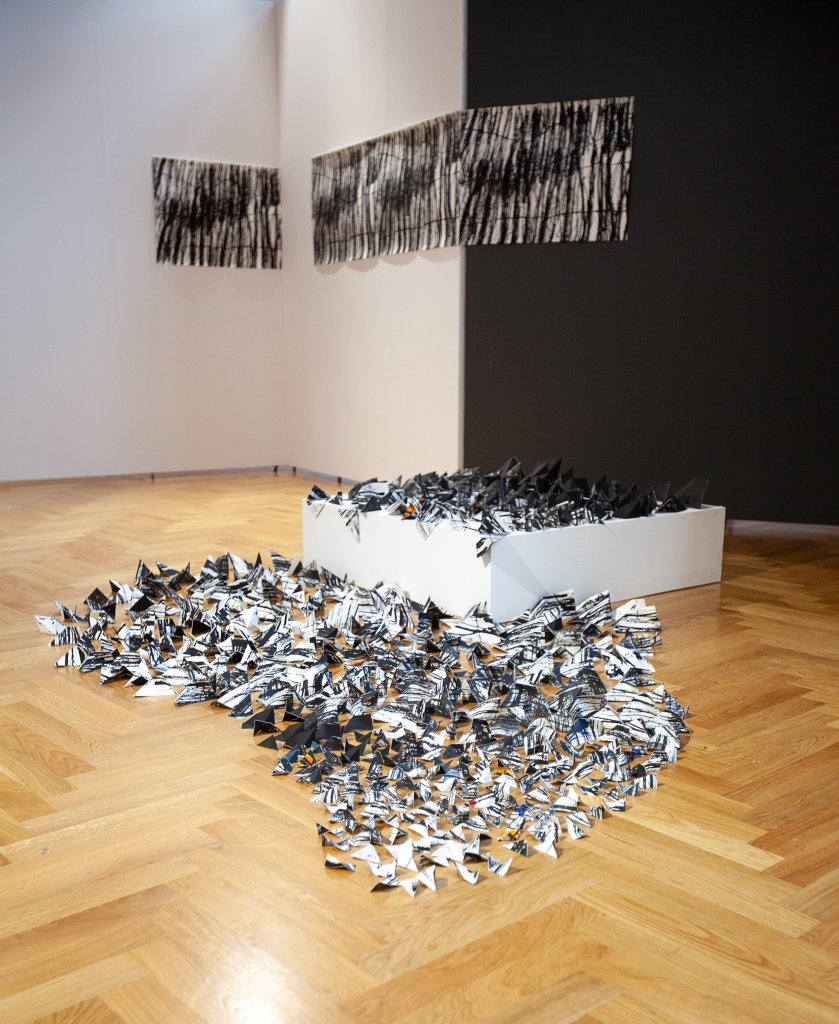
UNITY – Waste Paper Installation 2020 – ongoing
waste paper, 2021 (Accompanying Program MTG 2021 Kraków Inter-Connected – existence beyond waste, Galeria Neon, the Eugeniusz Geppert Academy of Art & Design, Wrocław, Poland, 2022 (Curator)
Unity is an ongoing project focused on a subject of racial injustice. This continuously growing installation strictly remains in black and white. Carefully selected tones and textures represent human populations within white and BIPOC cultures, their ongoing challenges, constant miscommunication, and lack of diversity.
Over the past ten years Malgorzata has become an expert in the technique of electro etching, which — when used correctly and at a low voltage — can offer opportunities for artists or hobbyists to make intaglio etchings or small metal sculpture and jewelry projects in ways that are free from any harmful emissions and allow for the continuous recycling of materials such as metals, etching baths and printmaking papers.
Electro Etching still has some of the mystique of the early days of 19th century research into atoms and electrons when the likes of Michael Faraday or Nicolai Tesla strode towards understanding the energetic forces of lightning, fire, or conducting metals and harnessing these as tamed electrons and useful electricity that can drive cars, power computers, light up cities at night, power the internet, and illuminate the screens of our cell phones when we go on social media. Yet we forget the sheer power of the forces at work, (we take it for granted?), and surely need artists such as Malgorzata Oakes to make us reflect on the natural magic we’ve harnessed. Her approach to electricity in art making is always a gentle one. Often the artist hosts shared making events that give students or other artists opportunities to enjoy the creative magic of the — today no longer secretive — electro etching approach in a collaborative community setting. Several etching tanks are often connected in series to the same power source so multiple artists can electrically etch images into metal plates at the same time.
History of Electro Etching, Cedric Green
Electro Etching was invented in 1840 by Thomas Spencer, and quickly became an important industrial technique, covered by various inventors, corporations, and many patents. Although the physical principles of the process are easy enough to understand, concrete knowledge of electrolytic etching for artist’s use was no longer available to a wider public audience or to individual artists until the late 1980s, when Cedric Green started early experiments and then perfected the method for artists and printmakers. Around the same time Keith Howard pioneered the general use of metal salts as safer mordants for artists, followed by similar work by Cedric Green, Nik Semenoff and myself that expanded the scope of metal etching without the use of strong acids. (Some links). Metal Salt Etching — as opposed to acid etching — was established as a new system for intaglio etching and etched sculpture. With these methods a low ionizing current is produced by an etching bath such as ferric chloride or copper sulfate. In electro etching, by contrast, an actual electrical current is guided into an electrolyte solution and passed between two metal plates through a stream of ionized particles.
Worried about unguided experimentation, safety experts voiced some concerns that the home made electro etching approach might be dangerous, and there is indeed some evidence that uninformed use of the electro etching can create hazardous conditions that produce hydrogen gases or could even have an explosion risk from wrong ingredients or high voltages. But the work of Malgorzata Oakes and her teacher Alfonso Crujera shows that the method can be practiced very safely and reliably if certain precautions are known and observed. For safety, it is important to always use the right kind of electrolyte chemistry and to keep voltages at a minimum. High voltages or concentrated chemistry can both lead to runaway reactions; but this is easy to avoid and the method is very safe.
Recent Works
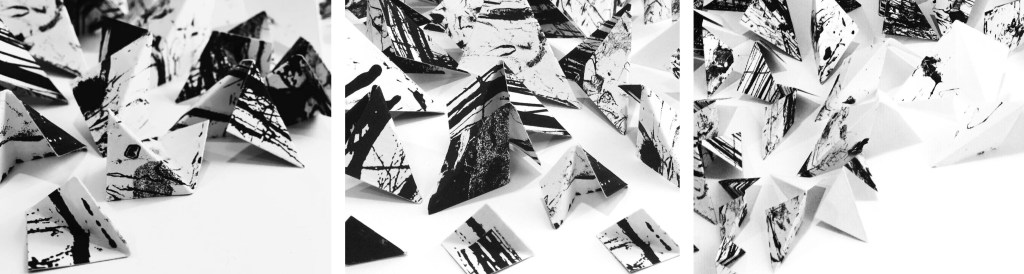
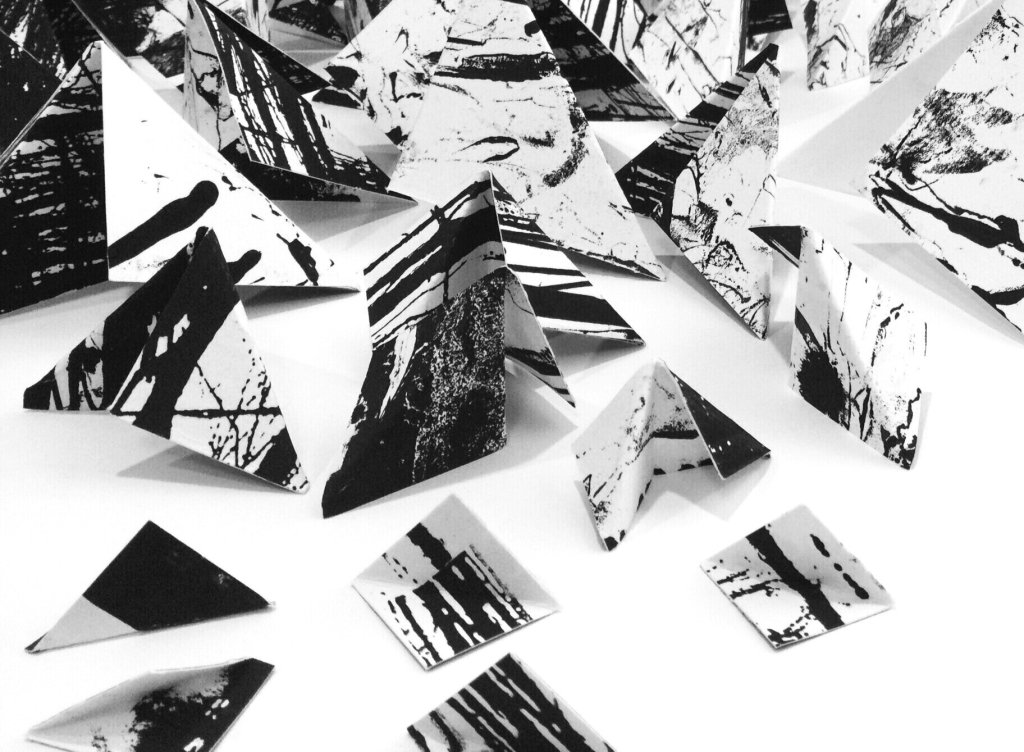
The two works ‘Array’ and ‘Unceasing’ at first glance both seem to be abstract compositions that are printed in black and white on printmaking papers. One has vertical black elements – almost like trees – that are repeated on a panoramic space in horizontal orientation. The space seems deep and impenetrable. Maybe there also is a suggestion of an element that looks like barbed wire going all across the surface of the piece. The other piece, ‘Array’, is made up of folded triangular forms created out of printed paper with strong black and white forms and marks going across the surfaces.
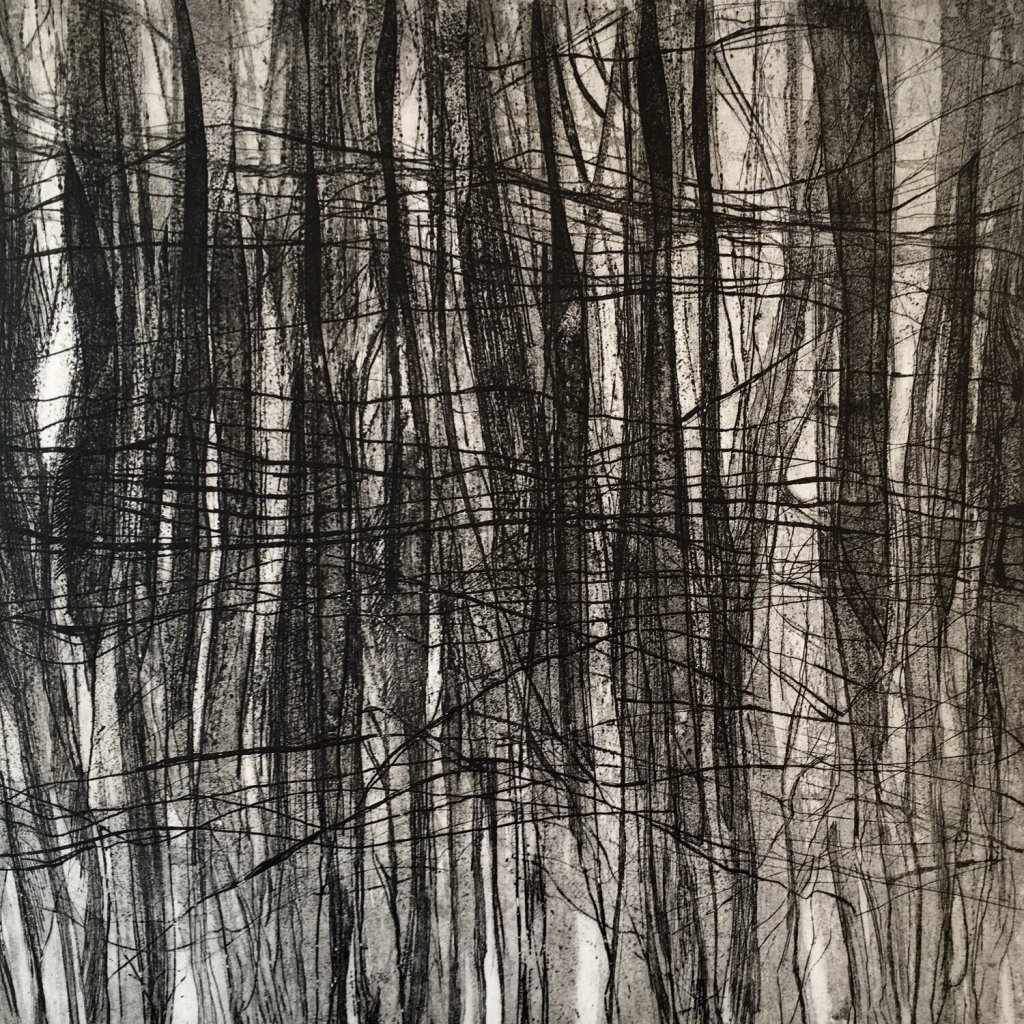
Vestige III, Electro-etching, 12” x 12”, 2020
The little paper pyramids of ‘Array’ in themselves look like something like mountains, with peaks, erosion marks, and valleys, and in their addition entire mountain ranges seem to emerge. This piece also has a social and collaborative dimension, as new pieces are created on a regular basis, and there is also a community aspect involved in donating leftover sheets of precious printmaking papers, which then get transformed and integrated in the series. The aim is to go beyond the conventions of the traditional work of art by working within a framework that grows and adapts while also drawing on the actions and histories of communities outside of the artist herself.
These topological forms, dense forest or mountainous terrain, would seem like good places that people could use as a shelter, a secure dwelling or a hiding place. The artist commented that these works are inspired by the courage of some of her family and community members who managed to seek shelter and survive in Polish forests during the Nazi occupation and reign of terror. While etching and silkscreen are preferred media of expression the artist’s art practice also extends into more context-based and site specific paper and print installations and into the classical media of drawing and painting. The artist says: “I keep collecting waste paper pieces in order to grow my paper installation addressing sustainability and social injustice issues.” It is important to see all these creative practices as interconnected within a larger conceptual framework that always entails collective memories.
Malgorzata Oakes’ work is predominantly monochrome – there are stark black etchings that are reminiscent of Ad Reinhard paintings (or Richard Serra’s black oil stick drawings) and these create powerful elemental spaces that can be seen as landscapes, shelters, fenced in enclosures, fields that could both threaten or protect. Rays of light always shine through the vibrant as light above a landscape (landscape that provides refuge and shelter), or as the glimmers of light and open sun filled space seen through a dense forest; even in dark times or spaces a brighter future shines through.
Linear repeat forms meander and connect throughout many of the etchings, installed arrays, or drawings through the addition of irregular bands, bars and striped forms that can be read in a variety of ways. The scale of many of these dark and powerful pieces — etchings, wall friezes, or paper installations — is always kept at a relatable and more human level, without ever becoming overwhelming like some Richard Serra black drawings do. Malgorzata admires some of the great (brash?) artists from 1950s Abstract Expressionism and the New York School and especially William DeKooning was an early connection to American art from the perspective of an Eastern European cultural upbringing, with its emphasis on tradition and figuration (the library in Warsaw carried monographs on DeKooning).
With a developing appreciation of abstract art Malgorzata absorbed many of the formal techniques and concepts of abstraction while finding a very personal and unusual approach to non-figurative work. In Oakes’s aesthetic philosophy the socially inspired charcoal drawings of Kaethe Kollwitz can be seen as form of abstraction, despite their figurative content, and this can be seen in the intricate web of vibrating marks and gestures that the drawings — often self portraits — are made of. Similarly, the paintings of Willem DeKooning that she admires and studies, carry psychological messages and expressive meaning much more through strokes of paint, vigorous gestures, and abstract shapes than through the faces and figurative forms that are still visible as fragments within an abstract weave.
There is a questioning of the ‘heroic’ and singular gestures of say Jackson Pollock (or Richard Serra), or the constructivists and a great appreciation of the kind of more feminine form of abstract and minimal art that can be found in the works of Eva Hesse. Many of Eva Hesse’s work are very large but they never overpower the viewer. Many of her works use modules and repetition and Hesse’s repeated forms are not machine like, hard and identical, or mathematical, but irregular, made from transient and fragile material such as latex, rubber, or rope, and always connected to the human scale of the viewer.
Malgorzata Oakes’ relocation from Poland to the USA in the year 2001 quickly accelerated this transformation in the artist’s work away from figurative works towards a practice that is much more elemental, abstract, socially engaged and conceptually based than a traditional canon of art. Work is never overpowering or attention-seeking but always invites contemplation and interaction on a more human scale.
Since the pandemic the artist started a new series of captivating paintings and drawings that are based on forces of nature: encaustic blue paintings of water and black and white drawings of the seaside. Pandemic constraints give way to wide open spaces; and the viewer can breathe. Many of the recent abstract artworks, installations and printmaking works engage with the kind of abstraction seen in the works of Eva Hesse, with its variations, accretions, and irregularities. Repetition as a vehicle of infinite variety, not for identical reproduction. Malgorzata Oakes made a name for herself as an innovator in the field of electro etching, and many of her powerful intaglio etchings are created in this new medium. The methodology used is especially geared towards safe use (even in a home environment) or for communal or educational contexts. Not only is the process reliable and free of risks, but the method is also one of the most sustainable ways to create intaglio etchings and the chemical solutions that are used can be reused and recycled almost indefinitely; there is little or no waste. To the artist electricity serves as as a gentle form of probing the depth of intaglio etching, not as the scary force that is present in lighting or high voltage transmission lines.
Recent Exhibitions and Projects:
Maironis Lithuanian Literature Museum, Kaunas, Lithuania, Ziemia Ulro: Labirynt eteryczny
Pharmacy Museum, Wrocław, Poland, Desydenci idei Berryboy Art Gallery, Warszawa, Poland, IMAGE OF THE YEAR Eugeniusz Geppert Academy of Art & Design, Wrocław, Poland, Neon Gallery, Black & White Wonthaggi ArtSpace, Bass Coast, Australia, Eco Arts project For Our Future Manhattan Graphics Center, New York, NY University of the West of England, Bristol, England, The Centre for Print Research, Hybrids MTG – International Printmaking Triennial Kraków 2021, accompanying program, Inter-Connected – existence beyond waste Galleri Heike Arndt, Berlin, Germany, Mini Maxi Print MEGALO Print Studio & Gallery, Australia, Intaglio Douro, Portugal, 10th International Printmaking Biennial Douro 2020 Zayed University, Dubai, Authentic Marks MESHTEC, Tokyo, Japan, International Screen Print Biennial, The 7th NBC MESHTEC
Electro Etching : The basic Process
The artist strongly advises those interested to learn about Electro Etching to study the method in a properly equipped studio with an experienced expert such as herself. Although her method is not only easy and straightforward, but also very safe, the direct teacher – student connection is needed to gain a full understanding, and to avoid mistakes, or chemical or electrical incompatibilities or even accidents.
SAFETY NOTE: (some electro etching set-ups are known to have caused hydrogen explosion through excessive voltages, use of the wrong chemicals, or excessive salt levels).
Alfonso Crujera gives a detailed and safety-oriented description of a contemporary electro etching process here:
Malgorzata Oakes’ Artist’s Homepage