
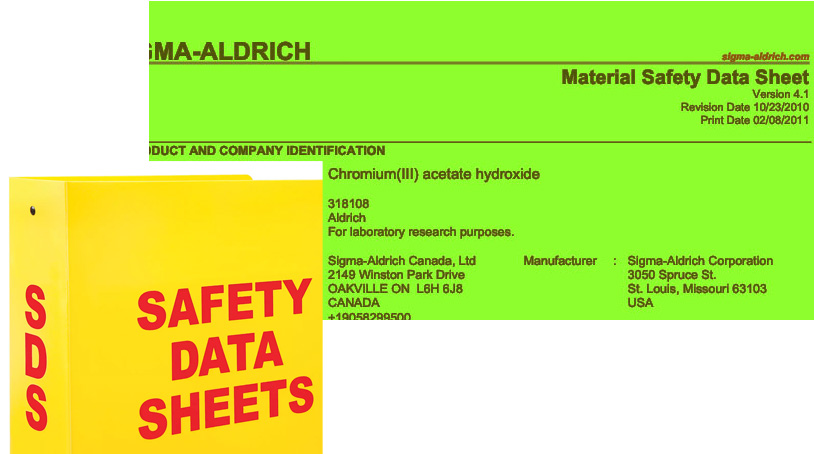
image (Wikipedia: SDS) https://en.wikipedia.org/wiki/Safety_data_sheet
editorial page; we recognize the kind help of Monona Rossol in evaluating this page. Monona Rossol is a chemist, artist, and industrial hygienist.
Staying safe with chemicals in 2026
Most individual users of chemicals, paints, art materials, and processes are familiar with the SDS (and ‘right-to-know data’) conventions which require manufacturers to declare hazards related their products to end users. Over the years this information proved invaluable, (and probably saved many lives), but sometimes was also found to be incomplete, misleading, and some sheets omitted toxic or poisonous compounds or emissions.
SDS information was an essential and necessary force for good and sometimes for not so good. In a professional workplace setting that has employees SDS are always a requirement, and there are strict OSHA rules related to these documents (check with OSHA about current guidelines).
Today, a new situation has emerged. In some places there may be a process of deregulation, where the previous rules of chemical hazard documentation may be relaxed, broken, and changed in sometimes unpredictable ways.
Many SDS sheets that could be easily found and accessed by anybody through simple Google searching even five years ago, have since then disappeared from easy access and broader public view. In 2026 some of these are now accessible via commercial paywalls, moved to more inaccessible locations, or have been deleted altogether.
This ‘missing sds’ situation is worrisome for industrial chemists, hygienists, and chemical technicians; and outright problematic, and sometimes sickening, for individual artists and makers who are trying to make sense of products and chemicals they are working with in the safest possible manner.
How do you access essential safety data at a time of change ?
This perceived situation is evolving; below are some suggestions for artists, crafts people and makers, wishing to stay abreast of key hazards, protective methods, and regulations, and make good safety decisions in their workshops and studios:
1) For reference, hold on to old SDS and MSDS sheets from years past. This practice used to be frowned upon by some — considering frequent SDS updates — but from the current perspective makes sense. Keep SDS collections as hard copies in your shop or create online access. In fact, in the US old copies of SDS sheets need to be kept by employers for 30 years (!). Those should all be in the ‘dead file’ because some of the diseases caused by chemicals do not occur for many years. A record of what was used in the past and how long it was used is needed. These rules apply if you have an employee.
Individual artists are not required to do this, but they would be wise to keep a ‘dead file’ in any case. And if they hire a bookkeeper, assistant, or any other help that would be exposed during the work day to the chemicals, they now are obligated to keep all the old document (or an electronic record of the same).
2) Try to cross reference SDS sheets for similar products from different manufacturers; some manufacturer give you an honest account of toxins that others omit.
3) Try to cross reference SDS information across countries. Countries that are known to be exemplary with their regulation of toxic substances are Sweden, Norway, Iceland, and other Scandinavian countries and Switzerland.
4) Spend more time learning about the basic chemical and physical principles — and hazards — that are at play in your art, craft, or making processes. Spend more time investing in appropriate masks, fans, extraction systems, etc., and always assume a process has some toxicity even if it is not obvious or documented.
5) The emerging tech-based making industry introduced many new hazards and cancer risks; (e.g. laser printers, 3D printers, plotters, UV cured resins, robotic sculpture etc.). Some companies like XTool also sell effective sophisticated add-on solutions for removing toxins and hazards from the workplace, and users are advised to install these; also for fire safety.
6) If in doubt, consult with a safety officer, chemist, industrial hygienist, public health officer, or other specialist with knowledge of chemistry and materials.
7) Write to a manufacturer or materials shop or distributor and ask them for a current SDS sheet and safety data. It is a requirement to provide this information on request.
8) Basic chemicals can be very hazardous, but many of these hazards are well known or documented in books and online sources. Examples: hydrochloric acid; (high toxicity); gum arabic (low toxicity). However, more complex chemical compositions and admixtures as found in most chemical products, are often patented, and can be hard or impossible to fully evaluate for toxicity.
9) Many polymers, paints, pigments, adhesives, resins, heavy metals, and dyes are often very toxic and require use of ventilation, respirators, PPE and so, for safe use.
10) If you can’t find a current SDS for a polymer product, find an equivalent, or use a rule of thumb, such as this: an example… PVC-monomer, Styrene, or Epoxy-based products for making rubber, plastic, glue or styrofoam structures are known to be highly carcinogenic, and should not be inhaled. Also: Ethylene gas from using hot glue guns.
11) The use of the terms ‘nontoxic’, ‘eco-friendly’, or ‘safe’ has become commonplace. These claims can be meaningless, unless a company can prove their products have undergone rigorous evaluation.
12) Some online art material vendors include full SDS information with their product listings (example: DickBlick.com), many vendors do not.
13) The School of The Art Institute Chicago maintain an exemplary online collection of SDS information that is accessible online.
(https://chemmanagement.ehs.com/9/350744af-8763-494e-8527-3a89580a7f6e/ebinder/?nas=True)
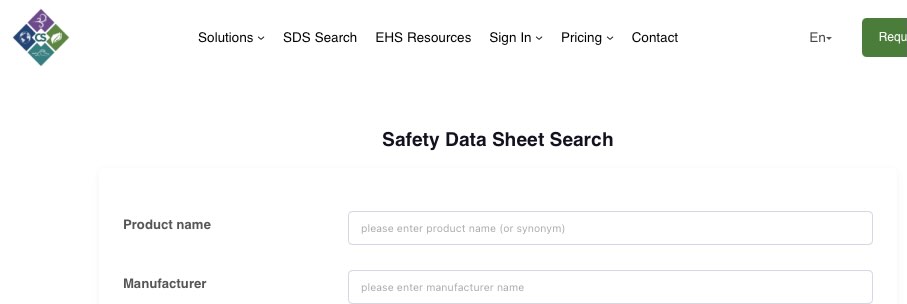
FINDING SDS SHEETS TODAY : SEARCH HERE
The company Chemical Safety Software offer free online search tools for many of the SDS sheets, past and present, that may no longer be available through basic browser searching. Artists and makers are strongly encouraged to use this service! Only write your own SDS sheets if you feel chemically competent and if cannot find any kind of first-hand source. (OSHA rules must be followed); see below.
SDS Requirement in the Workplace
Professional workshops or studios that have employees are required by law to provide SDS sheets to users related to materials that can cause harm.
Generally, substances that could cause harm require SDS sheets. Examples include:
**Explosive:** Chemicals that can explode when mixed or exposed to fire.
**Flammable:** Substances that easily catch fire.
**Corrosive:** Chemicals that can damage materials or skin.
**Acutely Toxic:** Chemicals that cause severe reactions from short-term exposure.
For a full list of hazardous characteristics, please reach out to OSHA.
The collection of SDS sheets (or online access), needs to be provided right in the studio, workshop, or work area, not in rooms or offices that are separate from the shop. This way users / workers can easily consult the SDS sheets during their work session.
To keep your SDS sheets compliant over time, consider the following:
**Familiarize Yourself with OSHA Guidelines:** Understanding the Hazard Communication Standard is crucial.
**Assign Responsibility:** Designate someone to oversee the hazardous communication program.
**Create a Systematic Plan:** Establish a clear process for handling new chemicals and updating existing sheets. Write your own SDS if needed.
If at all possible, SDS sheets should be used that are provided by manufacturers or a first-hand source. As outlined above, it has recently become harder to obtain first-hand and current SDS sheets. Given all the information that is available to you, you then need to write your own SDS sheets and make them available to your co-workers. These also need to be available should there ever be an OSHA inspection.
Creating a valid SDS sheet involves given steps and procedures, and needs to be left to professionals with a degree in chemistry, toxicology, or industrial hygiene:
1. **Collect Data:** Gather all relevant information about the product, including chemical components.
2. **Input Information:** Fill out the SDS sheet thoroughly, ensuring all required parts are completed.
3. **Compare to Similar SDS Sheets:** Review the sheet you have written against others to ensure completeness and clarity.
4. **Post the SDS Sheet:** Make it available in your workspace, either digitally or in a binder.
Artists or individual makers can write a short report on what they think are the hazards and issues for your own reference, but if anyone else is likely to use this information, make sure your lack of credentials are up front.
OSHA SDS WRITING RULES
below is a link to the current rules for writing SDS sheets, as published by OSHA:
https://www.osha.gov/laws-regs/regulations/standardnumber/1910/1910.1200AppD
Toxic and Hazardous Substances
Safety Data Sheets (Mandatory)