
Alicia P. Gregory, Odyssey, Fall 2000

The following article was published in 2000 and is reproduced here with the permission of the author and editor of Odyssey Magazine for the University of Kentucky, and Gerald Ferstman. Ross Zirkle died in 2007.
“Nobody should have to die to make art.” That’s the bottom line for UK (University of Kentucky) art professors Gerald Ferstman and Ross Zirkle. These devoted printmakers are creating non-toxic techniques to keep their craft alive. “Printmaking is part of the nature of man, the desire to leave an impression or mark that he was here,” says Zirkle, an assistant professor who came to UK in 1997.
Toxic elements first seeped into the printmaking world with the invention of oil paint, Zirkle says. New, often hazardous, chemicals were needed to break down oil-based inks. Common household chemicals like turpentine and lacquer thinner (for example, nail polish remover) are among the more than 100 toxic substances used by traditional printmakers. Some of the known side effects from continuous exposure to these chemicals, many of which are carcinogens, include birth defects, central nervous system damage, asthma and emphysema, systematic poisoning of the lungs, liver, kidneys and heart, nervous disorders, skin eruptions and dermatitis, and damage to the mucus membranes and upper respiratory tract.
“My grandfathers were both pressmen for newspapers,” says Zirkle. “One developed dermatology problems from handling inks and eventually died of cancer.”
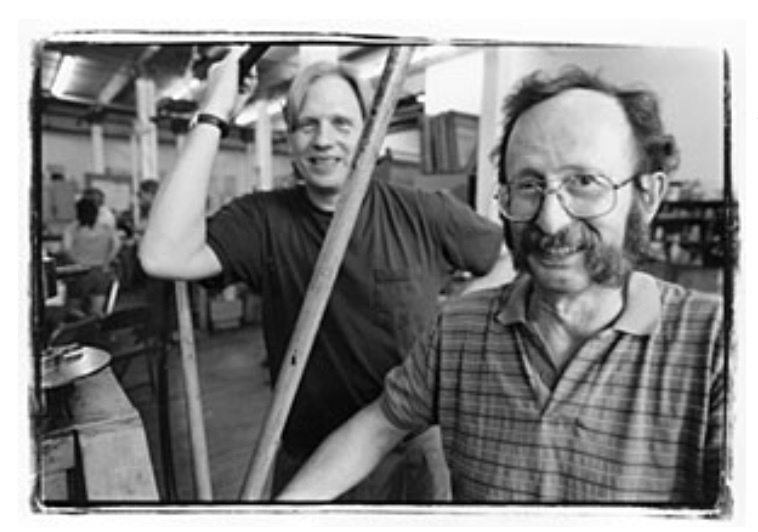
Ross Zirkle (left) and Gerald Ferstman at their metal press
As a research fellow at the Tamarind Institute at the University of New Mexico, one of the most prestigious lithography schools in the country, Zirkle worked with an artist who had cancer in an arm. “She told me that of the five women she had stayed in touch with for 20 years since they were in art school together studying printmaking, four had developed cancer,” Zirkle says.
“The ratio was too high not to suspect that it had something to do with what they were exposed to in art school.”
“There’s just too much evidence now to ignore the toxic nature of these chemicals,” says Ferstman, an associate professor who has spent two-thirds of his 30-year career at UK developing safer printing techniques. “Some art programs have been fined heavily by OSHA and the EPA, and there have been lawsuits by students who’ve suffered nerve damage they claim was caused by their exposure to chemicals. It’s a liability most schools aren’t willing to risk anymore.”
“A lot of schools are dropping printmaking altogether,” says Zirkle, “or offering it only as a sub-line, not on the same par with painting or drawing.”
Not many institutions can afford the expensive ventilation systems required by federal legislation, Ferstman says. “When I came to UK, we installed a ventilation system that was adequate for the acids we were using. Last spring the fire marshal came through and said our facilities were substandard for acids, and we could no longer use them. Fortunately, I’d developed a safe etching ground and am now using a salt etch that works well, so the program could continue.
The art of printmaking is really the art of process – a combination of artistic vision and chemical know-how. “Students look at printmaking as a kind of chemical laboratory of magical eventsbecause the process is so far removed from most people’s knowledge of art,” says Zirkle.
“Printmaking uses medieval processes in a digital age, which just makes this stuff seem more mysterious than ever.”
“Printmaking as we know it will change,” Zirkle says. “In a few years you may see some Macintosh G4s lined up along the wall and things will be made digitally, but actually making a plate with your hands, involving yourself in the rhythm of running it through the press each time you pull an impression – that kind of experience will be lost unless something is done.” “A press can be used for 100 years. You buy a computer, and it’s obsolete in three,” says Ferstman.
Not all artists and academics embrace nontoxic printmaking, say Ferstman and Zirkle. “At the most, 25% of schools and universities are using nontoxic techniques,” Ferstman says. “A lot of people are still holding onto the traditional ways because they don’t want to be re-trained. The older generation seems to feel the old ways are not so bad, it’s just a matter of having the right facilities.”
Traditionalists aren’t willing to invest the time to experiment with nontoxic alternatives, he says. “They’ll use something that’s more toxic, more dangerous, more of a liability, because they know exactly how it works,” says Zirkle. “That’s been a problem with the nontoxic movement in printmaking. A lot of products that came out were mostly hype, they didn’t work well, and a lot of people bought them and got burned, and then they said, ‘Well, this stuff doesn’t work’.”
“Artists have never been as concerned with their health as they are with the results of their work,” says Zirkle. “The burden of proof for change has been difficult. Not only do Jerry and I have to prove that our stuff is safer, we also have to prove it works as well as the traditional ways.”
Their research involves a lot of trial and error. “People want products; they want the science of success. They don’t understand that sometimes you can work for a long time and learn things, but you don’t come up with a product that’s workable,” Zirkle says.
The researchers are now looking for a water-based ink that can be used in all printmaking techniques and are experimenting with improving and adapting new non-toxic products. Zirkle’s research centers on waterless lithography. “In traditional lithography, water is used to repel oil- based inks from the non-image areas of the printing surface. In waterless lithography the non- image areas are covered with silicone that will also repel ink,” he explains. This isn’t any fancy kind of silicone – it’s the kind you buy at the hardware store to caulk your bathtub. “While I was at Tamarind, I became intrigued by the possibility of using water-based inks with the waterless printing process. Today we have a very workable system of ink and modifiers that provides a safe, economic and reliable alternative to oil- and solvent-based lithography.”
Water-based inks print more detail than is possible with oil-based inks and are safe to use even without gloves, Zirkle says. And another important advantage is time. “Clean up is so fast with water-based inks (just soap and water) that you can often clean up and print the next run in the time it would have taken you to clean up one solvent-based ink run. This new, faster process allows more time for experimentation and more color runs, which should produce better prints which are actually cheaper to print.” In four weeks, he says, his Beginning Printmaking students are printing color, a feat that with traditional lithography would take them up to four years to achieve.

UK printmaking teachers and their students discuss their latest works. From left to right: Emily Whipple, Teresa Koester, Ross Zirkle, Joyce Probus, Gerald Ferstman, and Helene Steene.
“When you teach printmaking to kids you’ve got to make it as user-friendly as possible,” says Zirkle. “And they want results. They’re paying tuition to make art, and they want things to work. The burden’s on us entirely to be able to troubleshoot for all the problems 30 kids might generate.”
But Ferstman says the students also generate useful ideas. “A lot of times they try things I wouldn’t have even thought of doing, and they work. It’s good that they see us experimenting with new materials and that that attitude transfers to them somehow so they understand a little bit about what research is.”
Ferstman and Zirkle’s work is supported by a network of like-minded artists around the world. One of their favorite collaborators is Nik Semenoff. “He’s an inventor,” Zirkle says. In addition to a number of novel rollers for printmaking, Semenoff created a salt etch – Ferstman’s key interest – the first good alternative to using acids to do etchings. “This strong salt is a lot safer than acid,”
Ferstman says. It’s not 100% non-toxic – after all, it has to eat through metal – but there aren’t any harmful fumes.”He’s spent the last six years developing safer etching grounds – a mix of ink and chemicals into which the image is etched. “In the summer of 1997, I began experimenting with water-based ink as a substitute for traditional etching grounds, because of their carcinogenic qualities and flammability hazards,” Ferstman says. “This new ground could be applied to copper, steel, aluminum, bronze, iron, and zinc etching plates, with excellent results. The only problem was that removal required strong detergents and ammonia. By adding a commercial water-based silk screen extender that is set with heat, I was able to come up with a new ground that washes off with just warm water and
dry laundry detergent.” In addition to applications for etching, Ferstman has been able to adapt this ground for silk screen printing.
“I was in the first class to use Jerry’s new soft ground,” says Joyce Probus, a student who earned her bachelor’s degree in fine arts last summer. “This process is a catalyst to getting down to the art- making as opposed to being inhibited by a lot of steps and chemicals.”
Another Semenoff innovation – a way to use and reuse the backside of commercial aluminum printing plates – has allowed the UK professors to operate their shop at a fraction of the cost that other universities incur. “We are able to print from the backside of plates that we get at salvage for free. And when it comes right down to it – are our students producing as nice a print as students at other universities using premium materials? More often than not, our students are actually doing better because they don’t have to choke on the cost of the materials. We give them as many plates as they want,” Zirkle says.
And the UK students’ work is often excellent, evidenced by the fact that they have been accepted into some of the nation’s most prestigious graduate printmaking programs. “In the first waterless lithography class I taught at UK, we had three students get accepted in a national juried competition celebrating 200 years of lithography,” says Zirkle. “Our students’ work was shown side-by-side with the work of artists who have been the mainstay at juried competitions for twenty years. These were all first-semester students.” In 1998 Zirkle’s students had a ground-breaking opportunity – they printed lithographs for Ecuadorian artist Nelson Santos with water-based inks. Graduate, Helene Steene, says the way Ferstman and Zirkle teach is a source of inspiration.
“These teachers can bring ideas out of every individual and encourage experimentation.” “A lot of process-related work is problem-solving, and there’s a lot of problem-solving in all art-making,” says
Joyce Probus. “You learn to direct the process instead of the process directing you. I’ve never faced a blank piece of paper without ideas as a result of getting to work with these new techniques. It’s been an excellent opportunity.”
Alicia P. Gregory, Associate Editor
Lee P. Thomas, Photographer
Odyssey covers the latest research advances, innovation scholarships, and outstanding people that are part of the University of Kentucky’s $300 million-a-year research enterprise.