
Innovation in Graphic Techniques
Ad Stijnman
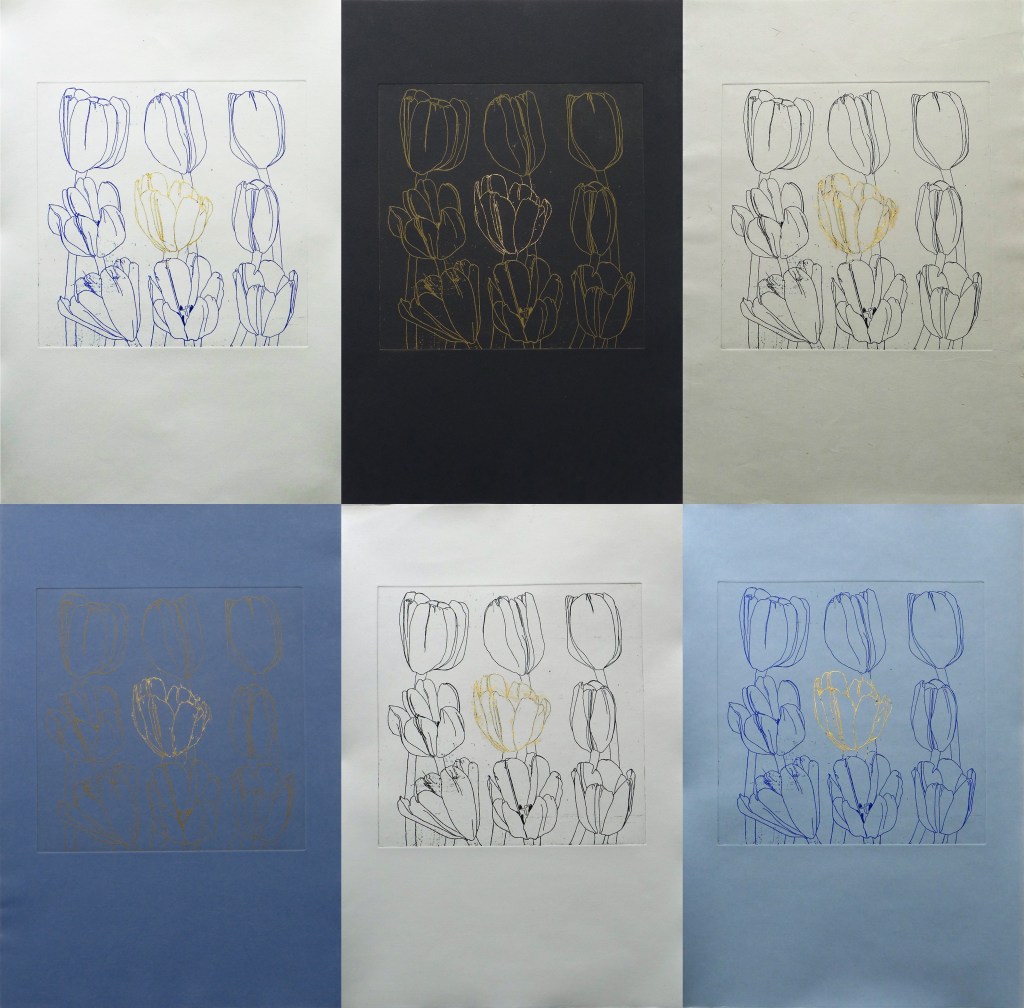
Ad Stijnman, etching 6 papers 3 inks goldleaf 98x97cm
I gratefully acknowledge Anthea Boesenberg for discussing and editing the original text. Sincere thanks go to Sytze Folkertsma, Willem Moezelaer, Willibrord van den Besselaar and Gerard Post van der Molen for the advice and information they supplied.
Statement: I am fine with all materials, tools and procedures used in printmaking,
as long as you take care of yourself, the people around you and the environment.
Otherwise, walking through a busy street during rush hour can be as damaging.
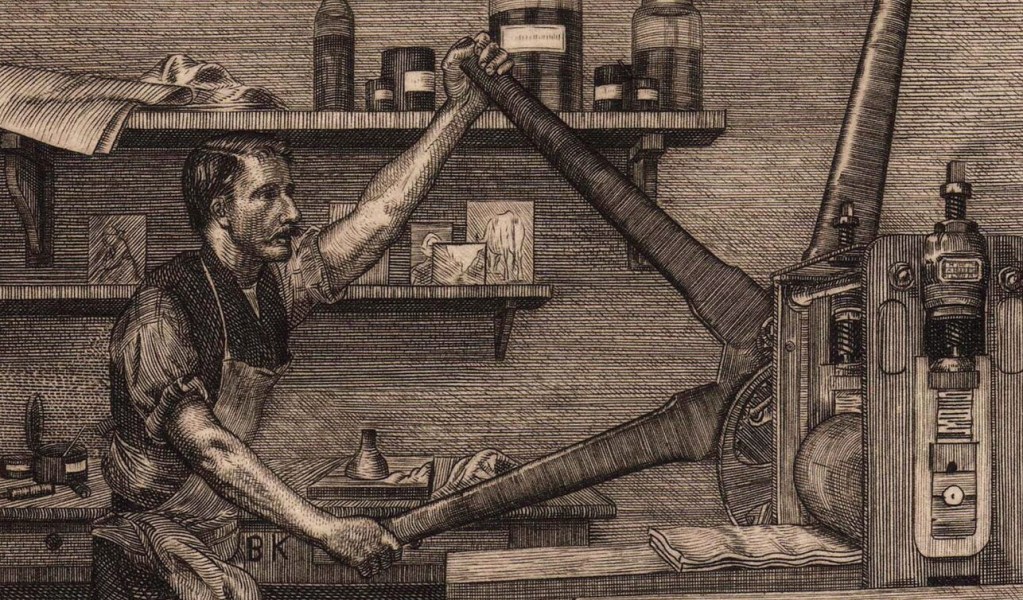
NB1: This is a translated and reworked version of: Ad Stijnman, ‘Veilig en veiliger. Innovatie in de grafische technieken’, in kM 50 (2004, Summer), pp. 41–43.
NB2: Often the term ‘non-toxic’ printmaking is used. A literally non-toxic way of working with the chemicals used in printmaking is not possible, as chemicals are present in grounds, are necessary in creating the image and are used in cleaning the plate. These chemicals are reactive and possibly harmful. Terms, such as ‘safer printmaking techniques’, ‘healthier printmaking’ or ‘less-toxic printmaking’ better express that chemical procedures are less dangerous compared to those in traditional printmaking. Only such techniques as Japanese-style woodcut printing, moku hanga, with paste inks can be called non-toxic.
NB3: Developments in safer printmaking procedures can be followed through the issues of the journal Printmaking Today from 1995 onward.
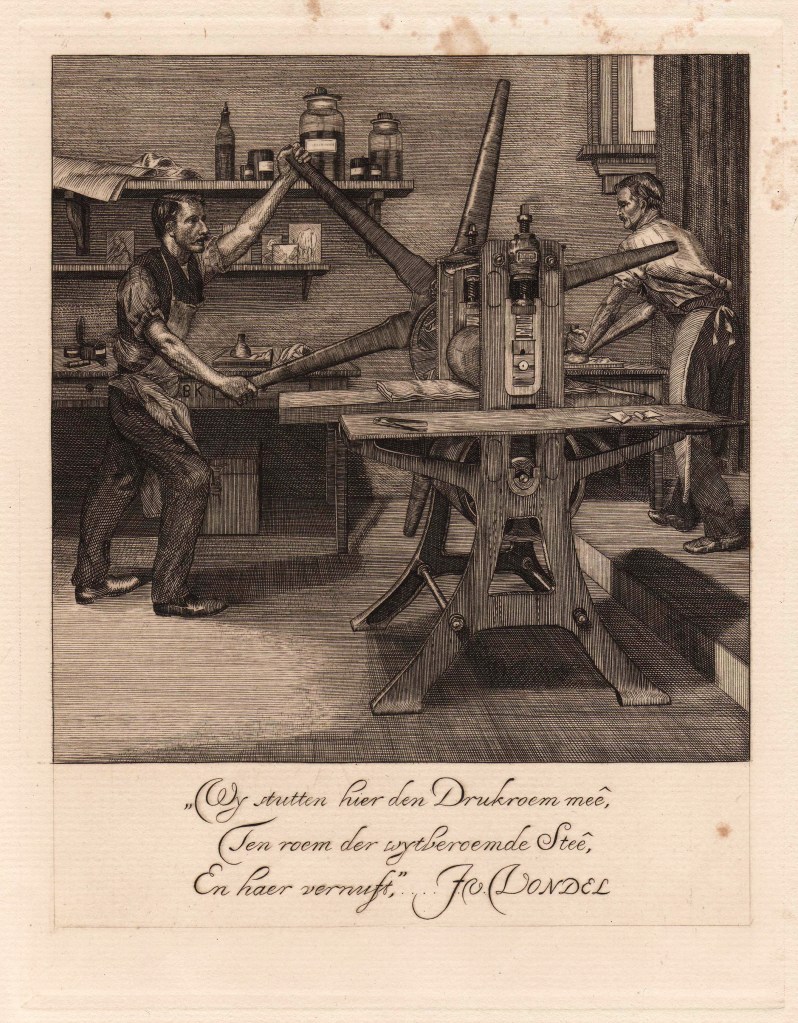
Introduction
Already in the 17th century we find references to harmful effects to the health of the etcher of the vapours rising from acids. New etching fluids, which were said to be safer, were developed in the 19th century. There was a profound awareness in the past that acids and other chemicals affected the printmaker’s health.
Acid booths, rubber gloves and face masks for personal protection entered the studio gradually, less aggressive substitutes were suggested. However, it lasted until the end of the 1980s before problems were handled at the sources, the chemicals themselves. Rigorous changes took place then by the introduction of alternatives which really sought to lessen the toxic burden. Now there are water-based screenprinting inks, acrylic grounds, light-sensitive photopolymer films and -plates, vegetable esters for clean up, and salt solutions for etching. The following essay is looking back at the major developments in safer printmaking procedures.
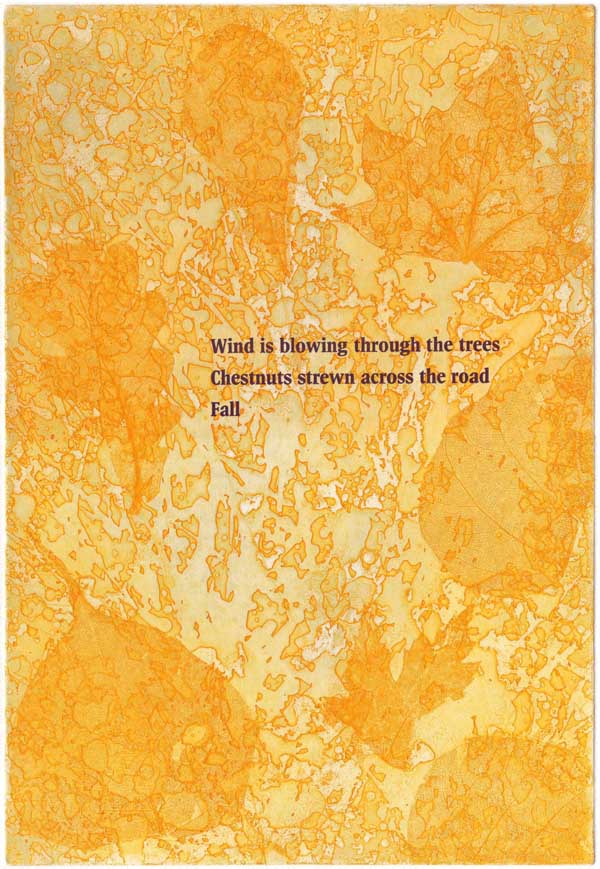
Ad Stijnman, softground letterpress 25×18 m
Health & Safety
The health of printmakers is burdened by the chemicals they use. These can harm skin and eyes. They can enter the body through the skin, by swallowing and by inhalation. Damage to skin and eyes, and penetration through the skin can be easily prevented by wearing proper clothing, suited rubber gloves and adequate face protection. It is obvious that chemicals should not be swallowed. Do not drink, eat or smoke in the studio, wash your face and rinse your mouth before leaving. Preventing inhalation, however, is the most serious problem. Using masks and exhaust hoods helps, but is not fully effective, is expensive and limits your activities. Better is it to fight the problems at the source and change to alternatives for acids and solvents which produce aggressive gasses and aerosols.
Etching
Corroding metal plates requires strong acids, or electrolytic activity between salts and metals. Nitric acid has long been favoured for etching copper plates, but became only on the market in the late 15th century. Mixtures of strong vinegar with various salts are also capable of etching metal and were perhaps already used in the Iron-Age to decorate sword blades. The earliest mentioning of etching iron using a ground to control the corrosive action of the mordant is by Vitalis de Furno, writing around 1300, but citing an older source. He explained that if you cover iron with wax, scratch through the wax and lay the piece in vinegar, your lines will be etched into the iron. It is a reference by a bibliographer and not a real recipe given by a practitioner, because chemically seen various salts should also be added to the vinegar. But nevertheless, it shows notion of control of the corroding process is present. From then on the etching of iron armour and tools developed. [Note: Von Lippmann, E.O., Beiträge zur Geschichte der Naturwissenschaften und der Technik, Berlin 1923, repr. 1971, vol. 1, pp. 181–182.]
The Augsburg armourer Daniel Hopfer can be credited for the invention of etching iron printing plates as an alternative for engraving copper plates shortly after 1500. Iron, however, had two drawbacks: it was too hard for additional engraving with a burin and the plates did rust. Both issues were overcome by the Italian Marcantonio Raimondi and the Dutchman Lucas van Leyden who independent from each other invented the etching of copperplates between 1515–1520. Their knowledge spread and became the standard intaglio printmaking technique after 1540. [Note: Stijnman, A., ‘Lucas van Leyden and Etching’, in Print Quarterly 5 (1988), no. 3 (Sep.), pp. 256–257. Landau, D. & Parshall, P., The Renaissance Print 1470–1550, New Haven, London 1994, pp. 264–265.]

Ad Stijnman, etching chine-collé goldleaf d.12cm
Nitric acid
What mordants they used was not documented contemporaneously, but copper was etched with either nitric acid or a mixture of different salts in strong vinegar until the mid-19th century. It was known that etching was unhealthy. French artist Abraham Bosse, author of the earliest (1645) treatise on etching copper printing plates, stated that etching with a mixture of salts in vinegar “was less detrimental to eyes and health than nitric acid”. [Note: Bosse, A., Traicté des manières de graver en taille douce sur l’airin: par le moyen des aux fortes & des vernis durs & mols, Paris 1645, p. 46.]
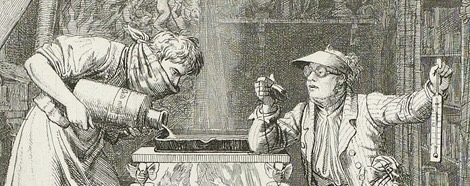
François Tiquet published a treatise with all kinds of art recipes in Antwerp in 1741. He described the making of an etching by ladies of higher classes and also considered about their health: “And because the smell of the strong water may incommode the Ladies, who as a pastime would like to engrave something themselves, they could have the strong water poured on by a house servant, and furthermore have windows and doors opened so that fresh air can come in.’ [Note: Tiquet, F., Korte onderrigting en leer, van zeer fraaye geheymen, Antwerpen 1741, p. 89.]
Alternatives
The search for alternatives for the unhealthy nitric acid started in the 19th century. Karl Urban Keller described in 1815 that, because of “the unhealthy [nitric] acid” he went looking for other techniques. He developed a mechanical way of roughening plates with gritty matter, which is comparable to mezzotint. [Note: Keller, K.U., Neue bisher noch unbekannte Art, den Tusch in Kupfer nachzuahmen, ohne irgend ein Aezmittel, Stuttgart 1815, p. 6.]
Of course he was right that the best way of avoiding unhealthy vapours is changing to mechanical means of working the plate, and scratching or roughening a printing plate has been invented again and again through the ages. But etching is attractive to printmakers and a number of alternatives for nitric acid have been recommended in the 19th century, such as Dutch mordant, ferric chloride, copper sulphate and electrolytic etching, to name the successful ones.
Dutch mordant
The German chemists Schwarz and Böhme published an article about etching copper with a mixture of hydrochloric acid and potassium chlorate in water in 1848. This etching liquid was developed to corrode copper more regularly than nitric acid did, but they also remark that “the weak chlorine smell is not as unpleasant as the vapours coming from nitric acid”. [Note: Schwarz, H., Böhme, R., ‘Neues Verfahren in Kupfer und Stahl zu ätzen’, in Polytechnisches Journal 29 (1848), no. 109, pp. 313-314.]
The avant garde of 19th-century British etchers adopted this mordant, starting with Seymour Haden, because it was “not so disagreeable in odour as the old one”. Mistakenly thinking it was used in Holland before, they called it “Dutch mordant”, while actually ‘Dutch’ should be read as ‘Deutsch’, or German, after its inventors. When Hamerton stated that the vapours rising from Dutch Mordant are less disagreeable, then it is only as far as the smell he observed. In mixing and etching with it, chlorine gas is produced which is highly toxic. [Note: Hamerton, P.G., The Etcher’s Handbook, 3rd ed., London, Boston (USA) 1881, p. 31.]
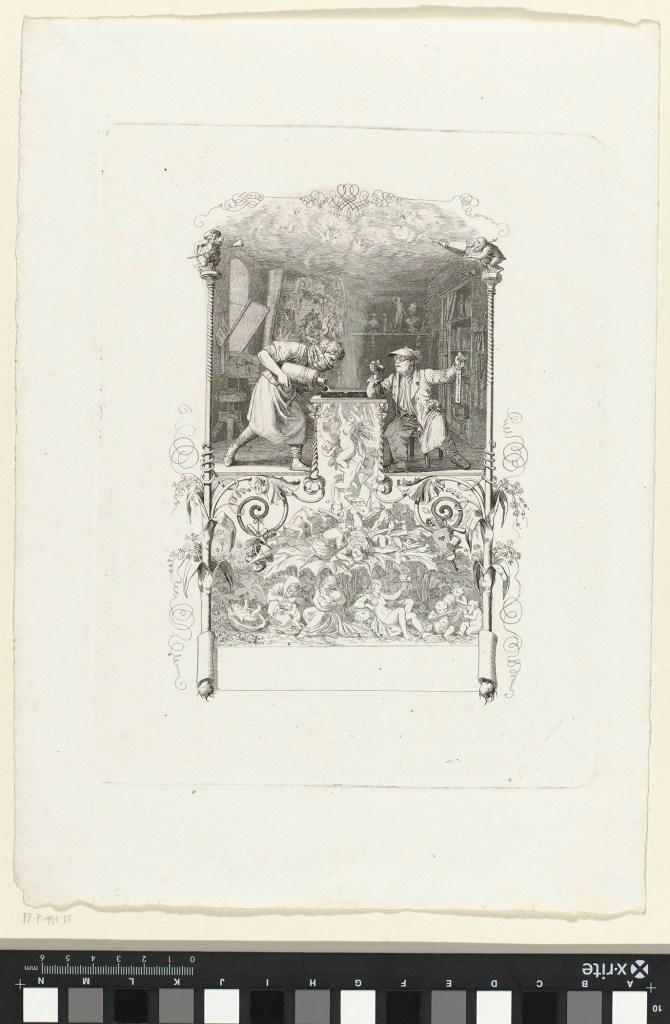
Ferric chloride
The Englishman William Fox Talbot, pioneer of photography, worried about the fading of his earliest photographic impressions. It is now understood that this was due to incomplete fixation. Fox Talbot wanted to solve this problem by making intaglio printing plates by means of his negatives and printing them with ink, because black printing ink does not discolour. He developed ‘photoglyphic engraving’, the forerunner of helio-engraving and photogravure, in 1852. Six years later he patented an improved version in which he etched copper plates with ferric chloride, being safer than nitric acid: “it quickly effects an etching, and does this without disengaging bubbles of gas, or causing any smell, for which reason it is much more convenient to use than aquafortis [= nitric acid]”. [Note: ‘Improvements in the Art of Engraving. Patented in London, by William Henry Fox Talbot, April 21, 1858’, in Journal of the Franklin Institute 57 (1859), pp. 193–197.]
The latest development in etching with ferric is the addition of citric acid to the solution. This is the so called ‘Edinburgh etch’, named like this by its inventor Friedhard Kiekeben in 1997 when working at Edinburgh Printmakers studio. Addition of citric acid prevents formation of a sediment in the grooves, a well-known disadvantage that was before overcome before in the printing industry by the addition of some hydrochloric acid. Washing the plate with a mixture of strong vinegar with 10% in volume of kitchen salt after etching has the same effect.

Ad Stijnman, mezzotint drypoint relief-etching 200x130cm
Etching copper in ferric chloride is safer than in nitric acid, because no toxic gasses are produced. However, you still need to be careful as the salt solution is also a strong acid (pH 1.5). Ferric should not be used for etching zinc or aluminium, as this makes the bath bubble vehemently with drops of the mordant going airborne giving a strong chlorine smell. [Note: Kiekeben. F., ‘New Etching Chemistry’, in Howard, K., The Contemporary Printmaker: Intaglio-Type & Acrylic Resist Etching, Rochester NY 2003, pp. 182–189, at p. 183; experience of the present author.]
Copper sulphate
Zinc can be safely etched in a solution of copper sulphate in water. The reaction is calm and stable, with pH 3.5. The temperature of the bath does not increase during etching as it does with nitric and no toxic gasses are produced. A minute amount of hydrogen gas is given off, as with etching copper with ferric chloride, but this gas is not aggressive and the amount of it is too little to catch fire. As with ferric chloride, sediment deposits in the grooves, which can similarly be washed out with the above-mentioned vinegar and kitchen salt solution. [Note: Kiekeben, F., ‘Perfect chemistry’, in Printmaking Today 13 (2004), no. 2 (Summer), pp. 22–23.]
Etching with copper sulphate was (re)invented simultaneously by Nik Semenoff in Canada and Cedric Green in France. Both published about it in 1998. Green called the mordant ‘Bordeaux Etch’, because “a copper sulphate solution is better known to vine growers, farmers and gardeners as ‘Bordeaux mixture’ (Bouillie Bordelaise)”. And also because he lived in the neighbourhood of Bordeaux. Semenoff and later Kiekeben furthermore explained that aluminium and steel can be etched with a mixture of copper sulphate with some kitchen salt added as propellant, which the latter called ‘Saline etch’. [Note: Semenoff, N. & L.W. Bader, ‘Intaglio Etching on Aluminum and Zinc Using an Improved Mordant’, in Leonardo 31 (1998), pp. 133–138. Green, C., Green Prints: A Handbook on Some New Methods for Safe Intaglio Etching and Metal Plate Printmaking, Sheffield 1998. Kiekeben, ibid. both. Stijnman, A., ‘Kopersulfaat voor zink: veilig, makkelijk en goedkoop etsen’, in kM 31 (1999), pp. 30–32.]
For an elaborate discussion on all modern developments regarding etching with copper sulphate see: ( https://nontoxic-print.com/saline-sulfate-etch/ ) .
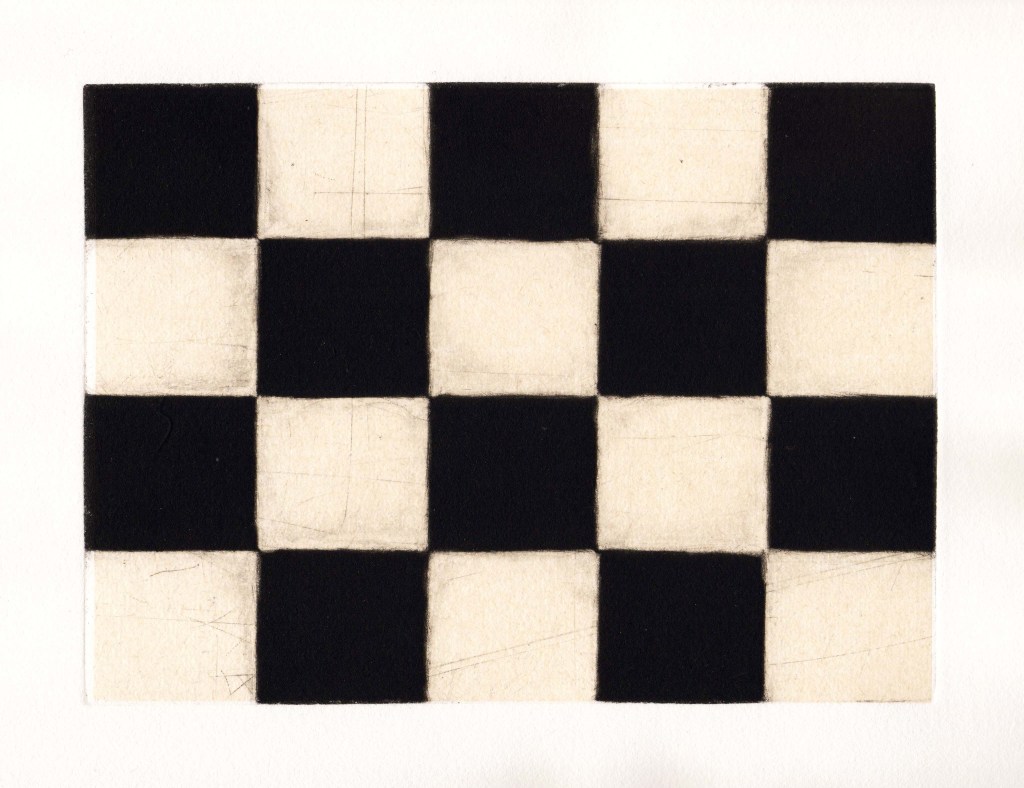
Ad Stijnman, mezzotint drypoint relief-etching 200x130cm
Electrolytic etching
In 1839, the same year that the Daguerreotype patent was published, also the technique of ‘galvanising’ was published, that is plating an object placed in a salt bath with a thin layer of metal by means of electricity. Contrariwise, by turning the poles in the galvanising bath, metal can be removed and in this way printing plates can be etched with electricity. G. Osann (1842) recommended the process to scientists as a simple way of producing themselves the images going with their articles. It is a clean technique, in the sense that only some hydrogen gas is given off during the process, creating straight lines bitten straight down without sediment. The process was used by 19th-century professional engravers for both intaglio and relief plates. [Note: Osann, G.W., Die Anwendung des hydroelektrischen Stromes als Aetzmittel, Würzburg 1842.]
Chattock (1886) stated: “Electro-etching has the advantage of being free from the exhalation of any deleterious gas, but the apparatus required … is more cumbrous, and the process itself more complicated than is the case with the ordinary methods of biting, and it does not appear to have been adopted for artistic work to any considerable extent.” Probably for the same reason also now it fails to become popular. Nik Semenoff, followed by the Americans Marion and Omri Behr and later Cedric Green, revived electrolytic etching in the 1990s, but it is still little found in printmaking studios. [Note: Semenoff, N. & Christos, C., ‘Using Dry-Copier Toners and Electro-Etching on Intaglio Plates’, in Leonardo 24 (1991), no. 4, pp. 389–394. Behr, O.M. & Behr, M.R., ‘Etching and Tone Creation Using Low-Voltage Anodic Electrolysis’, in Leonardo 26 (1993), no. 1, pp. 51–55. ‘Intaglio without Tears, Cedric Green Reassesses Old Electrolytic Plate-Making Processes’, in Printmaking Today 7 (1998), no. 1 (Spring), pp. 25–27. Chattock, R.S., Practical Notes on Etching, 3rd ed., London 1886, p. 42.]
Other mordants
More alternative mordants have been developed in the 19th and the 20t century. They were effective enough, but turned out to be unhealthy or too expensive, such as baths of chromic acid or silver nitrate solution. The main line always is to be able to do the same, that is corroding metal without unhealthy gasses or vapours getting airborne. For the eventual print it does not matter so much, because from the impression of the plate you can hardly distinguish what mordant or biting process was used.

Ad Stijnman, gyotaku 350x300cm
Collagraph
More effective to keep one’s health is not to use an acid at all. The above-mentioned Keller already told so and well-known are engraving, drypoint and mezzotint, all techniques for mechanically working the plate.
Another manner is the ‘collagraph’ technique. Norwegian artist Rolf Nesch started soldering bits of metal to a metal plate in order to create a relief, which he printed in intaglio, in the 1930s. After 1950, American printmakers started experimenting with pasting all kinds of materials to a base plate, while Glen Alps was the first to apply the term ‘collagraph’ to these printing plates. French printmakers Henri Goetz and later Maurice Rousseau-Leurent developed ‘carborundum engraving’. It is a kind of collagraph by which you paint with a mixture of glue and carborundum on a base plate, let this harden and print the plate in intaglio.
They saw it as a technique next to the already existing printmaking processes and not as a way to replace them. Safety was also not their issue, that notion was first expressed by Betty Winkler stating “carborundum collagraph … is non-toxic” (p. 1). The “non-toxic” is not completely true as volatile solvents evaporate from the glue in drying. [Note: Ross, J. & Romano, C., The Complete Printmaker, New York, London 1972. Goetz, H., Gravure au carborundum, nouvelle technique de l’estampe en taille douce, Paris 1969. Rousseau-Leurent, M., La gravure au carborundum = Carborundum Engraving, Villefranche-sur-mer 1991. Winkler, B., Carborundum Collagraph Printmaking, New York 1995.]
More sophistic ways for creating printing plates by building up layers on a base plate are invented in the 19th century. A copper plate was painted by a paste-like substance, covered with graphite and next electro-plated (galvanised). The whole could be printed in intaglio and was known under such names as ‘electrotint’, ‘galvanography’, ‘Herkomer-type’ or ‘spongotype’. One wonders if these techniques will also be picked up and revived now, as they allow the painter a free hand of work and are quite safe to use. [Note: Sampson, T., Electrotint, London 1842. Green, C., Green Prints: A Handbook on Some New Methods for Safe Intaglio Etching and Metal Plate Printmaking, 4th ed., Sheffield 1999, p. 46 referring to Charles V. Walker, Electrotype Manipulation Part 2, 19th ed., London 1855, paragraph 173. Herkomer, H., Etching and Mezzotint Engraving, London, New York 1892, p. 106.]
Acrylic grounds
The classical etching ground is a mixture of pine-resin, asphaltum and bees-wax. It is shaped into balls, cakes or rods, hence its name ‘ball ground’. For use, the printing plate is heated, a little ground is melted onto it and spread over the plate with a feather, a dabber or a roller. It is left to cool and the ground to harden. Such a wax-based ground is safe to work with, as long as it is not over-heated and charred.
It is also possible to dissolve this kind of ground in a volatile organic solvent. After its evaporation the ground is solid again. Mind that the vapours of the solvents released in drying are harmful to brains and nerve system; see the paragraph on VCA below.
One of the forerunners in the development of acrylic etching grounds was American Mark Zaffron around 1995. Others experimented with commercially available acrylic binders, floor varnishes and acrylic relief printing inks. The idea behind using acrylic grounds is not exactly clear. It is said that they replaced liquid classical ground with its aggressive volatile solvent, the kind mentioned above. Another argument is that the asphaltum in the classical ground is carcinogenic. Indeed it is, but only if you eat it, inhale it as dusty powder, or rub your skin with it regularly. But when rolling up ball ground onto a heated plate it should not smoke or burn, melting is enough and that is harmless. The other way around, liquid acrylic grounds contain a few percent of paint thinner and ammonia. These evaporate during drying and even more so when the grounds are ‘baked’ to harden them quickly. Only few people comment on this, most seem to take for granted that acrylics are ‘safe’, which they are not quite. [Note: Zaffron, M., ‘Z*acryl Etching Systems: New Materials for Safe Intaglio Printmaking’, in Printmaking Today 5 (1996), no. 1 (Spring), p. 27. For acrylics see the books in the list of reference literature at the bottom.]

Ad Stijnman, printing out of register 11x15cm
Photo-polymer films
Mark Zaffron began experimenting with light sensitive photopolymer films, which were used in the production of computer chips, in 1993. The films were stuck on a surface, such as a copper or zinc plate, exposed to UV light and there after the non-hardened parts were washed out. The film stayed on the plate and could be printed in relief or intaglio. Australian Keith Howard had been working on less toxic light sensitive films for printing plates. He and Zaffron came into contact with each other in 1994, and Zaffron explained about light-sensitive photopolymer films. Howard immediately began experimenting with them. The first type was called ‘ImageOn’ and was still toxic, later thinner and more sensitive foils were developed (‘ImageOn Ultra’, ‘Photec’, ‘Blue Shot’). Basically, impressions from these films were reproductions of the negatives or positives with which they were produced. However, you could also work directly into the film, which gave characteristic effects. Further etching of the metal support was also possible. [Note: Zaffron, M., ‘Photopolymer Films: A Safer and More Versatile Photo-Resist for Intaglio’, in California Printmaker (1995) (April), pp. […]. Howard, K., The Contemporary Printmaker: Intaglio-Type & Acrylic Resist Etching, Rochester NY 2003. Bøegh, H., Handbook of Non-Toxic Intaglio: Acrylic Resists, Photopolymer Film & Solar Plates, Etching, Copenhagen 2003.]
Photopolymer plates
Parallel to photopolymer films was the development of photopolymer plates. Flexography plates covered with light-sensitive polymer layers that could be washed out with water were available from around 1980. American Dan Welden started experimenting with these kinds of plates for use in intaglio printing then. He introduced them in Australia in 1992, where they were coined ‘solarplates’, as exposing the plates to the strong Australian sunlight was effective. Simultaneously Danish printmaker Eli Ponsaing started working with another type of photopolymer plate. Both types can be printed as an etching, but also as a lithograph. Planographic printing, but then without water, is possible because the silicones in the top layer repel oil-based ink; see the paragraph Lithography below. Photopolymers do not produce unhealthy vapours, but care should be taken not to touch the material with your bare hands, as they contain reactive chemicals. Scratching or gouging lines into these plates allow for additional structures. [Note: Ponsaig, E., ‘Photopolymer printing plates’, in Printmaking Today 4 (1995), p. 33. Longley, D. & Muir, P., ‘Solarplate Printmaking’, in Printmaking Today 5 (1996), no. 4 (Winter). Eskola, T. & Holopainen, K., Gravure: Polymer Photogravure, A New Method for Photographers and Graphic Artists, Helsinki 1996. Welden, D. & Muir, P., Printmaking in the Sun: An Artist’s Guide to Making Professional-Quality Prints Using the Solarplate Method, New York 1997. Longley, D., Printmaking with Photopolymer Plates: A New, Safe, Versatile Printmaking Technique for Artists and Students, Adelaide 1998. Neis, C., ‘Chemical Reactions [letter to the editor]’, in Printmaking Today 12 (2003), no. 4 (Winter), p. 4. Kiekeben, F., ‘ Photopolymer Plate Safety Concerns’ in nontoxicprint: Art + Science, ( https://nontoxic-print.com/photopolymer-plate-safety-concerns/ ).
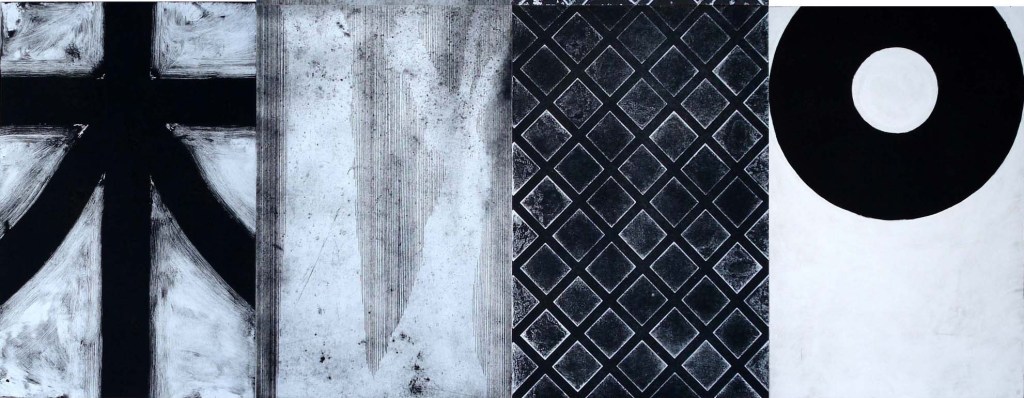
detail
Lithography
Silicon repelling oil-based inks was also used to effect by Nik Semenoff when he developed ‘waterless lithography’ in the early 1990s. He covered his plates with a layer of silicon polymer manually, and inked and printed the images as a lithograph, but no water was needed. Semenoff used an emulsion ink he produced himself, which dissolved in water. This allowed for a clean-up of plates and tools with water only. Other planographic kinds of plate materials, such as Pronto plates are available. [Note: Semenoff, N., ‘Waterless lithography’, in Printmaking Today 4 (1995), no. 1 (Spring), pp. 22–24, no. 2 (Summer), pp. 26–27, no. 3 (Autumn), p. 26–29, no. 4 ( Winter), pp. 32–33. Roberts, G.F., ‘Non-Toxic Polyester Plate Lithography’, in Printmaking Today 7 (1998), no. 3 (Autumn), pp. 28–29.]
Lithographic stones and plates were cleaned with a Vegetable Cleaning Agent (VCA, see the paragraph VCA below) in studios in the Netherlands, Germany, Canada and the USA. VCA is an non-volatile alternative for lithothine and similar solvents. Cleaning lithographic stones and plates with VCA goes exactly the same as with traditional solvents, except that it is not volatile. Care has to be taken to avoid smudging. [Note: Folkertsma, S., Sincovitz, P. and Stijnman, A., ‘Cleaning Printing Plates and Brushes with VCA’, in Printmaking Today 5 (1996), no. 1 (Spring), pp. 25–26.]
Screenprinting
Most screenprinting inks are water-based now. Developed in the 1970s these were commercially available since around 1980. Water-based screenprinting inks contain a small percentage of volatile organic solvents, and therefore exhaust hoods, strong ventilation and goggles are still necessary during printing. The inks can be mixed with acrylic paint, or you can print with acrylic paint mixed with a retarder. ‘Solvent-inks’ are still used for printing plastics or thin paper, which is not possible with water-based inks.
Printmakers sometimes use UV-inks. Their advantages are that they do not contain volatile organic solvents and dry slower or not at all, allowing for printing sharp details in edition. Disadvantage is that for drying the impressions exposure to strong ultraviolet radiation is required. The printing industry has drying tunnels through which the printed material is moved. A small drying machine may be used in a private studio. This, however, always leaks ionised air and UV radiation, both being rather unhealthy for the printmaker, while UV degrades paper and colours.
Cleaning of the screens can be done with mild lyes, low-volatile paint thinners, and there are esters that probably do not produce harmful vapours. Artistic innovations concern water-based inks that can print sharper details and thinner layers than solvent inks. Because water-based inks are more liquid and dry slower, the mesh of the screen can be finer. [Note: Adam, R. & Robertson, C., Screenprinting: The Complete Water-Based System, London 2003.]
Printing inks
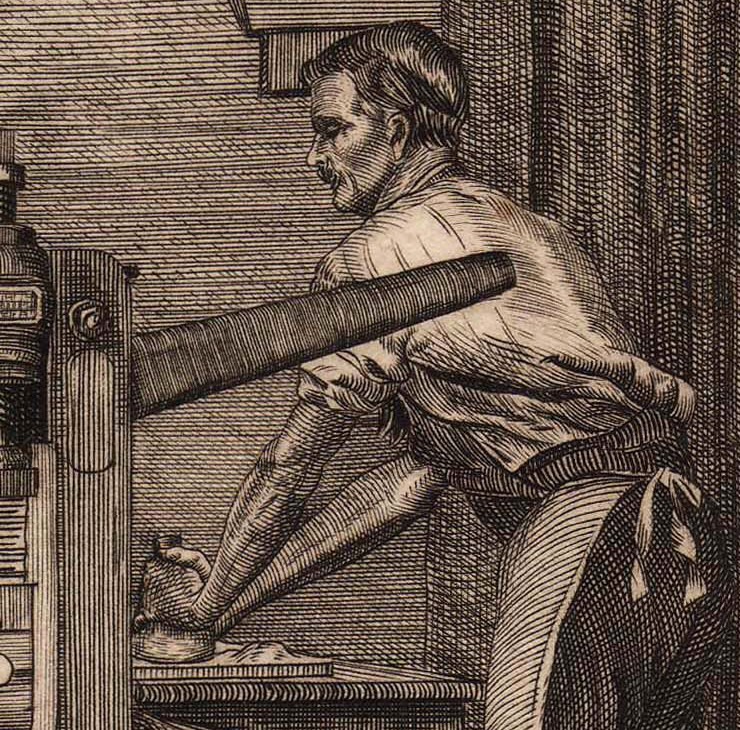
Some remarks have been made about printing inks in the above paragraphs, such as Semenoff’s emulsion inks for lithography, and the water-based and UV inks for screenprinting. Water-based relief printing inks were already used in blockprinting paper in 7th-century China and oil-based printing inks for blockprinting cloth developed in Europe from the 14th century. Printing woodcuts on paper by means of water-based inks, using gum arabic, gelatine or starch paste as binder has been practised in Europe since the early 15th century.
The base of relief, intaglio and lithographic printing inks has always been linseed oil varnish thoroughly ground with pigment powder. Cleaning ink off metal type was done by brushing the printing forme with boiling hot lye. The lye combined with the oil varnish in the ink and thereby saponified it. This soap-like substance was washed off with water.
Cleaning copper plates was done by warming them, rubbing the plates with olive oil — working as a plasticiser, not as a solvent — and running them through the press with a sheet of damp paper once more to get the ink out of the grooves. Any remains could be rubbed off with bread crumbs eventually. In case the ink was left to dry, the copper plate could be washed with strong lye to clean the grooves, similar to washing printing forms.
Alois Senefelder, developing lithography from 1796, used (volatile) oil of turpentine to clean ink off his stones. This continued until about the mid-19th century. Natural turpentine was produced in large quantities in North Carolina, USA, then, due to which it was cheap enough to be used for cleaning. The American Civil War (1861–1865) interrupted the trade, prices increased and alternatives were distilled from mineral oil, which solvents kept being in use ever since. [Note: [Short editorial on Naphta from mineral oil], in Laurens Coster 4 (1861), p. 371.]
In industrial intaglio printing (rotogravure) volatile organic solvents (VOCs) were introduced in the inks to increase drying time. For economic and health reasons, alternatives for these “evil smelling inks” were sought by developing water-based inks by the German printing ink firm Hartmann shortly before 1914. Results were poor and there was no continuation. [Note: Druckfarben: ihre Erzeugung und Verwendung, Ammendorf bei Halle-Saale 1914.]
detail
Eighty years later new attempts were made to create a water-based ink for manual intaglio printing ink (‘Createx’, ‘Green Drop’), but results were not particularly convincing. Akua-Kolor, New York, producers of water-based monotype inks, supplied their water-based intaglio inks from 2001. These were especially developed for the printing of photopolymer films and -plates. The pigments in these inks were very fine grained and the binder presumably was soy oil emulsified with a gum arabic in water. It printed the shallow structures of polymer films well, but gave a lot of plate tone with metal plates just because of the fine grain size of the pigment. After printing, the plates could be cleaned with water and a detergent. Disadvantages were that after some months the originally paste-like ink in the can turned liquid. This was because the emulsion fell apart, the gum-water separating from the oil, a common phenomenon with emulsions. At the bottom of the can was a layer of thick matter while on top floated a semi-transparent liquid. This ink did not dry by oxidation, as do the inks made from linseed-oil varnish, but because the binder did migrate into the paper. With thicker ink layers this caused the formation of halos around the ink turning yellow-brown in days, the ink offsetting for months afterwards. [Note: tests by the present author made in the early 2000s.]
New ink formulae have been worked out from about 2005, producing more stable products. Pigment and medium in the Akua inks can still separate, which requires thorough mixing before applying. ‘Oil-converter’ and ‘release agent’ are supplied to adapt the consistency of the ink, when wished for.
Modern water-washable etching inks, offered by various companies, are based on linseed oil, like traditional intaglio inks, but can be washed off the plates with soap and water because an emulsifier is added to the ink. A modest amount (less than 1%) of drier can be added to both inks to increase drying speed. With more voluminous intaglio lines or heavier drypoint burrs, these inks migrate through the damp paper during printing and stain the felt blanket next to the paper. Covering the printing paper with clingfoil just before printing avoids this.

VCA
The biggest problem in printmaking is the deterioration of brain and nerve system by the inhalation of vapours of volatile organic solvents (VOCs). These are present in liquid etching grounds, screenprinting inks, metal polish, lacquer paints, glues and, of course, clean up solvents, including citrus-based cleaners. By chronic or long-term exposure to these vapours they can cause an array of illnesses called Organic Psycho Syndrome (OPS). It is commonly known as ‘Painters’ Disease’, because it often occurs with house painters, but also with workers in the printing industry. It is a legally accepted complaint in Scandinavia and the Netherlands, and measurements have been taken to improve working conditions. From 2023, the Netherlands have legislation for this, meaning that people who developed work-related OPS can apply for a substantial compensation. However, prevention is always better. Simple precautions, such as taping the back of a printing plate instead of varnishing it, cleaning off ink with a vegetal oil and cleaning your brushes with soap, limits the use of solvents. But, again, it is safer to tackle the problem at the source. [Note: for information on OPS see: http://www.verenigingops.nl/.]
The Danish offset-printing industry began cleaning plates, rubber rolls and machines with Vegetable Cleaning Agents (VCAs) in 1989 in order to improve indoor air conditions. The use of VCA in the printmaking industry was further supported and propagated by the European Union in the ‘Subsprint Project’ in the 1990s. Every EU member, except France, partook in the project. VCA was picked up by Dutch printmakers in 1994, and tested for use in private and school environments. Thereafter its use spread over workshops throughout Europe, Canada, the USA, Japan and Australia.
VCA is a generic name of a group of esters, chemical compounds of a vegetable oil and an alcohol. A variety of combinations is available, applicable to many purposes and not just printmaking. Properties vary depending on the kinds of oil and alcohol, and additives. Its virtue is that is is not volatile while it has the same cleaning properties as white spirit and the like. After cleaning with VCA the object needs a further cleaning with some water and soap to remove an oily film. Though not volatile one needs to wear suited rubber gloves during cleaning. VCA dissolves oil and fat, and will therefore also dissolve the fat in your skin, as do volatile organic solvent. [Note: Folkertsma, S., Sincovitz, P. & Stijnman, A., ‘Cleaning Printing Plates and Brushes with VCA’, in Printmaking Today 5 (1996), no. 1 (Spring), pp. 25–26. For the use of VCA in road construction see: https://soysolv.com/.]
detail
1989-present
The past decades saw a giant leap ahead in the awareness of health aspects in printmaking and an enormous development of safer printmaking materials, while a lot of safer materials are easily available now. Printmaking studios have changed their equipment and offer educational programs aimed at working with safer procedures. Awareness is still growing, but can be hindered by the costs of certain products. Inexperienced students with limited funds may be tempted to fall back on the use of white spirit and nitric acid again, because these are cheaper. Another issue is that the availability of certain alternatives is at the will of producers and suppliers. If certain materials do not make enough money, then production and supply will stop. The introduction of all these new materials offers many new creative opportunities, while at the same time classical techniques such as engraving are revived. On the whole the printmaking world has seen a shift towards safer materials and techniques in printmaking since 1995.
Further reading:
– Michael McCann, Artist Beware, New York 1979.
– Tim Challis, Printsafe, a guide to safe, healthy & green printmaking, London 1990.
– Merle Spandorfer, Deborah Curtiss, Jack Snyder, Making art safely. Alternative methods and materials in drawings, painting, printmaking, graphic design, and photography, New York 1993.
– Michael McCann, Health hazards for artists, 5th ed., Guilford 2003.
– Robert Adam, Carol Robertson, Intaglio: Acrylic-Resist Etching, Collagraphy, Engraving, Drypoint, Mezzoint: The Complete Safety-First System for Creative Printmaking, London 2007.
– Ad Stijnman, Engraving and Etching 1400–2000: A History of the Development of Manual Intaglio Printmaking Processes, London, Houten 2012; check the references with the item ‘health and safety’ on p. 652, and see this keyword with the title descriptions of the manuals in the ‘Bibliography of Practical Manuals’, pp. 433–597.
– Mark Graver, Contemporary Printmaking: Safer Intaglio Techniques and Processses, London 2026.
– Warringah Printmakers: https://www.printstudio.org.au/essays-and-more.
Engraving and Etching 1400-2000: A History of the Development of Manual Intaglio Printmaking Processes
by Ad Stijnman (Author)
“As a reference source for techniques and technologies ‘Engraving and Etching 1400-2000’ is superb and unlikely to be superseded”– “The Library – December 2013”
ISBN-10 : 1904982719
Publisher : Archetype Books
For a list of errata see ( https://tulip88x.wixsite.com/ad–stijnman/recent-publications ), scroll down to Engraving and Etching 1400–2000 and find a link to its PDF in the annotations.

Bio
Ad Stijnman (PhD University of Amsterdam, Fellow of the Royal Historical Society in London) is a professional printmaker and leading authority on historical printmaking processes, specialising in manual intaglio printmaking techniques. He has lectured widely and published extensively on the subject, including his seminal, award-winning book Engraving and Etching 1400–2000: A History of the Development of Manual Intaglio Printmaking Processes (2012).
