
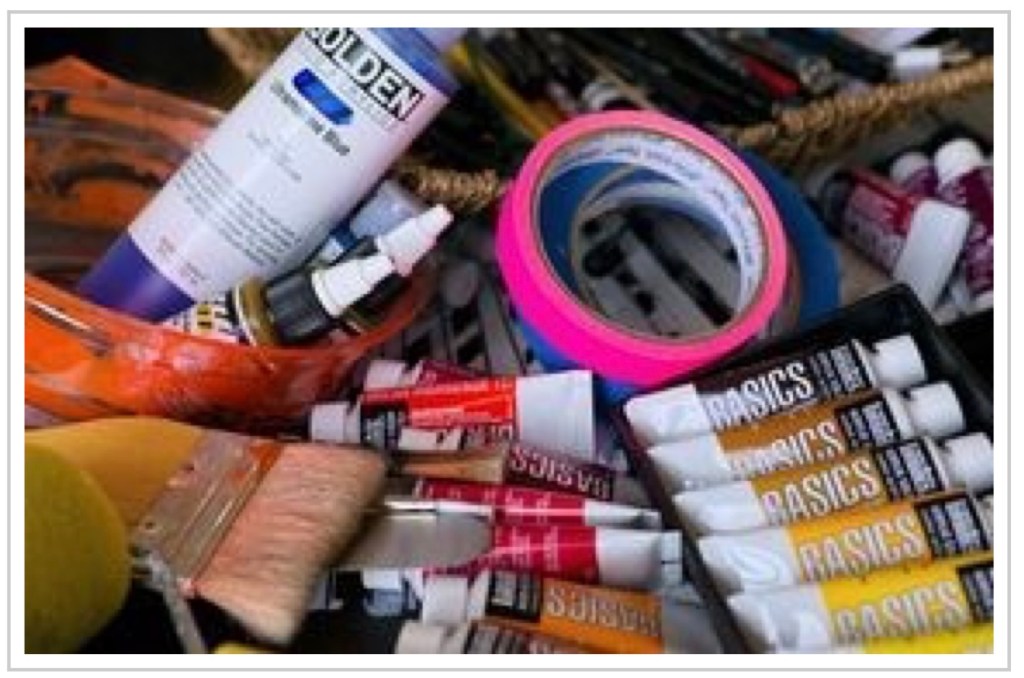
Substitution: Overview
Substitution of a hazardous art material or process by one that is safer should be the first precaution that is tried.
For children under the age of 12, it is mandatory to use non-toxic art materials. However, substitution will also work for older students and professional artists.
One of the basic types of substitution is to use water-based materials instead of solvent-based ones. For example, silk screen printing with solvent-based inks is one of the most hazardous art processes and requires expensive ventilation systems to work safely. Switching to water-based silk screen printing minimizes the health risks.
Similarly acrylic and water color painting are safer than oil painting which requires mineral spirits or turpentine. This is particularly a consideration in high school painting classes where exposures in a class of twenty students doing oil painting could be very hazardous because of the large amounts of solvents used. A fan exhausting 3000 cubic feet of air per minute would be required for every cup of turpentine or paint thinner evaporated in a one hour class period.
Instead, use acrylic, water color, or similar water-based paints.
If switching to water-based materials is not possible, then try less toxic solvents. The least toxic solvents are ethyl alcohol (sold as denatured alcohol), isopropyl alcohol, rubbing alcohol, acetone, and odorless mineral spirits or paint thinner. You can often use these solvents to replace more toxic solvents like methyl alcohol, lacquer thinners, toluene, xylene, and turpentine. Note that flammability should also be considered when making substitutions. Acetone, for example, is one of the least toxic solvents, but is extremely flammable.
Other examples of less toxic substitutes are cadmium-free silver solders, fluoride-free fluxes, asbestos-free materials, crushed walnut shells, or glass beads instead of sand for abrasive blasting, and lead-free glazes and enamels.
Changing a process can sometimes reduce exposure. For example, brushing or dipping materials is safer than spraying them since this eliminates inhalation of the particulates. Wet working methods also reduce the risk of inhaling dusts.
Other examples of process substitution include the use of moist clay, liquid dyes, and wet grinding techniques.
Avoid cancer-causing materials because there is no known safe level of exposure to these substances.
Of course, the lower the exposure, the lower the risk.
Finally, remember that substitution takes time to work. I have had many artists tell me that they tried substitutes such as water-based silk screen inks, but the substitutes do not produce good results. Usually, artists have tried the water-based inks a few times in the same way that they used the solvent-based inks. Using the same techniques will not necessarily give good results.
Substitutes often have very different properties from the original material, particularly if you are switching from solvent- based to water-based materials. For example, no painter would try to use acrylics or watercolors with the same technique used for oil painting. Therefore, allow time to experiment to find the proper way of using the substitute.
Art Hazard News, Volume 12, No. 5, 1989
Substitute Products
Vegetable Oils
The May 1991 issue of The Daily Hazard, the newsletter produced by the London Hazards Centre, reported on the International Hazards Conference that was held in Copenhagen in September of 1990. Of note were reports that 600 (3.5% of the total) Danish printers have been compensated for brain damage due to organic solvent exposure, occurring primarily during cleanup.
In efforts to find safer substitutes for the organic solvents, printers in Denmark have experimented with soya bean oil, vegetable oil, and coconut oil. While the oils had to be used in different ways, often in smaller quantities, to be effective, there was surprising success. The printers worked with a company to formulate “NatuRen” made up of soya and coconut oil which is being tested in 27 printing works. Laboratory workers have followed the printers’ example, and are experimenting with olive oil and coconut oil as substitutes. CSA encourages these substitutions, and also acknowledges that work processes and methods must be often changed in accordance with new products.
Citrus-Based Solvents
There are several citrus-based solvents on the market, some claiming to be composed of all natural, non-toxic ingredients. Leinos-thinner, orange solvent, and other citrus-scented solvent products use a chemical called d-limonene, a highly fragrant chemical present in many plants, especially citrus fruits. This is the same chemical present in Lithotine and dipentene. Because its chemical properties are similar to those of odorless paint thinners and mineral spirits, d- limonene has become a popular ingredient in many solvent and degreasing products.
The long-term health effects of d-limonene were investigated by the National Toxicology Program (NTP) because of the widespread use of this substance in food, cosmetics, and commercial products. NTP’s recent study of d-limonene
(Toxicology Report 347) found evidence of carcinogenic activity in male rats fed with d-limonene. Since researchers do not have complete information about the long-term effects of d-limonene on humans, those who use citrus products should exercise caution.
The attractive citrus smell can lead to accidental ingestion of large amounts. Other health effects include dermatitis and eye irritation. Skin contact should be minimized and inhalation of large quantities should also be avoided. We have had reports that the use of citrus thinners can be extremely irritating, especially in people who are already sensitive to solvents such as turpentine, or those used directly on the skin for the removal of special effects make-up.
Because the labeling of non-food products is not strictly regulated by the government, the phrases “all natural” and “non-toxic” can be misleading. Although d-limonene, like many other chemicals, is a “naturally occurring chemical,” it should not be assumed that it is harmless.
Lead-free solder
The Englehard Corporation has recently formulated Silvabrite 100, which is free of lead, zinc, and antimony. It is comprised of 95.625% tin, 4% copper, and 0.375% silver. This combination reportedly produces a wide melting range and excellent capillary flow and wetting action. It seems to be stronger and more professional looking than the standard 95/5 (tin/antimony) and 50/50 (tin/lead) solders without being much more expensive. Skin and eye contact with the fumes, as well as inhalation of fumes, may cause irritation, nausea, and metal fume fever. Contact with molten silver can produce argyria, a gray discoloration. Chronic exposure to copper fumes can result in capillary damage, discoloration of the skin, and liver and kidney damage. Prolonged overexposure to tin may result in a benign pneumonoconiosis called stanosis. While local exhaust ventilation is recommended for all types of soldering, solders that do not contain cadmium or lead are preferred. For more information, contact the specialty metals division at the
Englehard Corporation, 603 West Main Street, Mansfield, MA 02048. Tel: (800) 225-2130 or in MA, (617) 339-0589.
Art Hazard News, Volume 14, No. 4, 1991
These articles were originally printed for Art Hazard News, © copyright Center for Safety in the Arts 1989 and 1991.
They appear on nontoxicprint courtesy of the Health in the Arts Program, University of Illinois at Chicago, who have
curated a collection of these articles from their archive which are still relevant to artists today.
© nontoxicprint | the authors, 2023
_
Overview
https://www.nontoxichub.com/substitution-overview
Safer Substitutes in Art
By Angela Babin, M.S.
Waste Reduction
Artists work with many materials to create art. Certain art materials can be hazardous both to the user and to the environment. The best way of eliminating waste art materials is through source reduction – the elimination of hazardous
or non-hazardous wastes before they are created. Reuse and recycling are also good methods of reducing waste.
Several ways that art students and teachers can address this issue are listed below:
Substitute art materials that are less toxic to the environment – and also less toxic to the students;
Completely use up art materials. Purchase in container sizes that do not leave lots of residue.
Reuse or recycle art materials whenever possible.
Treat hazardous waste art materials by neutralization (see photography section) or other methods when possible to reduce the toxicity of the waste stream.
Understand that substitutions may involve using alternative art materials and techniques. It may take a little time to get used to these alterations. Also, remember that the safety of all recycled materials should be determined before use.
This poster contains general and specific recommendations for safer substitutes in art.
Elementary School Students
Some art materials are dangerous for young children to use. Basically, young children should only use art materials that are non-toxic. This poster recommends that young children use art materials that do not have any warning labels and carry the statement “Conforms to ASTM D-4236” or similar wording. Products that have been approved by a toxicologist and carry the Certified Product (CP) or Approved Product (AP) seal of the Arts and Crafts Materials Institute are generally approved for young children.
This poster shows safe art materials that can be SUBSTITUTED for the more hazardous ones in elementary school classes. Young children should not use any processes discussed under secondary schools unless also approved for elementary school students, at the top of each arts category.
Secondary School Students
Art materials used in the junior and senior high school levels are often more toxic. This poster shows safe and less toxic art materials that can be used to replace more hazardous materials. Please remember that sometimes the substitute materials can still be hazardous – just less so! Make sure that the label carries the statement “Conforms to ASTM D- 4236” or similar wording, indicating that the warning label conforms to the requirements of the Labeling of Hazardous Art Materials Act of 1988.
Since many art materials recommended here still might be hazardous, although to a lesser degree, secondary school students and teachers may still need to take health and safety precautions when using art products. These precautions may include types of ventilation, gloves, respirators (face masks), and other safety precautions. Remember to take the right safety precautions! (See references.)
Ceramics
Elementary School Students
Clays *Use only wet, pre-mixed clays. White Clays
*Use only talc-free clays.
Glazes
*Paint finished pieces with acrylics or tempera instead of glazing.
*Use CP/AP lead-free liquid glazes
Secondary School Children Through Adult
Clays *Use only talc-free, pre-mixed clays. Glazes *Use only lead-free glazes. Colorants *Use glazes that do not contain
carcinogenic nickel, cadmium, uranium, chromates, or talc.
Waste Clay
*Cut into small pieces and place in a barrel of water for recycling. Waste glazes
*Combine residual glazes and reuse.
Painting and Drawing
Elementary School Students
Paints *Use CP/AP water colors, tempera, and acrylic paints, not adult paints. Scented markers
*Do not use because they teach children to smell and eat art materials. Permanent markers
*Use CP/AP water-based markers. Pastels, chalks *Use CP/AP oil sticks, crayons, chalks, and colored pencils.
Spray Fixatives
*Use CP/AP clear acrylic emulsion to fix drawings.
Rubber Cement
*Use glue sticks or double-sided tape.
Secondary School Students
Painting
Pigments
*Use pigments that do not contain lead, cadmium, mercury, arsenic, chromates.
*Use pre-mixed paints.
Oil Paints
*Use water-based paints.
*Replace turpentine washes with acrylic underpainting.
Spray Paints
*Brush or spatter paints.
Solvent Cleaning
*Use baby, vegetable, or mineral oil instead of solvents to clean hands and brushes.
Turpentine*Use turpenoid, oderless paint thinner, or odorless mineral spirits.
Waste Solvents
*Reuse solvents by allowing to settle, then filtering or decanting.
Drawing Pastels
*Use oil pastels instead of dry pastels.
Drawing Inks
*Use water-based inks, not solvent-based inks.
Permanent Markers
*Use CP/AP water-based markers.
*Use alcohol-based markers instead of markers based on toluene or methyl isobutyl ketone.
Commercial Art
Elementary School Students
Scented Markers *Do not use because they teach children to smell and eat art materials. Permanent Markers
*Use CP/AP water-based markers. Rubber Cement *Use glue sticks or double-sided tape. Glues *Use CP/AP glues for
collage.
Secondary School Students
Painting/Drawing materials *Use water-based paint and inks instead of solvent-based ones.
Airbrushing *Use a tooth brush to spatter paint. Don’t airbrush solvent-based inks or dyes. Permanent Markers
* Use water or alcohol-based markers instead of markers based on toluene or methyl isobutyl ketone.Rubber Cement
* Use waxers or double-sided tape instead of rubber cement or spray adhesives.
* Use kneaded eraser to remove wax from mechanicals.
* Use heptane-based adhesives instead of hexane-base types.
Photography
Elementary School Students
Photochemicals
*Use polaroid cameras without transfer manipulation.
*Send film out to be developed.
*Do sungrams with blueprint paper and sunlight.
*Do photocopier art.
Secondary School Students
Black and White Processing
Developer *Use only Metol/hydroquinone developers or the less toxic phenidone/hydroquinone developers.
*Use replenishment solutions to reuse chemicals.
*Neutralize with stop bath or citric acid before disposal.
Stop bath
*Use water only, instead of acetic acid.
Fixers
*Use low acid fixers instead of high sulphur dioxide rapid fixers.
*Recover silver from fixer if using large amounts.
Reducers*use only Farmer’s reducer (potassium ferricyanide)
Intensifiers*Do not use intensifiers because of their high toxicity.
Toners*Do not use toners because of their high toxicity.
Hypo eliminators
*Use water or hypo clearing agents for washing.
Color Processing
Color Developers *Do not use phenylene diamine developers. Solvents *Use only low solvent color processes.
Formaldehyde*Do not use formaldehyde stabilizers.
Blue Printing
Fixer *Use dilute hydrogen peroxide instead of dichromates for fixing.
Metal Working
Elementary School Students
Jewelry *Bend metal wire instead of soldering. Stained glass
*use colored cellophane and black paper to imitate colored glass and lead came.
Secondary School Students
Jewelry
Silver solder *Use cadmium-free silver solder. Fluxes*Use borax instead of fluoride-based fluxes. Pickling baths
*Use sodium hydrogen sulfate (Sparex) instead of sulfuric acid.
*Neutralize bath with baking soda (sodium bicarbonate) before pouring down the sink with lots of water. Test with pH
paper.
Enameling
Enamels *Use only lead-free enamels. Enamel colorants
*Use enamels that do not contain nickel, cadmium, uranium, arsenic or chromates. Waste enamels
*Combine and reuse.
Metal Casting
Lead *Do not cast lead or lead-containing metals. Sand blasting
*Use glass beads or alumina instead of silica sand. Asbestos*Use asbestos-free insulation. SIlica investment
*Use plaster and sand mixture.
Stained glass
Lead Came *Use copper foil technique. Lead solders
*Use lead and antimony-free solders. Fluxes*Use acid-free an rosin-free fluxes. Glass paints
*Use colored glass or lead-free paints.
Welding
Metals *Weld metals like mild steel that are not galvanized, or do not contain lead, nickel, chromium, or cadmium.
*Use only found metals of known composition.
*Do not use metals coated with lead paint.
Fluxes*Do not use fluoride fluxes.
Degreasing*Degrease metals with detergents or odorless mineral spirits instead of chlorinated hydrocarbons.
Printmaking
Elementary School Students
Screen printing
*Use CP/AP water-based inks.
*Use cut paper stencils
Relief printing
*Use linoleum cuts instead of woodcuts.
*Use CP/AP water-based inks.
Secondary School Students
General
Pigments *Use pigments that do not contain lead, cadmium, mercury, chromates or arsenic.
*Use pre-mixed inks.
Cleaning solvents
*Use odorless mineral spirits instead of turpentine, kerosene, or gasoline.
Screen printing
Inks *Use water-based inks instead of solvent-based inks. Stencils*Use cut paper, contact paper, etc. instead of laquer
stencils.
Screen mounting
*Use staples or tape instead of solvent-based glues.
Photoemulsions*Use diazo photoemulsions or presensitized photo film.
Intaglio
Acids *Use ferric chloride (iron perchloride) instead of Dutch mordant. Dutch Mordant
*Neutralize nitric acid baths with baking soda before pouring down sink. Test with pH paper.
Cleaning Solvents
*Scrape inking slab and press with palette knife to reduce amount of ink, remove remaining ink with vegetable, baby, or
mineral oil, and wipe oil film with cotton ball and rubbing alcohol for cleanup.
Photoetching*Use pre-sensitized plates or xerox transfer/screen process instead of techniques that use highly toxic
solvents.
Lithography
Acids *Use pre-mixed gum etches instead of using concentrated acids.
Vinyl laquers
*Do not use because of high toxicity.
Dichromates* Use fountain solutions based on water and gum arabic.
*Use citric acid as counter-etch.
Hydrofluoric acid
*Do not use because of extreme toxicity.
Talc*Use asbestos-free talcs (e.g. baby powder).
Phenol*Use mechanical cleaning of stones.
Photolithography*Use positive/negative re-sensitized offset plates.
Woodworking
Elementary School Students
Woods *Use only common soft woods. Glues*Use CP/AP glues.
Paints*Use CP/AP water-based paints.
Secondary School Students
Preserved *Do not use woods treated with chromated wood copper arsenate (CCA), pentachlorophenol, or creosote.
*Use ordinary woods.
Particle board
*Use ordinary woods to avoid and plywood.
Tropical woods
*Use non-allergenic and non-irritating woods.
Leftover wood
*Recycle into new projects.
Glues*Use white glues, hide glues, and other water-based glues instead of epoxy, formaldehyde, or solvent-based
glues.
*Use small containers to minimize drying out of glue.
Paints and Coatings
*Use water-bawsed products instead of solvent based ones.
*Use lead and mercury-free paints.
Shellac*Use shellacs containing denatured alcohol, not methyl alcohol.
Oil & Solvent
*Recycle by drying or sending to a recycling soaked rags laundry.
Sculpture
Elementary School Students
Modeling clays *Use pre-mixed clay or CP/AP modeling materials. Papier mache *Use black and white newspaper with
CP/AP pastes or CP/AP instant papier maches made from cellulose.
Secondary School Students
Clay *See Ceramics
Plastics
Plastic resins *Do not use polyester, epoxy, acrylic, or polyeurethane resins because of high toxicity. Solid plastics
*Use saws instead of hot wire or torches.
Stone
Soapstone or seatite Carve alabaster or cast plaster.
Wax
Waxes Use beeswax or petroleum waxes, not chlorinated waxes.
Textile and Fiber Arts
Elementary School Students
Synthetic Dyes *Use vegetable dyes (spinach, tea, onoin skins, etc.) or food dyes. Synthetic Fibers
*Use fibers that have not been treated with formaldehyde sizings.
Textile remnants
*Left-over textile scraps can be used for stuffing pillows or soft sculture projects.
Secondary School Students
Fibers
Animal fibers *Use hair and wool not imported from the Middle or Far East because of anthrax.
Dyeing
Mordants *Use non-dichromate mordants. Fiber-reactive dyes
*Use liquid fiber-reactives, not powders.
French dyes
*Use water-based dyes. Leather dyes
*Use leather dyes containing denatured alcohol rather than other solvents.
Batik
Wax *See Sculpture, wax Dyes*See Dyeing Solvents*Boil out or iron out wax instead of using solvents.
Papermaking
Woods, plants *Use non-allergenic and non-irritating materials.
*Recycle used paper and cardboard, or use rotten or mulched plant material to about boiling in alkalai.
Lye*Use soda ash (sodium carbonate) not lye.
Dyes and Pigments
*Use liquid dyes and pigments instead of powders. See also Dyeing.
______________________________
References
1. Babin, Angela and McCann, Michael. “Waste Management and Disposal for Artists and Schools”. CSA, 1992.
2. Babin, Angela, Peltz, Perri, and Rossol, Monona. “Children’s Art Supplies Can Be Toxic”. CSA, 1989.
3. McCann, Michael, Artist Beware, 2nd Ed., Lyons & Burford Publishers, New York, 1992.
4. McCann, Michael, “Health & Safety for Secondary School Arts and Industrial Arts”. CSA, 1989.
5. McCann, Michael, “Teaching Art Safely to the Disabled”. CSA, 1987.
6. Spandorfer, Merle, Curtiss, Deborah and Snyder, Jack. Making Art Safely. Van Nostrand Reinhold, 1993.
Art Hazard News, Volume 16, No. 3, 1993
This article was originally printed for Art Hazard News, © copyright Center for Safety in the Arts 1993. It appears on
nontoxicprint courtesy of the Health in the Arts Program, University of Illinois at Chicago, who have curated a collection
of these articles from their archive which are still relevant to artists today.
© nontoxic-print | the authors, 2023