
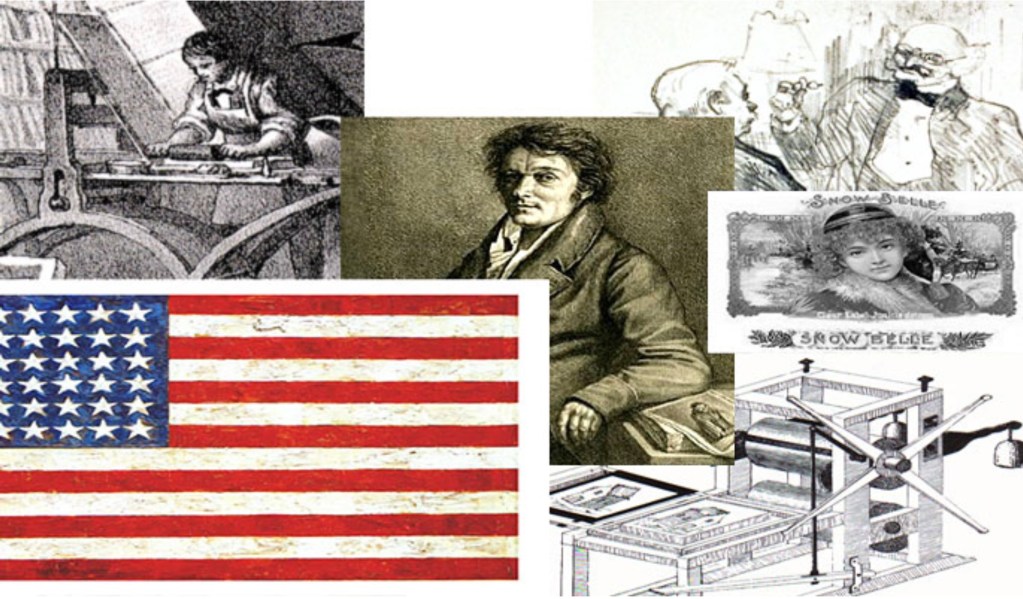
Lithographs, left: Renoir ‘Chapeau’, top right: Toulouse Lautrec: ‘Clemenceau Mayer’. Bottom: ‘Flag’, Jasper Johns, mixed media, 1954-55, MOMA
The actor Alois Senefelder (center) made a name for himself as the founder of modern commercial printing through the invention of Lithography in 1789.
For over a century the process was used for a variety of purposes from the reproduction of famous paintings to the production of all sorts of multi-colored commercial printed goods such as this cigarette packet ‘Snow Belle’, booklets and posters. Interestingly, the first lithographic press was derived from an etching press.
Lithography has been cherished as a unique medium by many artists and printers since its invention by Alois Senefelder in 1798. The public love lithographic prints created by the greats, ranging from Toulouse Lautrec to Jasper Johns and Jim Dine, and print studios such as the Tamarind Institute in New Mexico celebrate the unique lithographic language of artistic expression.
Lithographs convey a delicate, subtle, and fragile aesthetic that continues to appeal to artists and art lovers alike.
The principle of lithography:
Lithography uses simple chemical processes to create an image. For instance, the positive part of an image is a water-repelling (“hydrophobic”) substance, while the negative image would be water-retaining (“hydrophilic”).
Thus, when the plate is introduced to a compatible printing ink and water mixture, the ink will adhere to the positive image and the water will clean the negative image. This allows a flat print plate to be used, enabling much longer and more detailed print runs than the older physical methods of printing (e.g., intaglio printing, letterpress printing).
Lithography was invented by Alois Senefelder in the Kingdom of Bavaria in 1796. In the early days of lithography, a smooth piece of limestone was used (hence the name “lithography”: “lithos” (λιθος) is the ancient Greek word for stone).
After the oil-based image was put on the surface, a solution of gum arabic in water was applied, the gum sticking only to the non-oily surface. During printing, water adhered to the gum arabic surfaces and was repelled by the oily parts, while the oily ink used for printing did the opposite.
https://en.wikipedia.org/wiki/Lithography

The original form of lithographic printing – stone lithography – relies on a particularly harsh chemical mix of asphaltum (a tar-like product), rosin, pure nitric acid, and mineral spirit solvents. Many of these materials are suspected or known carcinogens and neurotoxins. Cancer, brain disease, birth defects in offspring, and infertility are known health risks of this 18th century form of printing.
Lithographic lime stones carry no toxic risk aside from the obvious lifting hazard. Many of the various volatile chemicals that are applied to the stone surface, however, are very toxic.In the general public there is little notion of the very significant health risks inherent in the medium. Insiders in the printmaking profession know that traditional stone lithographers have a greatly increased risk of contracting cancer, and of suffering through lengthy periods of illness – even of dying prematurely as a result of the insidious toxic exposure that daily long-term lithographic practice can entail (see article ‘Not dying for their art’).
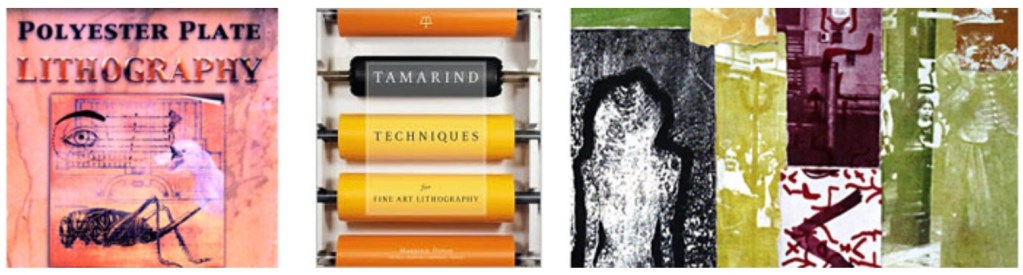
The recently published ‘Tamarind Techniques Manual’ by Marjorie Devon lists
19 carcinogenic substances that are used regularly (see list below). The inventor of the process Alois Senefelder, who developed the method to commercialize the printing of musical scores (think Mozart’s music) was already aware of unpleasant tar fumes and possible health risks of his invention, so as a caution he termed the process ‘Chemical Printing’.
Beware: in this method your are dealing with harsh chemicals, not just benign drawing materials. This original term was soon replaced by the term ‘Stone Printing’ or ‘Lithography’ by Parisian artists and printers who were enchanted by new creative possibilities and the prospect of making fortunes…and so the emphasis shifted away from the known hazards of chemistry to the romance of drawing on stones. Drawing on paper is very safe, so why should drawing on stones not be?
According to the ‘Tamarind Techniques Manual’ 19 carcinogenic substances are used (with extensive safety precautions) in Tamarind’s lithographic practice: Acetone | Asphaltum Gum Etch | Ammonium Dichromate | Anco Litho Wash I and II | Asphaltum | Blanket Wash | Denatured Alcohol | Shellac Solution | Lacquer Thinner | Lithium General Purpose Grease | Mineral Spirits | MS (Shellac Solution) | Naptha | Paint Stripper | PN Red Developer | Spray Paint Enamel | Talc
Today, thanks to the work by innovators in lithography such as George Roberts and Nik Semenoff the entire vocabulary of lithography, including subtle crayon marks and earthy reticulations, can now be very successfully replicated in other media such a Polyester Plate Lithography, Waterless Lithography (which is still evolving), and perhaps surprisingly also in Water-based Silkscreen and in Intaglio Type. In most of these media the porous surface of a stone is substituted with a slightly rough transparency which allows for the same subtlety of detail and mark-making.
Rather than printing from the imaged surface directly, an intermediate photo-exposure process is often used to transfer the image to the printing plate. This replaces the dangerous chemical processing necessary in stone litho, and ensures that the printing substrates are stable and able to print larger editions. In essence, artists have adopted the same approach pioneered in the offset printing industry, where the imposing but temperamental lithographic stones (that are unsuitable for large-scale industrial use) were replaced with grained metal plates and then photo-mechanical mage transfer over a century ago.The book Tamarind Techniques for Fine Art Lithography by Marjorie Devon lists important toxicological data and professional safety measures recommended to practice Stone Lithography with relative safety, and gives an up-to date overview of the medium. Polyester Plate Lithography by George Roberts (2001) instead champions the sole use of an intrinsically safe system of lithography.
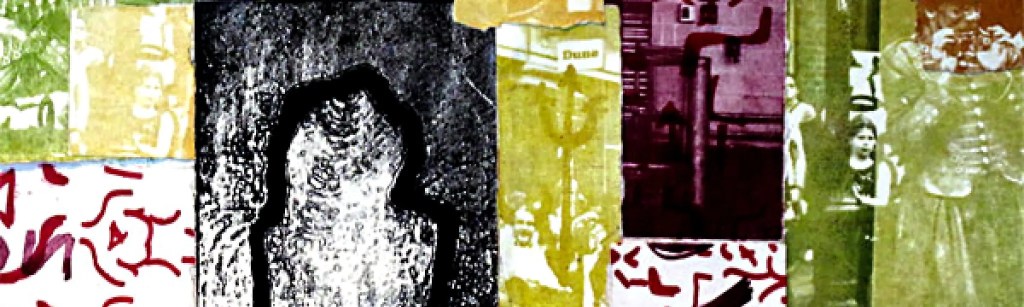
Emily McCoy: Polyester Plate Lithography Collage, 2010
Polyester Plate Lithography
Lithography, Cancer Risks, and Safeguards
Anecdotal and medical evidence suggests that long term practitioners of stone lithography are prone to contracting various forms of cancer. Already by the early 1990s it was understood that a multitude of measures was required to practice Senefelder’s method with any reasonable degree of safety. The manual ‘Making Art Safely’ co-written by Merle Spandorfer, Deborah Curtiss and Jack Snyder M.D., and first published in 1993, recommended that three levels of protection were needed to protect the lithographer from harmful vapors:
1) individual respirator
2) a general dilution ventilation system &
3) additional local fume extraction at any source of airborne contamination, including the lithographic press.

petroleum-derived solvents when used indoors require the use of effective ventilation / local extraction and a personal respirator with organic vapor cartridge
Only a combination of all three of these measures would suffice in safeguarding against the highly volatile, corrosive, and reactive chemicals needed to process stones. The Tamarind Institute confirm the necessity of these requirements in ‘Tamarind Techniques’, by Marjorie Devon’: ‘Two types of ventilation are necessary for a workshop in which toxic materials are used: a high quality air-exchange system and local exhaust hoods.’
But even today this type of comprehensive protection is found only in the most safety conscious lithographic studios, such as Tamarind. Some less safety-aware educational institutions and print shops may fall short of the need to educate their students sufficiently about hazards and possibly don’t meet requirements – or are unaware of the need – to install effective local extraction to remove all toxic VOCs. Some also do not provide respirators where needed, or maintain a ‘stonewalling’ attitude towards progressive nontoxic methods and non-hazardous process substitutions. In some instances students are willfully put at risk out of fear of change.
Out of concerns over public health, the fields of science, toxicology and industry have made massive advances towards the goal of complete elimination of toxic VOCs from consumer
products:
Today, the emphasis has shifted from hazard management to hazard avoidance.

In Stone Lithography pure nitric acid is poured onto the stone during processing. Often this is done without the use of extraction or use of a respirator, exposing the artist directly to highly noxious fumes.
Art schools should not ignore contemporary health-requirements by asking for certain traditional media – for instance Stone Lithography – to be exempt from what is now believed to be good and safe practice. Many of the materials that were classed as ‘suspected carcinogens’ in the 1980s have since been re-classed as being ‘known carcinogens’ – agents that are known to cause cancer – and their use is no longer recommended. Amongst these are most petroleum derived solvents and the various tar products utilized all across traditional printmaking.
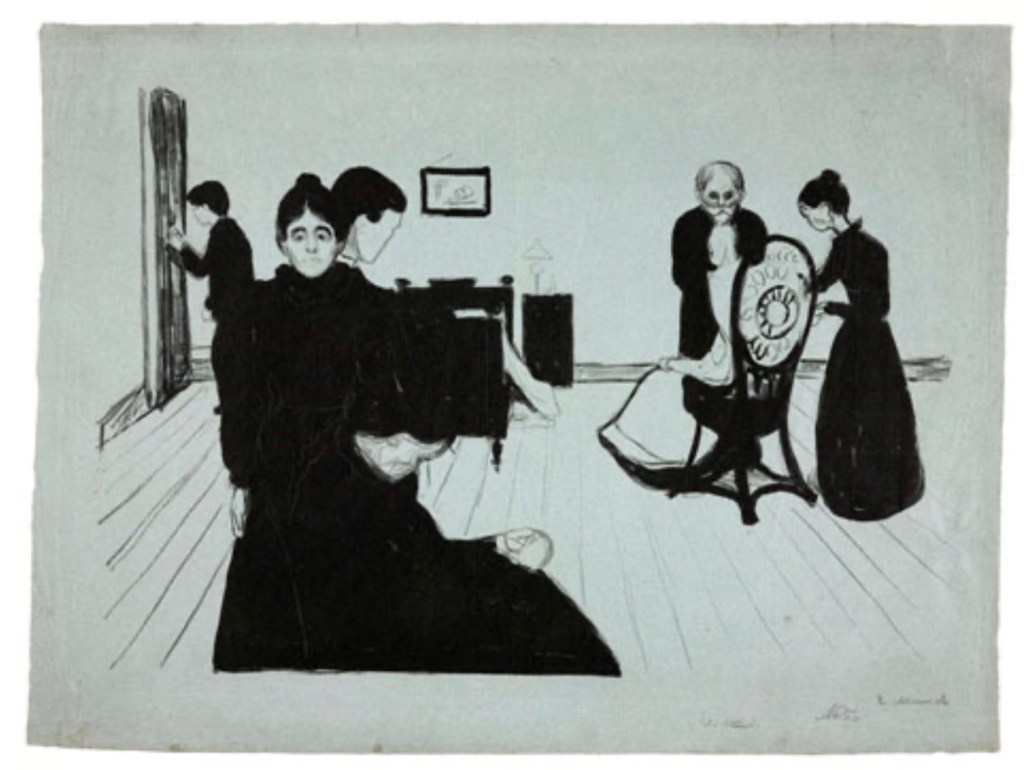
Edvard Munch ‘A sick person dying’ Lithograph with crayon and tusche on blue textured rag paper, 47 x 62 cm, printed by Auguste Clot, Paris, 1896
Staedel Museum, Frankfurt
Tusche, Toxicity, and New Directions for Ink Washes
The great attraction of stone lithography lies in its ability to replicate the repertoire of the medium of drawing, from crayon marks to solid or reticulated ink washes and dry-brush marks. The German word ‘Tusche’ means ‘India ink’ – and India Ink is nontoxic – but its lithographic equivalent is highly toxic because of its tar and Naptha content. The lithographer Nik Semenoff set out in 1984 to find a nontoxic alternative. During his sabbatical year he discovered the use of dissolved photocopier toner as a viable alternative. Nik Semenoff’s account of his discovery can be found on the following page: Litho Toner Wash.
Since then, the method has been adopted and expanded across a variety of media by other innovators such as Keith Howard, Carol Robertson, Dan Welden, the paint makers Lascaux, and by the Tamarind Institute. The photocopy toner wash method is now widely used in lithography, silkscreen printing, and intaglio. The process is no longer solvent based so artists can enjoy the pleasure of working with grainy washes, solid black brush strokes, and dry brush effects without exposing themselves to noxious fumes. The main precautionary measure required is wearing a dust and particle mask when mixing the toner particles into solution. Best purchase a ready made solution such as Lascaux black wash medium.
The method requires the use of specialist sheets of acetate or transparency, such as ‘truegrain film’ that allow for wet brush work to register faithfully and without unwanted ‘beading’. These reprographic films can be expensive, but materials such as frosted inkjet acetates or hand- sanded sheets of acetate can be used as a cheaper alternative. Once the image has been drawn the transparency is exposed to a photo sensitive emulsion, such as a photo-litho plate, a polyester plate (transfer via photocopying), a coated silkscreen, or a photo polymer plate (intaglio type or solar plate).
The results can be stunning and often are virtually indistinguishable from a traditional stone lithograph (especially when using lithographic printing media). All non-stone lithographic media, such as ball grained aluminum and zinc plates, offset litho plates, and polyester plates can – surprising to some – be printed on both lithographic and intaglio presses. The printing industry now offers a range of nontoxic planographic printing systems for imaging, plate making and printing, and artists, art schools and master printers are encouraged to research and utilize these new developments in their own practice.
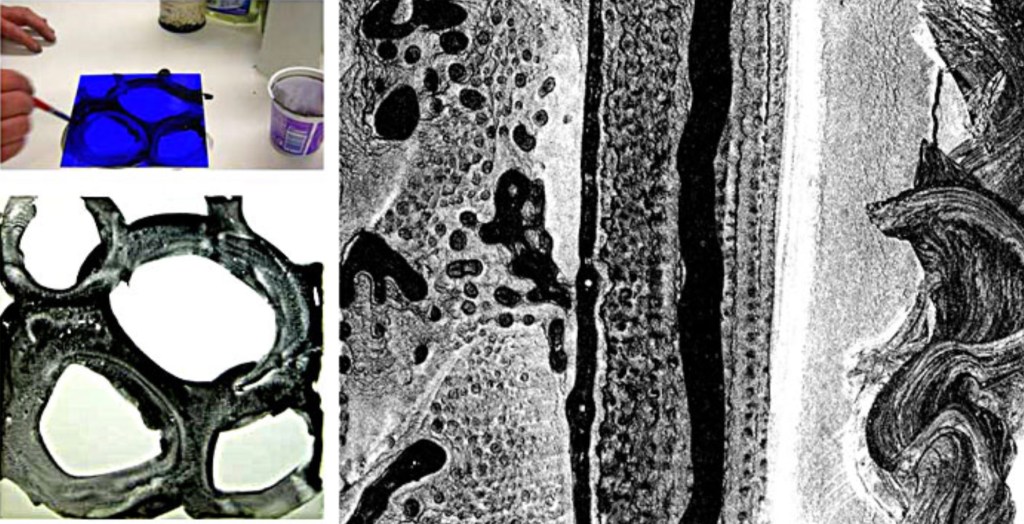
Toner-based Reticulated Ink Washes
samples of reticulated wash work using photocopy toner. (left): Donna Adams – wash for intaglio type | (right) wash for waterless lithography by Nik Semenoff.

Image shows the Nederman ‘Gas Cart’
VOC Fume Extraction at Source
There are ways to remove toxic VOCs and acid fumes at the actual source, i.e. the surface of the stone. Companies such as the Swedish firm NEDERMAN make custom-fixed or portable extraction systems with flexible hoses that they claim provide sufficient protection – especially if used in conjunction with respirators and dilution ventilation. These systems also have filters that capture VOC residues, so that environmental requirements can be met. Some well equipped and more safety- conscious lithographic studios (for instance Tamarind) have similar fixed systems with flexible hoses suspended from the ceiling.
Lithographers are often attracted to the medium because of the pleasure derived from drawing onto the stones. Not wishing to hamper the fluidity and freedom of the technique can also make practitioners reluctant to use the kind of heavy-duty, sometimes cumbersome protection measures outlined here. No doubt some may be thinking, “If Senefelder didn’t wear a mask, why should I?”
Dwight Pogue has developed safer chemistry for stone processing:
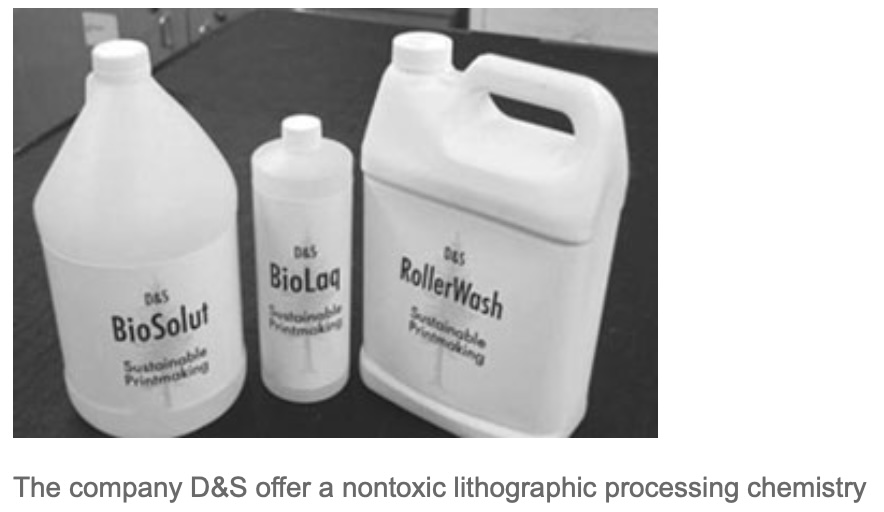
“D & S BioSolut is 100% bio-based Ethyl Lactate, and is considered to be a biodegradable solvent. It is formed from lactic acid and ethanol (grain alcohol). Upon contact with water molecules, whether in liquid or vapor form, it hydrolyzes back into those components, and the human body has well-developed metabolic mechanisms for coping with both of them. “