

The following article was originally delivered as the lecture “The Green Print Studio in the USA: A Model for the 21st Century” as part of the SGC ‘Global Implications’ conference held in Chicago, March 2009. The text is reproduced here with the kind permission of Liz Chalfin. (Zea Mays Printmaking)
One of the greatest challenges of the 21st century is environmental sustainability. The implications are borderless and stateless. Environmental degradation in one area of the planet has profound consequences globally; and environmental leadership in one area of the world can resonate around the planet.
Since the 1990s there has been a movement to develop safer alternatives to
traditional toxic printmaking processes. The motivations for the “non-toxic”
printmaking movement have been twofold: to create a healthier environment in
which to make art, and to make less of a toxic impact on the environment. Great
strides have been made in the years since the original research took place in
Scotland, Canada, and Australia and “greener” printmaking is beginning to make an impact on the global print community.
Before I go much further, I think it’s important to clarify the terms “green” and “non-toxic” in relation to printmaking. As stated in this website (nontoxic-print.com) “the term nontoxic/non-toxic has become synonymous with safety-conscious practice”. So called ‘Nontoxic’ processes still use a variety of chemicals, and the ultimate safety of any material and process is dependent on their informed use.”1 In this article I use the terms “green” and “non-toxic” interchangeably to describe processes and materials that are solvent-free
and that aim to use the safest current practices.
Zea Mays Printmaking studio and its green mission statement.
http://www.zeamaysprintmaking.com/
Zea Mays Printmaking is a studio, workshop, gallery, educational facility and research center dedicated to the safest and most sustainable printmaking practices available. The studio is continually researching exciting new techniques and products. They share this information through our workshops, consultations and private tutorials. We offer workshops in safer printmaking processes; access to state-of-the-art studio; exhibitions; residencies; prints for sale and more.
Green History
Since the mid-1980s there has been a trend towards exploring safer and non-toxic alternatives to traditional printmaking practices. The technical research was conducted at studios and universities in the UK, Europe, Canada, Australia, and the United States by innovative artist/scientists who recognized the need for safer methods. Much of the impetus came from the growing awareness that traditional printmaking was harmful to the health of the practitioner and the environment. These creative innovators went on to spread their knowledge and experience with greener alternatives to the larger printmaking community through workshops, demonstrations, books, videos, DVDs, and an immense
generosity of spirit.
Slow to take hold, the non-toxic printmaking movement has gained new ground during the last two decades. Many colleges and universities are teaching non-toxic printmaking methods to a new generation of students. Dedicated faculty, from all over the country, have taken it upon themselves to train in the new technologies and to impart that information to their students. The initial resistance to the processes is being chipped away and more people are embracing this contemporary and conscientious approach to printmaking. Besides being healthier, the new methodologies have opened up new avenues for creative exploration.
Over the past decade, a handful of green shops have emerged on the printmaking landscape. Founded by artist/printmakers they provide a vital place for the dissemination of new printmaking technologies to an audience of non-student artists. These studios are lifelines for hundreds of practicing artists who no longer have access to school facilities.
They provide a physical space to work in a healthier environment; a theoretical and practical laboratory in which to test, explore and evaluate the green printmaking products; and a philosophical home where environmental consciousness can be expressed through art practice. Each of the studios represented in this article make a unique contribution to the global printmaking community – through the workshops they offer, the exhibitions they
organize, the studio spaces they provide to artists, and the outreach they practice in the global printmaking community.
Going Green
Where does one print outside the Academy? What about the generations of artists who were trained traditionally, but who now have the need and the desire to learn safer alternatives? Where are the print shops, the collectives, and the private studios in communities across the USA that practice green printmaking, and how does one go about setting up a green studio? Once you do set up a studio what obstacles do you face? Is there resistance from the traditional printmaking community to greener printmaking? How do we overcome resistance and broaden our outreach? What are the rewards?
In order to find out the answers to these questions I developed a questionnaire and sent it to all the green studios I knew of in the United States. The conclusions and studio profiles in this article are based on the answered questionnaires.
Let’s start with the rewards. The implications of having green studios are broad. Artists are returning to printmaking. Many studio directors spoke about their clientele as individuals with a background in printmaking that had left the field because the toxic chemicals caused health problems. These artists believed they would never be able to return to an art medium they loved and had mastered. The green studio provides a place for these artists to work safely – and to re-discover printmaking.
Green studios are less expensive than traditional print studios to set up and to maintain. When you walk in the doors the first thing that hits you is the absence of solvents and their odors. The usual smell of a print studio and the subsequent headaches are gone. Because the solvents are removed from the space, there is no need to invest in expensive ventilation systems. This cuts down significantly on the costs of setting up a studio. The green products are generally cheaper to purchase, and many can be bought from a supermarket or hardware store. Most of the materials are less time intensive to maintain and use; clean up is easier and the studio stays neater. Disposal is far less of an issue than in traditional print shops.
Zea Mays Printmaking studio members and workshop participants.

Green studios retrain mid-career artists as well as emerging artists in safer techniques. They speak to a growing consciousness of preserving the environment. They train artists from around the world who take this knowledge back to their countries. They create communities and dialogue between communities. They demonstrate, through practice and exhibition, the high quality of prints made using safer and non-toxic processes. Finally, the
relative safety of the materials allows for greater experimentation and a whole new way to approach printmaking.
But does a green print shop also face unique challenges? Yes and no. The main challenge each studio cited was a mindset, a prejudice against the new techniques and products from a generation of printmakers comfortable using traditional materials. Many of the green-print-studio founders spoke about an initial attitude that new approaches couldn’t create works of art that were comparable in quality to prints made using the toxic materials. This attitude has softened over the years, mainly because of the strong work coming out of each of these venues and their counterparts in higher education. The rich and dynamic prints emerging from green studios sell the processes and the more people
see the art, the less the resistance.
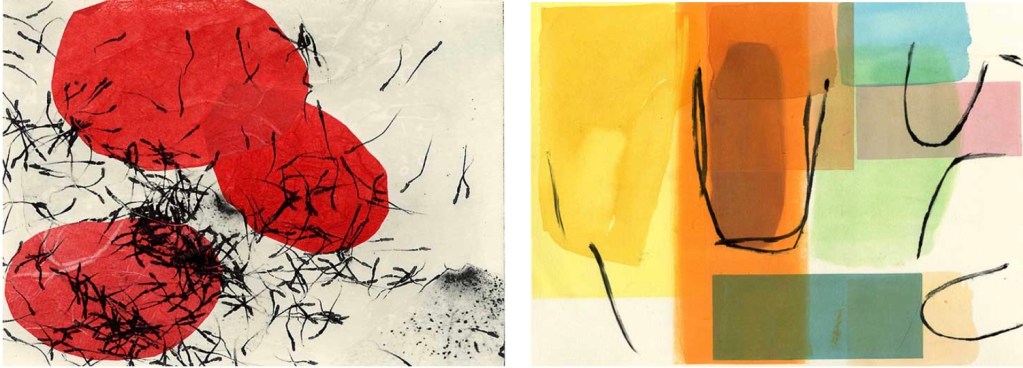
Prints by members of Zea Mays Printmaking: Joan Wiener (left), Nancy Van Deren (middle),
Another challenge the directors spoke of was the learning curve. Many printmakers who come to the various studios need to learn a whole new way of working with new materials. Seasoned printmakers who are not invested in the mission of safer and non-toxic printmaking are reluctant to learn substitute methodologies. Printmakers who are on board with the mission of safer and non-toxic approaches still have to step back to a beginners level as they master the nuances of contemporary techniques.
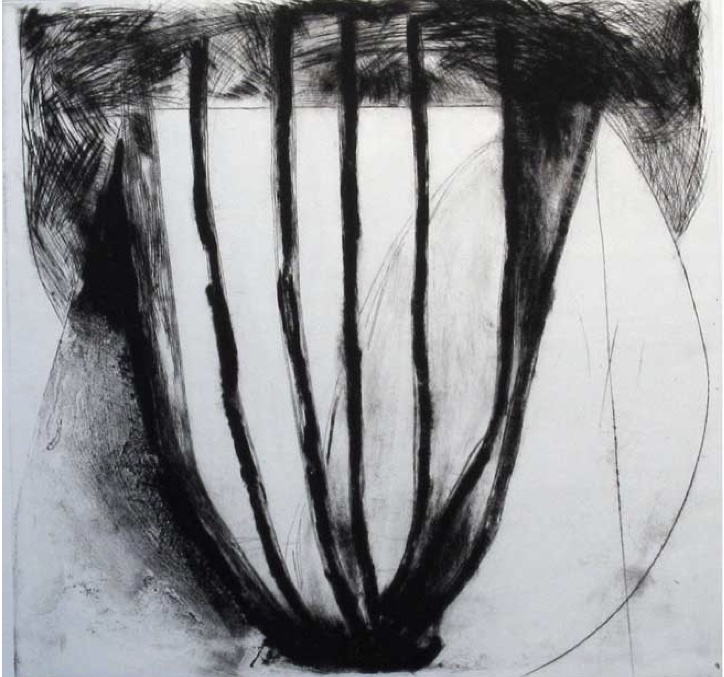
Joan Dix Blair
The Techniques
The simplest way to start greening up a print studio is to remove the solvents used for clean up. All oil-based inks can be cleaned off work surfaces, plates, brayers and tools with vegetable or mineral oil. The oil loosens the viscosity of the ink enabling you to wipe the ink away. The greasy residue left behind can be cleaned with soap and water, or a biodegradable cleanser such as Simple Green.
Viable replacements for etching grounds, oil-based inks, and photo chemicals abound. ACRYLIC RESIST ETCHING has been well documented on FRIEDHARD KIEKEBEN’s websites
(nontoxic-print.com) and in informative books by Robert Adams and Carol Robertson, Keith Howard, and HENRIK BOEGH.2 Z*Acryl and Lascaux make wonderful grounds and stop-outs for all manner of intaglio.3 KEITH HOWARD and DAN WELDEN have written great technical books about photopolymer intaglio processes.4 Susan Rostow has developed a superb water-based ink (AKUA Kolor).5 Other ink manufacturers have joined in the movement and
are making water-based and water-miscible inks (Faust, Daniel Smith, Graphic Chemical, and Caligo to name a few). In terms of materials and information, there is no longer a good excuse not to remove the toxic elements from the print studio.
Research Projects
Part of the mission of Zea Mays Printmaking is to research new developments in safer, less-toxic and non-toxic printmaking. Our goal is to find materials and processes that can replace solvent-based, toxic printmaking techniques while maintaining quality.
Each research project sets out to discover the best practices for a particular technique, product or formula. The research was done by Zea Mays Printmaking interns, under the supervision of Liz Chalfin, the studio using an airbrush to apply aquatints, hardening grounds in a convection oven, etching copper plates in vertical etching tanks with Ferric Chloride, degreasing plates with soy sauce, stripping acrylic grounds in a sodium carbonate bath and deoxidizing in a vinegar and salt bath. We have divided the Research Projects section of the website into units. Each unit covers an entire research subject and includes all of the experiments done on that subject. Each experiment was tightly controlled and documented in detailed notes and photographs. All of the successes and
failures are included in the documentation. When we were able to get consistently good results for a particular process we have added a step-by-step process handout.
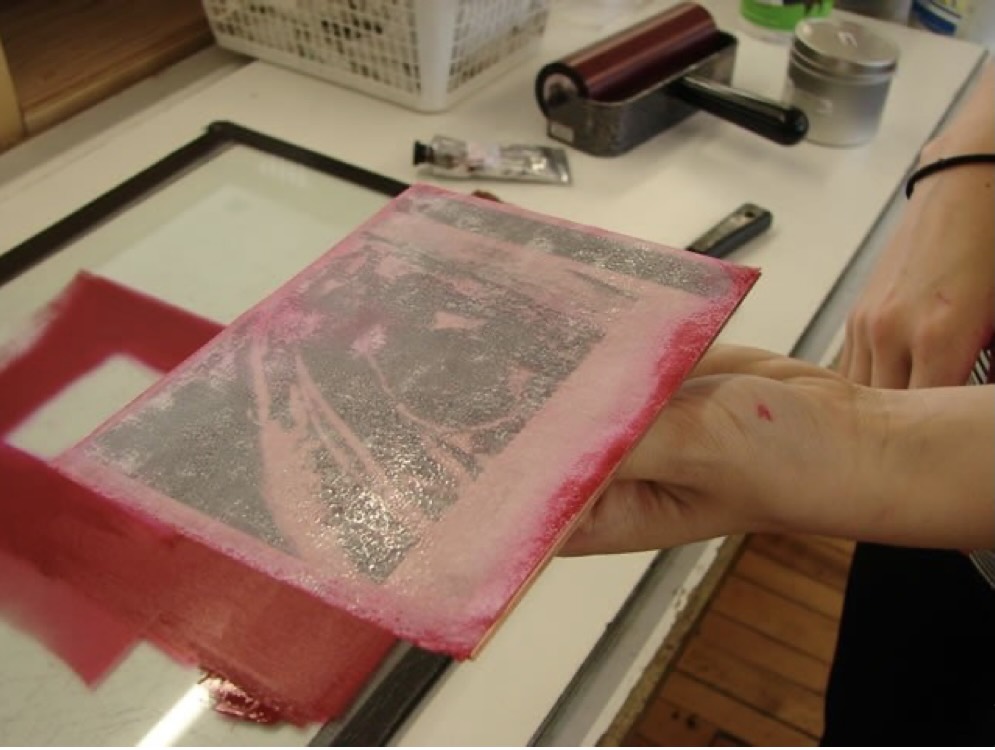
Click on the name of a Research Project and you can proceed to the experiments and documentation.
Part of the mission of Zea Mays Printmaking is to research new developments in safer, less-toxic and non-toxic printmaking. Our goal is to find materials and processes that can replace toxic printmaking techniques while maintaining quality. We test products that have gone to market, recipes we were given to explore and techniques we’ve heard about and want to dive into in a deeper way.
c o n t a c t