

selected resources
Michael McCann PhD:
Art Safety Procedures for Art Schools and Art Departments developed out of the many industrial hygiene consultations that I have carried out for art schools and college and university art departments over the last fifteen years.
Usually, I was called in by the Art Department or Art School to make recommendations for ventilation, storage and handling, personal protective equipment, etc. However, what I almost universally found was a lack of health and safety programs…
Examples include bladder cancer in painters;
lead poisoning in stained glass artists, potters, and enamelists;
peripheral nerve damage in commercial artists;
emphysema in acid etchers;
aplastic anemia and leukemia from use of benzene;
severe asthma among users of fiber-reactive dyes;
cyanide poisoning and cadmium poisoning in jewelers,
kidney damage from cadmium silver solders in jewelers;
brain damage in silk screen printers;
death of a weaver from anthrax;
and metal fume fever in welders.
Toxic or not toxic?
Chemistry, material and medical science, and the field of toxicology are in constant change!
For example, many materials or processes thought of in the 1980s or 90s as safe, have recently been shown to cause sickness. Unfortunately, most of the latest research is not fully in the public domain, potentially leaving artists, educators, students, and paint users unaware of hidden dangers. We recommend using the advanced search function on the US PubMed library to find current and up-to-date research and safety recommendations:

National Institutes of Health (NIH) | (.gov)https://pubmed.ncbi.nlm.nih.gov
ADVANCED SEARCH on PubMed
https://pubmed.ncbi.nlm.nih.gov/advanced
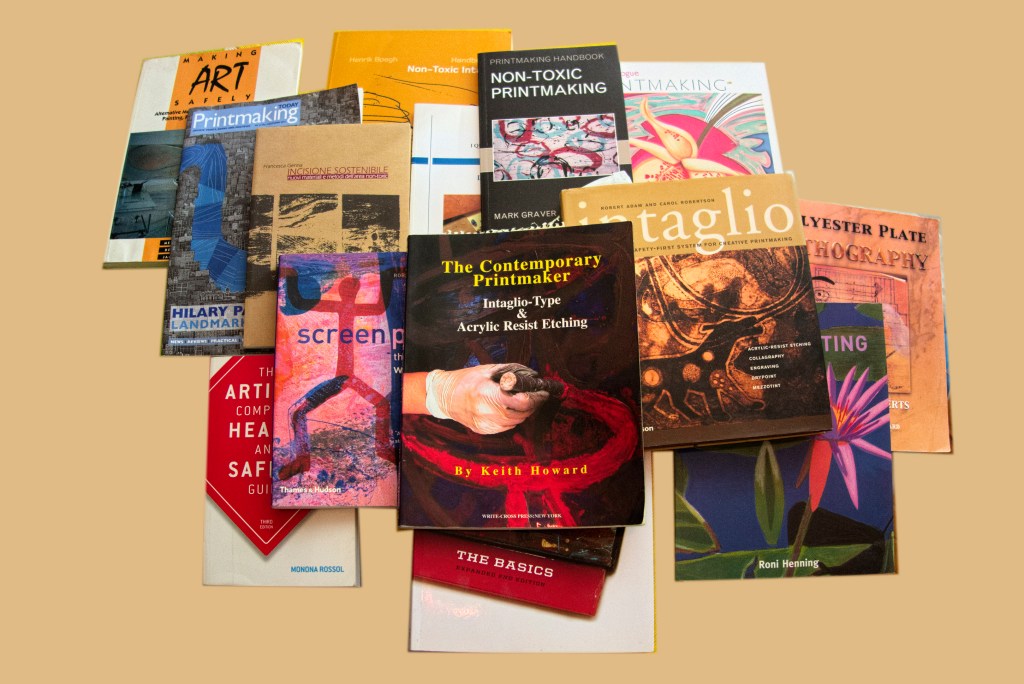
there are many books on safer art practices; a selection
INDUSTRIAL HYGIENE
how can this field be defined?
Industrial hygiene has been defined as : “that science and art devoted to the anticipation, recognition, evaluation, and control of those environmental factors or stresses arising in or from the workplace, which may cause sickness, impaired health and well-being, or significant discomfort among workers or among the citizens of the community.” Industrial hygienists use environmental monitoring and analytical methods to detect the extent of worker exposure and employ engineering, work practice controls, and other methods to control potential health hazards.
In practice these criteria apply in any industrial setting just as much as they need to be considered for art schools, artist studios, maker spaces, printmaking workshops, sculpture workshops, or any kind of craft making facility. Even schools require industrial hygiene measures to operate safely.
There has been an awareness of industrial hygiene since antiquity. The environment and its relation to worker health was recognized as early as the fourth century BC when Hippocrates noted lead toxicity in the mining industry. In the first century AD, Pliny the Elder, a Roman scholar, perceived health risks to those working with zinc and sulfur.
He devised a face mask made from an animal bladder to protect workers from exposure to dust and lead fumes. In the second century AD, the Greek physician, Galen, accurately described the pathology of lead poisoning and also recognized the hazardous exposures of copper miners to acid mists.
In the Middle Ages, guilds worked at assisting sick workers and their families. In 1556, the German scholar, Agricola, advanced the science of industrial hygiene even further when, in his book De Re Metallica, he described the diseases of miners and prescribed preventive measures. The book included suggestions for mine ventilation and worker protection, discussed mining accidents, and described diseases associated with mining occupations such as silicosis.
Industrial hygiene gained further respectability in 1700 when Bernardo Ramazzini, known as the “father of industrial medicine,” published in Italy the first comprehensive book on industrial medicine, De Morbis Artificum Diatriba (The Diseases of Workmen).
The book contained accurate descriptions of the occupational diseases of most of theworkers of his time. Ramazzini greatly affected the future of industrial hygiene because he asserted that occupational diseases should be studied in the work environment rather than in hospital wards.
Industrial hygiene received another major boost in 1743 when Ulrich Ellenborg published a pamphlet on occupational diseases and injuries among gold miners.
Ellenborg also wrote about the toxicity of carbon monoxide, mercury, lead, and nitric acid.
In England in the 18th century, Percival Pott, as a result of his findings on the insidious effects of soot on chimney sweepers, was a major force in getting the British Parliament to pass the Chimney-Sweepers Act of 1788. The passage of the English Factory Acts beginning in 1833 marked the first effective legislative acts in the field of industrial safety. The Acts, however, were intended to provide compensation for accidents rather than to control their causes. Later, various other European nations developed workers’compensation acts, which stimulated the adoption of increased factory safety precautions and the establishment of medical services within industrial plants.
In the early 20th century in the U.S., Dr. Alice Hamilton led efforts to improve industrial hygiene. She observed industrial conditions first hand and startled mine owners, factory managers, and state officials with evidence that there was a correlation between worker illness and exposure to toxins. She also presented definitive proposals for eliminating unhealthful working conditions.
Excerpt from:
IMDUSTRIAL HYGIENE
(OSHA.gov)
WIKIPEDIA:
Occupational Hygiene
https://en.wikipedia.org/wiki/Occupational_hygiene
I