
Intaglio Manual
by Friedhard Kiekeben, 1994 – 2026
Intaglio Manual : Metals | Plate Preparation | Hard Ground | Orono Ground (soft)| Aquatint | Dry Techniques | Intaglio Printing | Collagraph | Acrylic Wash | Mark Making | Preparing for Etching | Stripping | The Acrylic Resist Etching Workshop | Color Printing
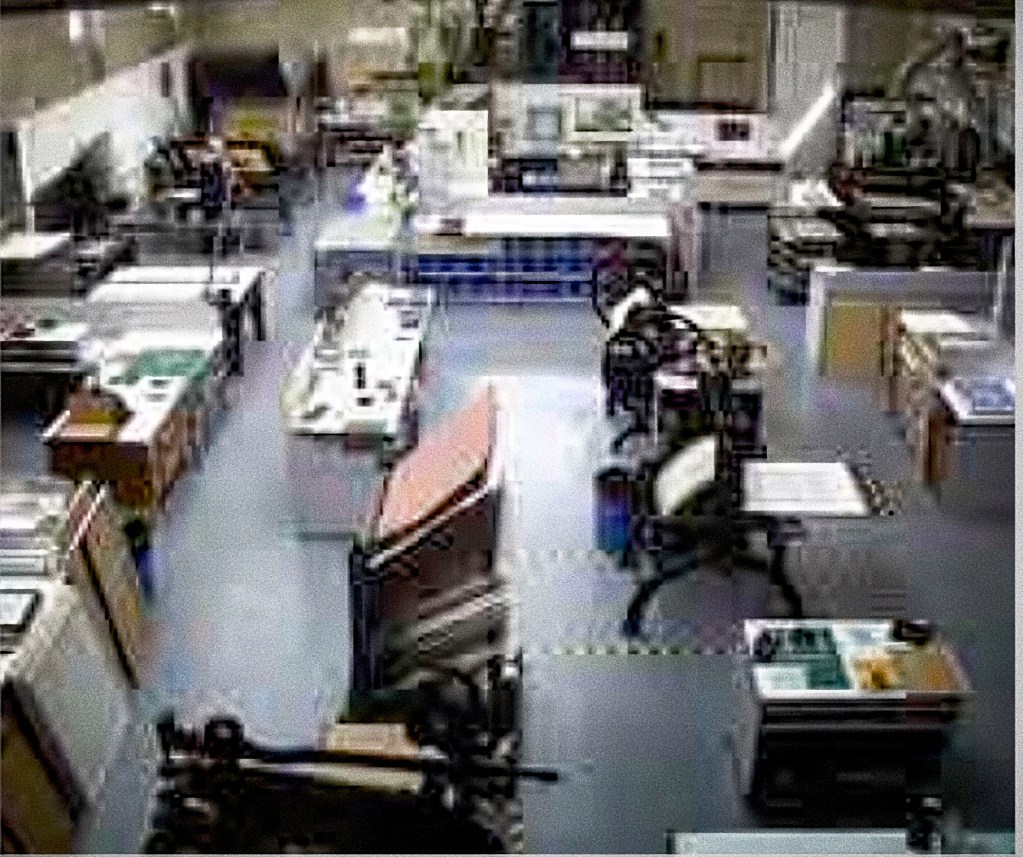
the old location of Edinburgh Printmakers
The Acrylic Resist Etching Workshop
safe, simple, economical
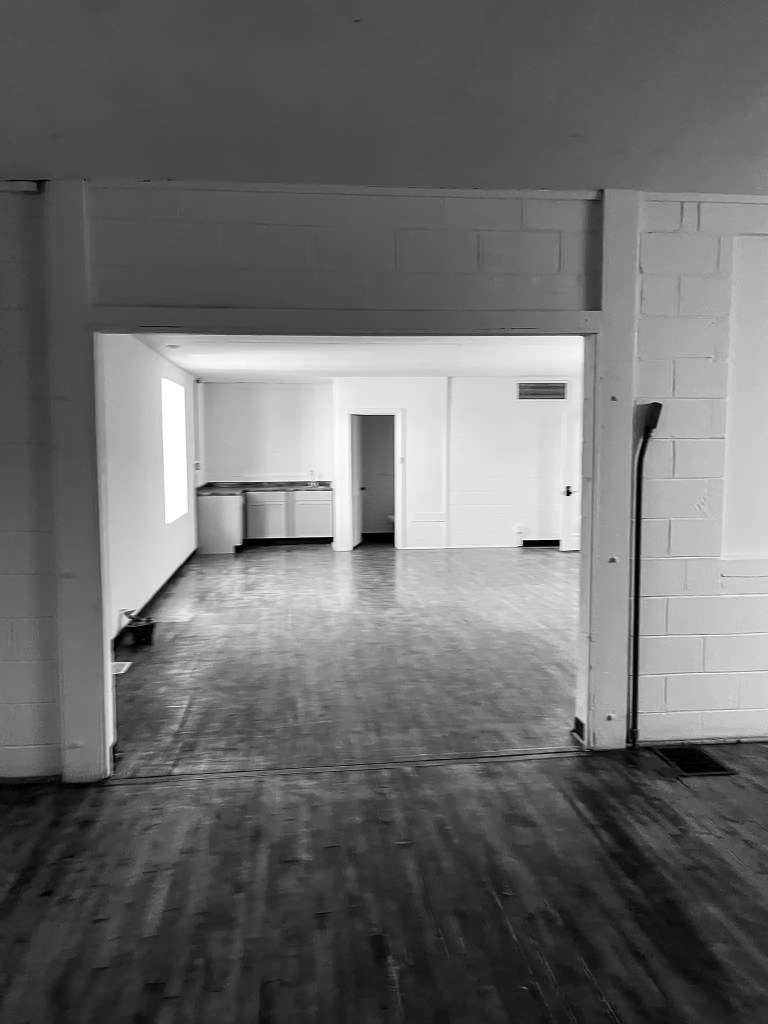
the Artwell Studio in Indianapolis, (coming late in 2025)
for details, see:
The etching press | Inking benches | Print drying | Drawing area | Ground application area | Spray booth | Plate preparation area | Chemicals / Corrosive area | Etching and stripping tanks | Drying cabinet | Paper area | Photopolymer area
The acrylic resist etching system is ideally carried out in purpose made workshop facilities. It can also be put into operation with fairly limited means and a small budget, making the intaglio medium much more accessible to small set-ups and individual artists.
The materials used in the new processes are so safe that etching is now a viable option for artists wishing to carry out intaglio work in their own studios as well as for schools who have recently found traditional printmaking impossible due to health and safety regulations. With the new system, no costly fume extraction system is needed, no seriously harmful substances are involved.
For the more professional workshop or educational department investment in a number of facility developments is recommended to ensure ideal results and efficiency. These facilities are easily constructed and any expense is quickly recouped by the savings made by operating a nontoxic acrylic resist workshop.
Accommodating acrylic resist etching facilities into an existing set-up can present an opportunity to reassess and redesign all areas of practice to offer a nontoxic facility that is rational, practical, safe and healthy with clearly defined areas of activity allowing artists to move from one dedicated space to another as they progress through different stages of their printmaking.
Rethinking the Printmaking Studio and Ergonomics – Some History
Robert Adams and Carol Robertson, Alfons Bytautas and Keith Howard were key pioneers in rethinking ergocomics and workshop design at Edinburgh Printmakers Workshop from the early 1990s onwards, in the context of a popular, much-used and professional print shop environment. Key aspects of these systems, across all printmaking media, were a desire to reduce or eliminate toxic solvents vapors, use safer inks, adopt water based systems where appropriate, and make processes ergonomical and user friendly. The studio adopted white inking surfaces that are topped with tempered glass; this facilitates easy cleaning and makes more colors visible during inking. For thicker printing substrates and collagraphy new types of non-felt blankets were researched from alternative materials such as vinyl interfacing and foam blankets. Most solvent cleaning was replaced with cleaning with vegetable oil and a water-dish soap mixture; as was recommended by new Scandinavian regulation at the time; see:
More recently, Zea Mays Printmaking in Florence MA have become a leading force in innovative studio layout, with a particular emphasis on recycling of materials and cradle to cradle circular processes.
Large shops can easily accommodate all the facilities and equipment but it is also perfectly possible to create a nontoxic workshop in a much smaller space if a multifunctional design is adopted. An acrylic resist etching facility can in fact be easier to accommodate than traditional facilities because the new processes require much less space. The following is a suggested floor plan. There are many other ways to layout the nontoxic workshop but the aim here is to demonstrate that change does not necessarily require a large budget or major construction work.
SUMMARY
Area 1. PRESSES: The intaglio presses form the nucleus of the nontoxic printmaking workshop. All other areas of activity are grouped around this centrally located area like satellites. The presses are easily accessible from the blotting area, the inking areas, drying racks and boards; and can be supervised by a technician from virtually anywhere in the workshop.
Area 2. INKING: Benches where inking and wiping and other messy preparations can be carried out without contaminating clean preparation areas.
Area 3: PLATE PREPARATION: A sequence of stations where the printmaker can move from sanding bench to degreasing sink and on to the drying facility.
Area 4: GROUND APPLICATION: All processes related to the application and curing of grounds can be carried out here.
Area 5: CHEMICALS and CORROSIVES: Processes such as stripping and etching involving the use of corrosive chemicals are restricted to an enclosed area in which strict precautions must be followed.
Area 6: PAPER PREPARATION: A clean area for the preparation of paper.
Area 7: PHOTOPOLYMER: A light proof space (with yellow light filter) featuring a UV exposure unit. Can be combined with an existing dark room.
All Areas: SAFETY: All processes or materials requiring caution are labelled with prominent notices and advice regarding their usage. Barrier cream, eye wash station, emergency first aid kit and fire extinguishers are kept in central locations. Gloves, goggles, masks and visors are provided in all those areas where they are needed. MSDS Safety Data Sheets are made available to all users.

The etching press
(image: POLYMETAAL graphic art equipment. JW-80 etching press)
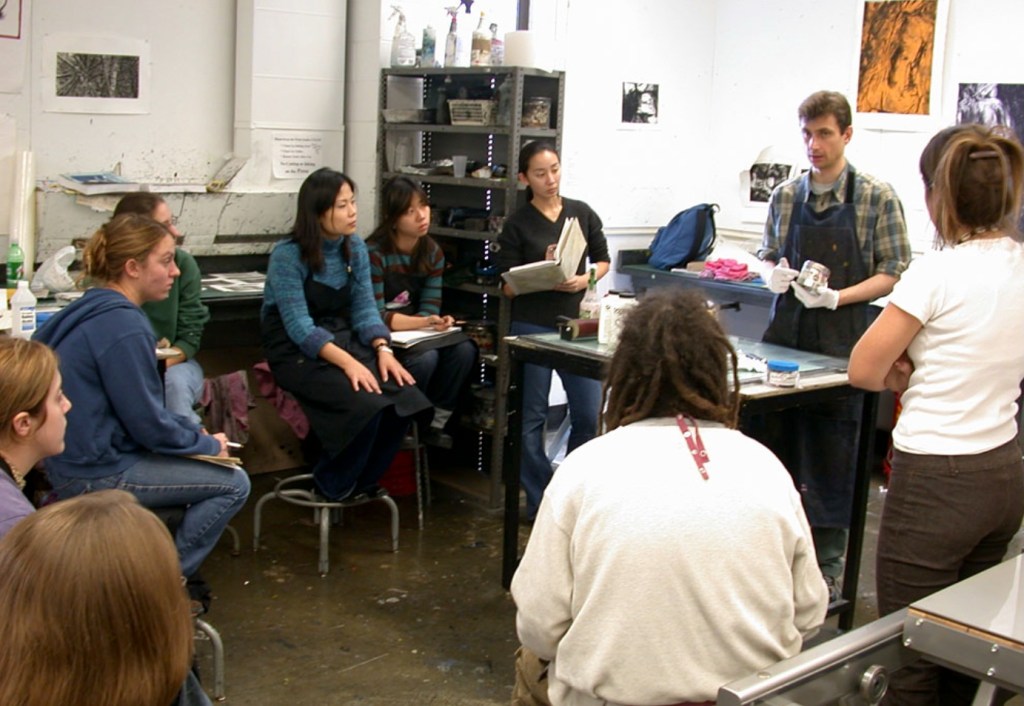
The RIT print studio in NY
The most essential piece of equipment in a printmaking workshop, especially an intaglio workshop, is of course the etching press. As opposed to other print media like screen or relief printing it is not possible to print etchings on improvised equipment. If there is one item in the intaglio workshop where expense should not be spared, it is the press. For once, the thinking that the most modern equipment is best is not necessarily the case. An etching press should be of a very sturdy construction so it can exert tremendous pressure and absorb tension and stresses. Old etching presses and modern versions built according to old designs can be relied upon to be heavy, sturdy and to deliver sufficient pressure and to provide many years of trouble free service.
The basic design always incorporates two heavy rollers suspended within a rigid framework with a press bed sandwiched between the rollers and driven through them by means of a wheel or equivalent mechanism. The pressure is adjustable by turning two spindles attached to either side of the top roller. The earliest presses made in the 16th Century were wooden constructions and were driven by a massive star wheel. Today only a few presses have a direct drive and star wheel, a design which fails to give the printmaker the best indication of pressure. Most presses used today are operated by a flywheel connected to a gear mechanism which makes intaglio printing much less strenuous and therefore more accessible to all. Some presses are even motorised.
A few tips when buying a press:
Look for a press with rollers and a frame that are as heavy and rigid as possible. Lightweight presses frequently have disappointing print quality and may be of poor construction. Rollers should be solid or the tread of the two steel cylinders should be as thick as possible. They should be of a fairly wide diameter and normally the bottom roller is larger than the upper one. If the press has hollow rollers, check that they are fitted with internal support structures. Rollers lacking rigidity and girth are prone to bendingunder pressure – something that is indicated by a gradual loss of tone and detail towards the middle of a print. It is better if the drive is fitted to the top roller. Presses with a driven bottom roller can push plates out of register.
The press frame should be made of cast iron. Other kinds of frame are prone to small but significant flexing or stretching under pressure. However, (2025), currently a number of good designs are available that are made with thick sheet metal frames rather than cast materials. The bearings are a particularly crucial element of any press. On the best machines these bearings consist of a solid steel shaft fitted to either side of the roller which runs within a cylindrical bronze inset in the press frame.
This type of roller bearing, when frequently lubricated with machine oil, can give decades of trouble free service. It is important, however, not to allow the top roller to tilt as this can cause the bearing to shear off. There are a few good presses that make use of high quality ball bearings which are suspended in a cast press frame but on the whole ball bearings are often — but not always — the sign of an inferior design. Many, but not all, cheap presses (often half the price of a good press) are prone to breaking down or printing poorly. Beware of adverts for inexpensive presses of a lightweight modern construction. Even though much more portable, these less robust machines often fail to satisfy the demands of professional intaglio printmaking. This also goes for multipurpose presses that claim to be able to print anything from an intaglio plate to a litho stone.
The press bed need not be made of heavy gauge steel and in some workshops even compressed particleboard is used to satisfaction. Thinner steel beds tend to become slightly curved with use and need to be reversed from time to time. The press bed should be covered with a thin smooth board such as Formica to provide an even and easy to clean surface and to keep the actual bed from rusting. Any press bed must be secured within the press with stops on both sides. A loose bed can actually run out of its tracks between the rollers and cause serious injury.
In short, this means that a good etching press is a heavy piece of equipment which needs specialised transport and may even require hydraulic lifting gear to be moved about the workshop. For this reason, it is also important to ensure that the workshop floor is strong enough to bear the weight of a press which can often be up to several hundred kilos. On the positive side, due to the relative simplicity of a good etching press, they can be assembled by anyone with basic DIY skills.
Inking benches
The inking benches form an area of activity in which most of the preparatory work for printing is carried out. It is quite normal for an intaglio printmaker to spend much more time here than on the actual press so these work areas should be well laid out, sufficiently lit and located away from clean areas of activity, especially those in which paper is handled. The inking benches should however be within easy reach of the press.
Inking areas often turn into the messiest part of the printmaking workshop. This fact is often exacerbated if inking and wiping is carried out in gloomy conditions on black wooden jiggers etc. It is impossible to keep dark absorbent surfaces clean. Messy workstations are not only a potential health hazard but also encourage the kind of cross-contamination that can make clean color printing impossible. For this reason it is good practice to cover all benches with thick sheets of acetate which serves as a good mixing, inking and wiping surface as well as one that is easy to clean because ink deposits are clearly visible.
Inking benches should not be too low or too high – the average height of a kitchen unit is a good marker. Benches are often equipped with storage areas under the work surface but often these areas can become cluttered with all manner of materials. It is best to have clearly defined compartments for things like reusable scrim of different colors. Better to keep
ink tins, additives, cleaning oil, cleaning spray, card squeegees and tissue in separate containers on raised shelves at the back of the bench.
There are numerous ways to keep this area of the workshop tidy, functional and economical. For example, to avoid wastage etching inks now come in ink guns which dispense in measured amounts. Another useful item is a wall-mounted magnetic kitchen knife holder which can be used to hold spatulas. It may come as a surprise to some, but the cleaning of rags can result in the biggest part of a workshops expenditure! So, as rags are always in demand, it is a good idea to establish a system for their use and reuse. Because no organic solvents are used in acrylic resist etching, rags can be used several times until they have become saturated with ink and cleaning oil. The rocket system makes use of a cylindrical bin with an opening at the top and conical opening at the bottom. When a rag has been used once but still has remaining absorbency, it is put into the rag rocket along with other similarly used rags, ready for reuse. Only when a rag has become fully saturated is it put into a separate bin and the contents handed to a rag recycling company. Clean, pristine rags are kept in a separate bin.
BIN 1: clean rags
BIN 2: used rags with remaining absorbency
BIN 3: fully saturated rags for recycling
Any rags soaked with ink or cleaning oil must be kept in fireproof containers with lids as they are combustible. This is not
normally a serious hazard, except in very hot conditions. The same goes for tarlatan soaked in ink. If all rags are used for
waterbased clean up there is no such fire hazard.
Print drying
The print drying facilities should be located close to the etching press. Sheets of pin board are ideal for drying prints and flattening them at the same time. Stacks of these boards do however tend to become very heavy and difficult to sort through. Smaller and more manageable stacks can be created by constructing a sturdy rack with shelves on which several boards can sit on top of each other. A workshop with sufficient space should also have a metal drying rack of the kind used in screenprinting for prints that can be air dried rather than dried flat.
Drawing area
Due to the amount of bulky equipment, the drawing areas available in a printmaking studio are often limited. However, it can be most beneficial to find some conducive space where artists can go to draw and consider their work etc. Where possible, this should also include a facility for pinning up artworks or proofs. Even the sturdiest tables deteriorate from thephysicality of intaglio printmaking so it is best to cover them with replaceable sheets of acetate which are simply held in place with adhesive tape. Some workshops also make use of color-coded boards which are designated as clean boards to be used solely for drawing, paper tearing etc. Other designated boards include messy boards for intaglio work and cutting boards which provide a surface for trimming etc.
Ground application area

(also suitable for BIG GROUND)
Roll-On Ground
This should be a glass or acetate topped bench similar to the inking benches which mainly serves as a roll-up slab for acrylic roll-on hard and soft ground as well as for other specialised grounds such as lift ground and wash techniques. This bench should not be used for inking up as all processes carried out here demand an entirely non-greasy surface. Shelves above and underneath the bench provide ample storage space for all acrylic resist etching paraphernalia such as ground rollers, stop-out varnishes, wash and lift media, cleaning agents, jars, bowls and brushes etc.
Hard Ground
In some workshops this area is designed as a bay incorporating a drying cupboard.
Spray booth

The spray booth is a wooden or metal cabinet with a funnel-like hood and fume extraction; possibly filtration. Portable spray booths in a variety of sizes are available online (Amazon etc.), for hobby airbrush applications. An air tube connects the hood with an extractor fan fitted into a window that generates the required sucking airflow that removes the acrylic spray mist from the workshop area. The interior of the booth is fitted with lights and has a slightly angled backboard where plates are propped. There are often pins or clamps so that newsprint sheets can be hung behind the plate.
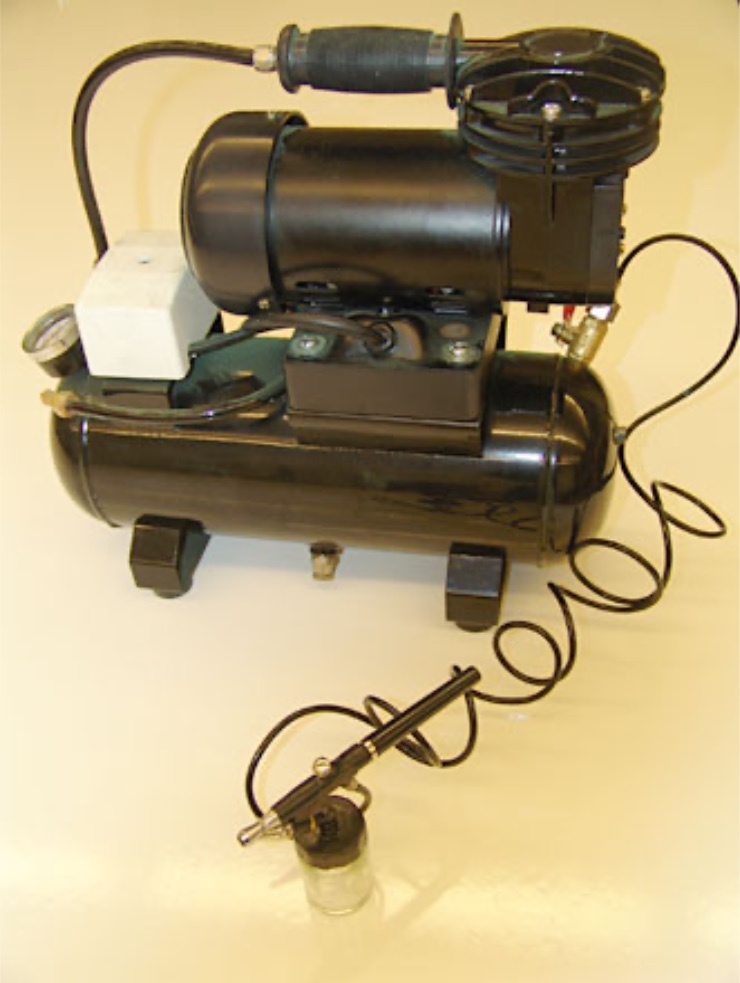
The front flaps of the spray booth can be extended to accommodate large plates. The bottom front cover conceals the compressors. Adequate ventilation needs to be provided if a compressor is fitted into an enclosed space. Switches for the fan, lights and compressors can be mounted on the front panel of the booth and are best covered with an acetate sheet to insulate them from wet hands and spray mist. Underneath the booth can be fitted with shelves for the temporary storage of plates-in-progress as well as various spray chemicals and cleaning agents.
A simple but serviceable compressor with 1.5 horsepower can be purchase reasonably cheaply at most DIY stores. These tend to be quite noisy machines. Much better for a shared workshop is a compressor with integrated air reservoir. These machines run very quietly. A designer’s airbrush compressor which is entirely silent uses a different technology and is best obtained at a professional art materials supplier.
The actual spray guns and other attachments are connected to the compressor by means of a pressurised air hose. There are various adapters available. A very long air hose makes it possible to run the compressor in a separate room or area from the spray booth. The large spray gun best suited for working with acrylics is often labelled a gravity fed gun, to indicate that the ink container is mounted on the top of the gun. This type of tool is much less likely to clog up than other models. Designer airbrushes with no valves or other intricate components tend to work best.
Plate preparation area
It makes good sense to carry out all plate preparation processes in one designated area if sufficient space is available. Some workshops lay this area out in a way that allows etchers to proceed step by step from the sanding bench to the degreasing sink and on to the drying facility. A guillotine can also be part of this area. The sanding bench is the place where all the mechanical processes are carried out and where appropriate tools (files, sanders, sandpaper etc.) are kept. As many of these processes produce metal filings and dust it is best for this to be confined rather than spread across the workshop. The degreasing sink should ideally be made from robust polypropylene or stainless steel and designed to accommodate the largest plates used in the workshop. It should be equipped with a hose or shower attachment and a hot and cold water supply. Fit a wooden grid into the bottom of the sink. It is also useful to have an adjacent shelf for storing degreasing materials.
Next to the sink, there should be a clean bench for drying degreased plates with room for a paper towel/ tissue dispenser for blotting and a blow dryer. It is important for the dryer to be a properly designed wall-mounted hot air fan – not a plug in hairdryer which, in a wet area, is an electrical hazard. In practice, most workshops do make use of hairdryers – these should be fitted with a circuit breaker for safety.
Chemicals / Corrosive area
In the acrylic resist etching system it is best for all etching and stripping processes to be incorporated in a general corrosive area. This area can be divided into wash and etch sections. Both sides comprise tanks or trays containing the active solutions next to a rinsing facility. The sink units should be made from polypropylene and mounted on a stainless steel stand. The polypropylene is a strong kind of plastic which is unaffected by strong alkalines or acids.
These sink units can be fabricated by specialist manufacturers according to the dimensions required by the workshop.
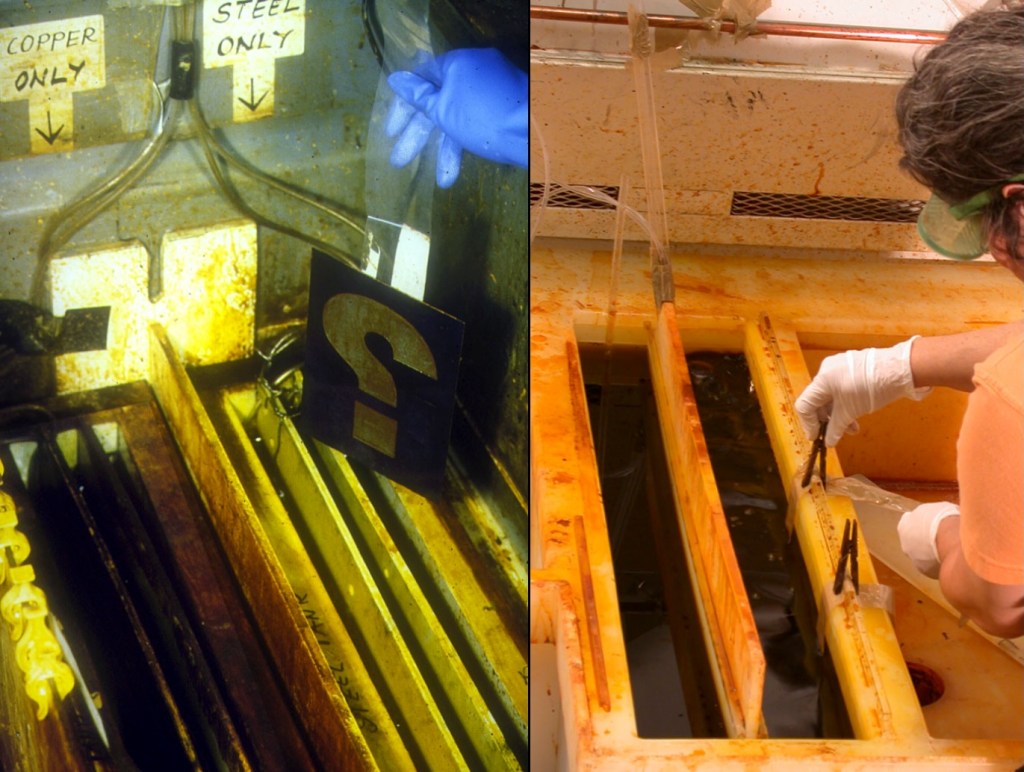
Etching and stripping tanks
Dip tanks for etching and stripping can be built into this sink design as a compartment or made separately so that they can be removed when necessary e.g. for maintenance purposes. This removable design necessitates the inclusion of a special top rim which prevents any spills. Both sinks should be fitted with rinsing hoses supplying cold water for rinsing off etched plates and hot and cold water for stripping off acrylics. The stripping side should also be equipped with a strainer or other catchment facility for acrylic particles.
Tanks should not sit on top of a sink unit as this heightens the likelihood of splashes coming into contact with the eyes. The sliding of plates in and out of the tank is much more controllable if the top of the tank is at around tabletop level. Metal salt etching solutions do not produce harmful fumes as traditional acid etching does. However, a degree of local ventilation is desirable to extract any salty iodized vapours that may be produced.
The actual casing of a dip tank should be one single leak-proof unit which has been moulded or vacuum formed. The material used needs to be of a sufficient thickness (about 5mm-10mm) and must be proven to resist corrosive chemicals.
Polypropylene is the preferred material as it can be cut and welded to any specification. Due to the pressure exerted by the heavy liquid inside a tank it is vital to ensure all seals are leak proof – especially at the bottom of the tank. It is also recommended to construct a wooden frame to support the tank and to absorb some of the pressure.
Dip tanks for etching with ferric/ Edinburgh Etch are best divided up into a number of slots or compartments using slot-in panels (drilled with holes) which allow several plates to be bitten simultaneously. The compartments should be about 2 inches wide to allow the aeration pump to produce the best circular flow within the solution. The option to have slide in/out dividers makes it easier to retrieve plates that have accidentally fallen to the bottom; to pump or ladle out exhausted ferric solution when the time comes; and to carry out cleaning of the tank.
The Saline Sulfate Etch works best in large high-sided trays or tanks fitted with a lid. A wooden grid inside the tank allows the etching deposits to sink to the bottom, keeping the solution clean. The actual aeration pump is a simple aquarium pump – the more powerful the better. It can be mounted on a wall away from the wet area. These pumps are relatively maintenance free apart from the rubber valves that will need to be replaced every couple of years. The best way to operate the pump is with a safe pull switch. The actual aeration tubes known as air-lines can transmit the pulsing air over several meters without any loss in pressure. The air-lines are fed into the ferric and can be
fitted with adjustable valves to allow for the fine-tuning of the airflow in each compartment of the tank. All these pieces of equipment can be obtained cheaply from any aquarium/pet store. Other small pieces of equipment to be stored in this area include acetate strips, pegs and clips, goggles, gloves etc. Dip tanks for stripping are similar in construction to etching tanks but are not divided into compartments. A plastic basket or cradle with handles allows plates to be lowered in and raised out of the tank. Pumps can be used to empty the stripping tank but even a large tank can be emptied quickly and safely by simply using a plastic jug as a ladle.
Drying cabinet
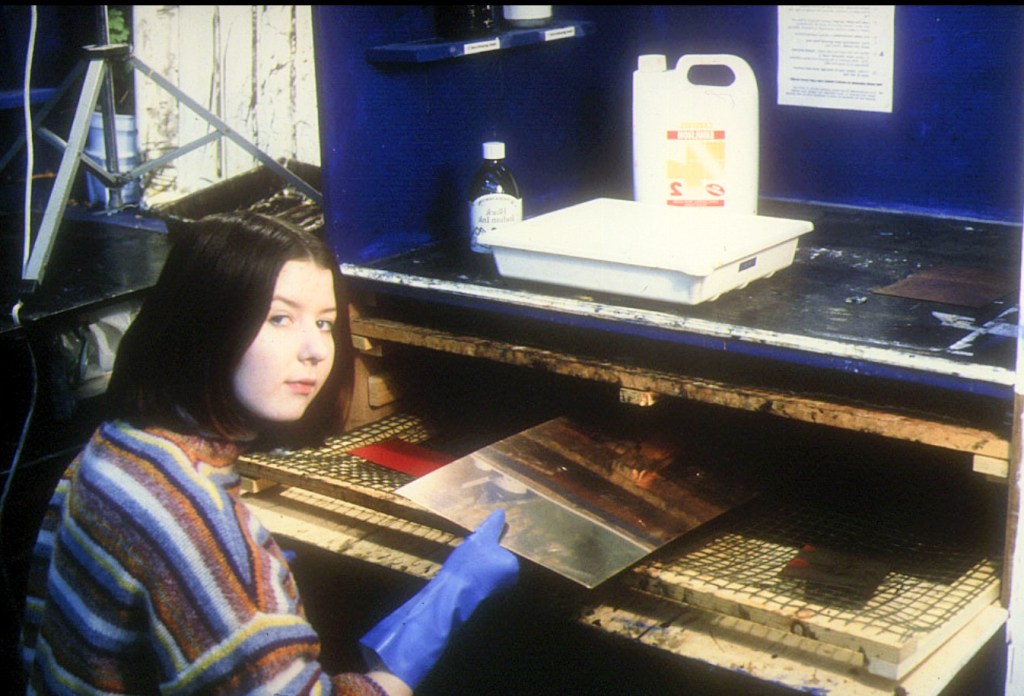
Drying cabinets can be used for drying and curing acrylic grounds as well as for drying plates after etching and stripping. An electric fan heater blows hot air into the wooden box, passing the hottest air into the plate drying compartment then cooler air into the ground-drying compartment. A bay for carrying out the application of a pour-on hard ground can be accommodated next to the cabinet so that plates can be placed straight into the drying cabinet. Many designs of drying cabinet are available and in smaller workshops, can be accommodated under a workbench to save valuable space.
FIRE HAZARD: Do not use wood to make a drying cabinet! Use circuit breakers, and have a fire extinguisher nearby
Make it from fire retardant materials such as steel plates, wire grids or plaster board.
Paper area
The paper soaking and blotting area should be fairly close to the etching press but isolated from the other intaglio processes, all of which tend to be messy. The most important items are a soaking tank large enough to accommodate large sheets of paper and a clean blotting bench. The tank can, again, be fabricated from polypropylene and should beequipped with a water supply and plug. Large sheets of Perspex/plexi/petg can also be mounted next to the sink to serve as draining boards. Excess water from the soaked paper is squeegeed off and drains back into the tank via guttering fitted at the bottom of the Perspex. A very useful item that can prolong the life of blotters is a ball rack or similar device suspended above the blotting area for hanging up damp blotters.
Photopolymer area
Photopolymer work is ideally carried out in an enclosed room adjacent to the intaglio workshop. This can be combined with a conventional darkroom but should in any case be equipped with yellow lighting. Painting the casing of existing white lighting with translucent yellow paint should suffice to create a safe light environment for photopolymer work. However, any windows must be blocked out and a lightproof curtain should be fitted over the entrance.
An exposure unit
is the main piece of equipment in the photopolymer area. In addition, a clean workbench provides space for cutting and handling sheets of photopolymer film and a larger area for developing and rinsing. The actual UV exposure unit is a cabinet with light fast doors. Beneath it there is often a storage shelf for mezzotint screens. Simple switches operate both the suction pump and the exposure. Inside the cabinet a tabletop vacuum bed with suction pump provides the exposure frame into which laminated plates and positives are inserted. The UV light source is suspended from above or mounted below. An ideal but more expensive UV exposure source is a metal halide light source used in conjunction with a light integrator. This electronic gadget allows for a very finely gauged exposure in equal light units and the metal halide lamp guarantees a fast and powerful exposure. In UV exposure units that do not have light indicators or a shutter mechanism (see below), it is vital to take the warming-up cycle of the UV bulbs into account for calculating exposure times. During this cycle the exposure times increase in a multiplied rather than an additive way. This is because the bulbs emit a more powerful UV light after say 10 minutes than after the first 10 seconds. However, once a certain warm-up phase of about 15 minutes is completed, the light emission stabilises to a constant level.
Many printmakers make very serviceable exposure units out of cheap security halogen lights or photofloods.
Watch out for updates on UV LED Curing Lights as an exposure source (many LED UV lights are suitable)
An exposure unit with a light integrator or a shutter system gives absolute control over the exposure but for many photopolymer tasks an inexpensive mercury vapour light source controlled by a simple timing device works perfectly well. Here, however, the control over the exposure is relative i.e. the warming up of the light source will only allow for approximately similar results in repeated exposures. For plates up to say A2 in size, two mercury vapour lamps wired in parallel to the same switch are sufficient but for the even exposure of larger sizes four or more lamps are required. These should be mounted above the exposure table in lightproof conditions, in an enclosed cabinet or with UV filtering curtains. A custom -built cabinet for Intaglio Type exposures can also include a simple pulley-operated shutter mechanism mounted beneath the lamps. This kind of system allows for exposure times as accurate as those possible with an electronic integrator simply by opening and closing the shutter once the bulbs have gone through their warming up cycle. For a self made exposure cabinet it is also recommended to fit an indicator lamp as part of the switching circuit so that users are warned not to open the cabinet doors when exposure is in progress. If a lot of high definition photopolymer work is to be done the best results can be achieved by equipping the exposure unit with a UV light source as fast and powerful as possible, ideally of the metal halide type. (now LED UV lamps).
Many of the components needed in a photopolymer area can be obtained cheaply on the second hand market. Due to the move to digital technology many companies in the graphics industry are disposing of reprographic equipment such as vacuum beds, contact tables and suction pumps – all of which can be easily converted into photopolymer equipment. The kind of UV plate making equipment once used by professional lithographic printers are perfect for the exposure of photopolymer plates without even needing modification.