
Respirators, Eye Protection and Gloves
Note: since the recent Pandemic the availability of some specialist masks and respirators for industrial jobs such as spray painting has experienced limitations and shortages; making it at times more difficult for artists and workers to protect themselves from airborne VOVs, noxious fumes, dusts and mists.
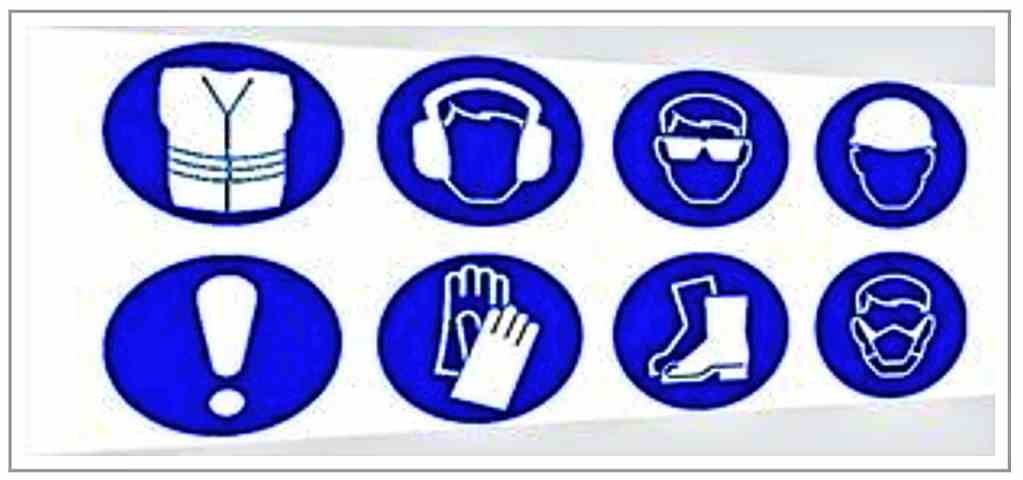
NIOSH Filters for Respirators
By Angela Babin, M.S.
NIOSH Filter Selection

National Institute for Occupational Safety and Health Standard for Filter Selection
In 1995, the National Institute for Occupational Safety and Health (NIOSH) published its revised respirator standards for particulate respirators (see NIOSH Certified Equipment List). These new respirator certification standards were
upgraded from those of Part 11 (Title 30 of the Code of Federal Regulations (CFR), Part 11) to those of Part 84 (Title 42 of the Code of Federal Regulations (CFR), Part 84), regarding filters only; the gas/vapor requirements are unchanged.
A comprehensive respirator program must be instituted prior to the use of either Part 11 or Part 84 respirators. The details of a respirator program can be found in the American National Standards Institute (ANSI) Z88.2 (1992), Practices for Respiratory Protection. The legal requirements are found in the Occupational Safety and Health Administration (OSHA) standard 29 CFR 1910.134.
This article outlines the differences between filter selection under the old standard (Part 11) and give some basic guidelines for filter selection under the new standard (Part 84).
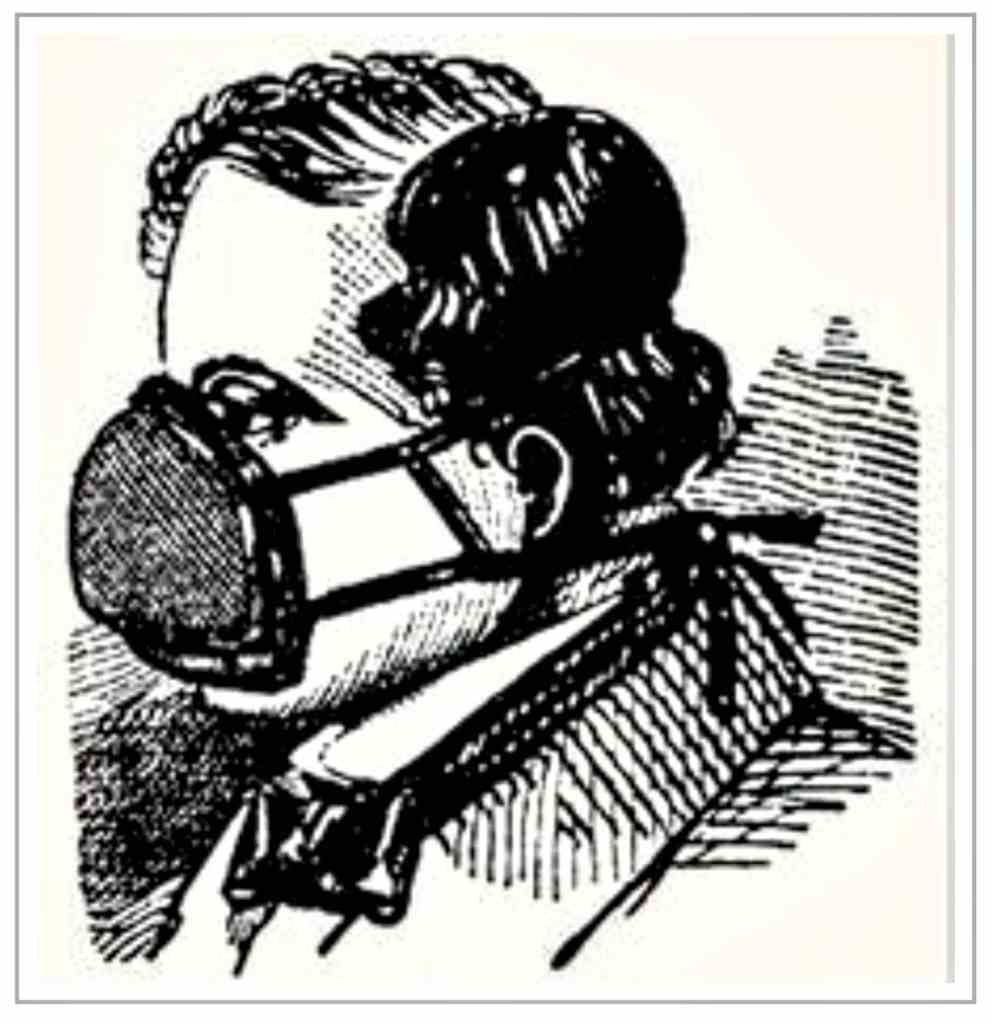
a John Stenhouse mask from 1870; useful for ‘permitting respiration in places where the atmosphere is charged with noxious gases, or vapors, smoke, or other impurities.’
Filter selection is relevant to two types of respirator use: 1) a half- or full-face air purifying negative-pressure respirator that can be equipped with both chemical cartridges and/or particulate filters; and 2) re-usable disposable masks (like the 3M 8710 toxic dust mask).
Summary of the Old Part 11 Standard
Filters under the old standard were called: dust and mist (DM), dust, fume and mist (DFM), high efficiency particulate and aerosol, (HEPA), as well as spray paint, and pesticide. The filters on all Part 11 respirators contain certification
numbers like TC-21C-xxx or TC-23C-xxx.
Dust, Mist (DM) respirators are labeled as “permissible respirator for dusts and mists or approved for respiratory protection against dust and mists having a time-weighted average (TLV) not less than 0.05 milligram per cubic meter or
2 million particles per cubic foot.”
Dust, Fume, and Mist (DFM) respirators are labeled as “permissible respirator for dust, fumes, and mists or approved for respiratory protection against dusts, fumes and mists having a TLV not less than 0.05 milligrams per cubic meter or 2 million particles per cubic foot.
High efficiency respirators (HEPA filter respirators) are labeled as “permissible respirator for dusts, fumes, mists, and radionuclides or approved for respiratory protection against dusts, fumes and mists having a TLV less than 0.05
milligram per cubic meter or 2 million particles per cubic foot and radionuclides.” The filter (or in a disposable respirator, the exhalation valve) in a HEPA respirator is usually color coded magenta (reddish-purple).
Paint spray respirators are labeled as “Permissible chemical cartridge respirator for mists of paints, lacquers and enamels or approved for respiratory protection against lacquers and enamels.”
Pesticide respirators are labeled as “Permissible chemical cartridge respirator for pesticides or approved for respiratory protection against pesticides.”
Laboratory test data indicated that some DM and some DFM respirators allow unexpectedly high penetration of particles that are 2 micrometers or smaller in diameter. Therefore, NIOSH recommends (and ANSI requires) that if the
contaminant is an aerosol, with a very small size (less than 2 microns) or of unknown particle size, a HEPA filter should be used.
Summary of New Part 84 Standard
The new “Part 84” filters must pass a more demanding certification test than the old filters. The new regulation provides for nine classes of filters (three levels of filter efficiency, each with three categories of resistance to filter efficiency degradation). The three levels of filter efficiency are 95%, 99%, and 99.97%. The three categories of resistance to filter efficiency degradation are labeled N, R, and P. N means not resistant to oil, R resistant to oil, and P oil-proof. These categories are a useful memory key.
(Actually, the “R” is as resistant to oil as the “P,” but it has a time-use limitation.)
The class of filter is clearly marked on the filter, filter package, or respirator box. For example, a filter marked N95 would mean an N-series filter that is at least 95% efficient. Chemical cartridges that include particulate filter elements will carry
a similar marking that pertains only to the particulate filter element. The filter packaging of Part 84 particulate respirators contain certification numbers of the form TC-84A-xxx.
Respirators certified under Part 11 can be sold and shipped by the manufacturer as NIOSH-certified until July 10, 1998, and can be used after this date, however OSHA has not determined actual filter use past July 1998.
Filter Selection
Users can identify three types of filters with three efficiencies each as follows:
Respirators with N100, N99, and N95 filters (99.97%, 99%, and 95% efficient filters) may be used for any solid or non-oil containing particulate contaminant.
Respirators with R100, R99, and R95 filters (99.97%, 99%, and 95% efficient filters) may be used for any particulate contaminant. If used for an oil containing particulate, a one shift use limit applies.
Respirators with P100, P99, and P95 filters (99.97%, 99%, and 95% efficient filters) may be used for any particulate contaminant. No time restrictions apply, the limitations are hygiene and breathing resistance.
No particle size limits apply to respirators with Part 84 filters. Protection for the user is based on the efficiency of the filter and the PEL of the contaminant.
Particulate Respirator Selection and Use
If you already own a respirator, but want to purchase new filters, the following guidelines will aid in your choice of filter. Using these guidelines may result in filter recommendations that exceed those actually required in a particular work
setting. (For example, because both the 99% and 95% filters outperform the DM and DFM filter classes, there may be situations where the 99% or 95% filters are an appropriate substitute for a HEPA filter). See Table 1 for filter
recommendations for specific processes.
If you are currently using a DFM or DM filter:
- In a work setting free of oil aerosols, the minimally protective filter would be an N95.
- In a work setting that may contain or does contain oil aerosols, the minimally protective filter would be an R95 or
- If you are currently using a HEPA filter:
- In a work setting free of oil aerosols, an N100 filter would be protective.
- In a work setting that contains or may contain oil aerosols, an R100 or P100 filter would be protective. The P100
filter looks exactly like the old HEPA filters – with the magenta colored casing etc.
- If you are currently using a paint-lacquer-enamel combination cartridge:
- In a work setting free of oil aerosols, a combination respirator consisting of an organic vapor cartridge and an N95
particulate filter with an optional prefilter (to prevent rapid clogging by paint aerosols) would be minimally protective. - In a work setting that may contain or does contain oil aerosols, a combination respirator consisting of an organic
vapor cartridge and an R95 or P95 particulate filter with a prefilter (to prevent rapid clogging by paint aerosols) would be
minimally protective.
- If you are currently using a pesticide respirator for protection against a particulate and an organic vapor:
- A combination respirator consisting of an organic vapor cartridge and an N95 (non-oil aerosols) or an R95 or P95
particulate filter would be minimally protective. - As another example, a particular pesticide may have such low vapor pressure that only a particulate filter may be
needed. Thus in certain situations, there may be no need for a combination particulate filter and organic vapor cartridge
as recommended above. - If the pesticide contains oil, then an R95 or P95 particulate filter would be the minimal protection.
Remember that particulate filters will not protect against gases or vapors. In the chart below, listed are both the new
filter recommendations and the chemical cartridge recommendations. Note that sometimes two filters are listed. This is
because some filter types (e.g. N99, N100) may be difficult to find on the current or future market.
Table 1. Filter and Cartridge Selection Chart
Substance of Process CartridgeFilter Aerosol Spray Cans OVN95 Air brush Water based -N95 solvent-
basedOVN95AmmoniaAN100, HEPA Asbestos-N100Dusts (Silica): clay, glazes, etc -N95Dye Powders – N95Fiberglass–
FormaldehydeFORP95Glycol Fogs (theatrical) –Hydrochloric Acid AGN95 if acid mist generated LacquersOV-Metal
grinding with no or water-based lubricant -N95 with lubricant oil -P95Metal melting -N95 Cadmium-N100
Lead- N100Metal Powders – N95Oil Mists (theatrical smoke) – P95Paint strippers (solvent type) OV-
Pastel Dusts - N95 (higly toxic metals) -N100Pigment powders -N95 (highly toxic metals) -N100Plastic, resins, and glues OV –
Plastics sanding , grinding, etc. -N95 Polyvinyl chloride AGN95 Polyeurathane* (see diisocyanate article
re:decomposition) OVN95 Formaldehyde plastics FORN95Silica-N100Soldering (lead) -N100 with acid, fluoride,
zinc chloride fluxes AGN100SolventsOV-Spraying water-based-N95 solvent-based OVN95Sulfur dioxide AG-Welding
(metal fumes only) -N95 (except lead, highly toxic metals) N100 Key A-ammonia
AG-acid gas
FOR-formaldehyde OV-organic vapor
*supplied-air recommended
Art Hazard News, Volume 20, No. 1, 1997
This article was originally printed for Art Hazard News, © copyright Center for Safety in the Arts 1997. It appears on nontoxic-print courtesy of the Health in the Arts Program, University of Illinois at Chicago, who have curated a collection of these articles from their archive which are still relevant to artists today.
© nontoxicprint | the authors, 2025
Eye and Face Protection
By Angela Babin, M.S.
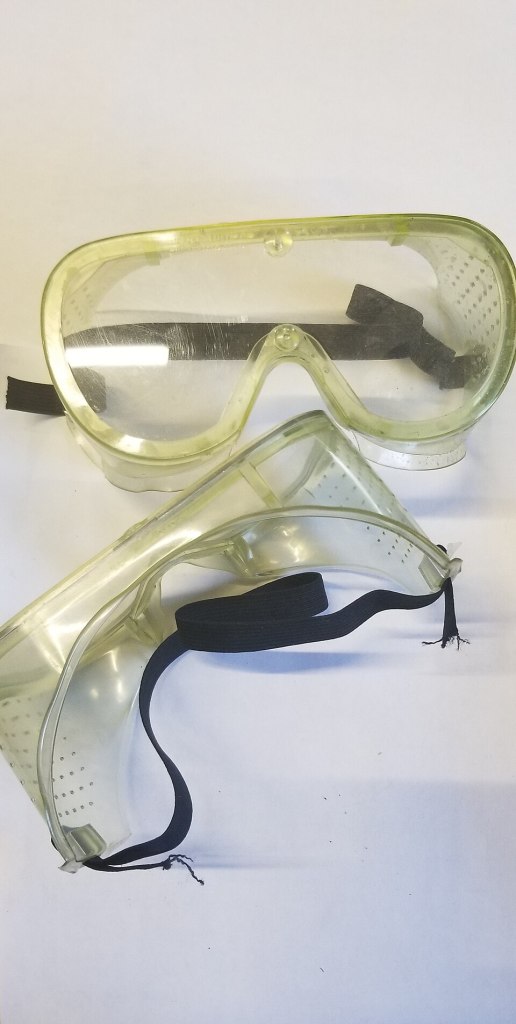
The revised American National Standard Practice for Occupational and Educational Eye and Face Protection (Z87.1-1989), was approved in February 1989 by the American National Standards Institute, Inc. (ANSI).
The eyes and face must be protected from a variety of hazards, including impact (chipping, grinding, etc.), radiation (welding, glassblowing, carbon arcs, kilns, foundries) and chemical splash (acids, caustics, etc.). Safety equipment chosen should state that it meets the ANSI standard. All eye and face protection devices meeting this standard have “Z87” stamped on them. Z87.1-1989 states that its scope applies to occupational and educational operations and processes where face and eye hazards exist, including machining, welding, cutting, chemical handling, and assembly.
(Not applicable under this standard are hazards related to x-rays, gamma rays, high energy particulate radiation, microwaves, radio-frequency radiation, lasers and masers, and sports).
There are a few revisions between Z87.1-1979 and Z87.1-1989 that are worth mentioning. There is now identification of primary versus secondary eye and face protection. Those protective devices that are secondary protectors are NOT adequate without additional primary protection. Primary protectors include spectacles and goggles. While spectacles and goggles are primary protectors, they certainly may be used in conjunction with secondary protectors such as welding helmets and face shields. Spectacles commonly protect the eye from impact and optical radiation. They sometimes are equipped with sideshields. Goggles protect the eye from a variety of hazards, and can be fitted to the eye like an eyecup, or fitted to the eye area on the face. This second type can be used in conjunction with spectacles worn underneath.
Face shields cover the whole face by means of headgear, and, as mentioned above, need to be used in conjunction with either goggles or spectacles to provide adequate protection. Similarly, welding helmets and hand shields provide
additional protection from optical radiation and impact.
Z87.1-1989 has specific considerations concerning the ability to both remove and clean lenses or windows, optical requirements, flammability resistance, corrosion resistance, prescription lens, fit, ventilation, and lens shade and
transmission for all four types of eye protectors. CSA’s revised data sheet Eye and Face Protection will itemize and include this information in table form.
Z87.1-1989 also has instructions on use and maintenance, and a description of the tests that were conducted to account for recommendations and requirements.
The old standard, Z87.1-1979, included a table on the choice of filter lens shades. Different lens shades were specified for different welding and cutting operations. While Z87.1-1989 provides almost exactly the same ranges of lens shades
for the same operations, the table with exact shade number recommendations is deleted. In discussing the table with the Z87 chairman, it seems that the Z87 Committee felt that it was impossible to specify each situation because of the
great variation in welding processes.
They determined that if one selected a lens that was appropriate for the operation being done and the one with the darkest shade possible, safety conditions would be met. For more detailed itemization for welding procedures, one can consult ANSI Z49.1-1988 Safety in Welding and Cutting. There is a decrease in the shade number recommended for soldering; in Z87.1-1989, a lens shade from 1.5-3 is adequate, while previously a range from 3-4 was the shade recommended.
The Occupational Safety and Health Administration (OSHA) includes in their proposed Personal Protective Equipment Standard (CFR 1910.133) a table much like the previous ANSI table of filter lens shades for protection against radiant energy. The adoption of this table was due to its practical format and easy readability. The only change between the proposed OSHA table and the old ANSI table is the decrease of the minimum lens shade recommended for soldering.
OSHA suggests a shade number of 2, decreased from the previous ANSI minimum level of 3.
Infrared radiation is not specifically addressed in the new ANSI standard. In Table 1, which lists transmittance requirement for clear lens and general-purpose filters, there is a column for maximum infrared transmission, with lenses ranging from 25% transmission to a low of 0.3 transmission. Infrared transmission decreases with shade number. For looking in pottery or enameling kilns, use eye protection with a shade number between 1.7 and 3. For glassblowing and foundry work, a shade number of 3 is often used. Again, select the darkest lens or filter shade possible that allows accurate vision to meet safety conditions for both shade number and infrared transmission recommendations.
Consult CSA’s revised data sheet on eye and face protection or ANSI at 1430 Broadway, New York, NY 10018 for more
information on this topic.
Art Hazard News, Volume 12, No. 9, 1989
This article was originally printed for Art Hazard News, © copyright Center for Safety in the Arts 1989. It appears on nontoxic-print courtesy of the Health in the Arts Program, University of Illinois at Chicago, who have curated a collection
of these articles from their archive which are still relevant to artists today.
© nontoxicprint | the authors, 2025
——-
Glove Selection
Selection of appropriate protective Gloves
Many acids, solvents, and other liquids found in art, craft, theater, and conservation materials are capable of damaging the skin. Dermatitis is the leading industrial disease, and solvents and lubricants are the two types of chemicals responsible for this disease.
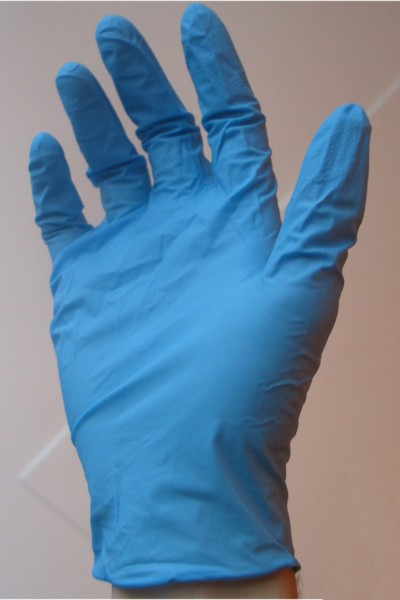
Choosing the right glove for different uses can be difficult since there is such a variety of plastic and rubber gloves on the market and they all have different properties. There is no one type or brand of glove that is resistant to all kinds of
liquids: one brand might be able to resist turpentine, but will dissolve in xylene, while another brand may do the opposite. Appearances are deceptive – gloves that may seem resistant to a liquid can actually allow permeation of the substance’s vapor. Dishwashing and surgical gloves almost never protect wearers against the solvents and acids found in many art materials.
Solvent Penetration
Liquids, especially solvents, may penetrate gloves either in liquids or gas form (as vapors). In liquid form, solvents can cause some glove materials to dissolve. This is usually apparent to the wearer as the gloves soften and disintegrate.
Concentrated solutions (eg concentrated acids) will penetrate gloves faster than dilute solutions. Gloves made by dipping the hand mold into a solvent-based solution are more resistant than gloves made from latex solutions. Obviously, the thicker the glove, the more resistant it is. Other factors such as heat and abrasion will also adversely affect glove performance.
Vapor penetration or permeation of gloves is more difficult to detect and may leave the glove unchanged in appearance. Instead, they must be obtained through direct experimentation.
Selection of Gloves
Glove selection begins with knowledge of the chemical composition of your materials. A Material Safety Data Sheet (MSDS) — now SDS– with the listing of ingredients can be obtained from the manufacturer.
Glove charts from safety supply distributors list chemical resistances rated on performance under ordinary conditions. For gloves used in special circumstances, such as with heated solutions or with abrasive action, it is recommended that
you consult the manufacturer or test the glove in its particular application to ensure suitability.
Gloves are available in various sizes and lengths, and it is important that the glove fit well. Make sure you select a glove of sufficient length to adequately protect your hand and forearm while working. As regular cleaning and drying of your
gloves is necessary to maintain them, you’ll need a spare pair while your regular gloves are begin cleaned.
Types of Glove Material
It is important to remember that glove performance varies between manufacturer even if the actual glove material is the same. Therefore, each chemical resistance chart is supplier-specific.
E-Excellent
P-Poor
G-Good
NR-Not Recommended
F-Fair
-Information not Available
Natural Neoprene
Buna-N Butyl PVC PVA Polyethylene Nitrile Rubber Chemical
Mineral Acids
Hydrochloric Acid
G E E G G P G E Organic Acids
Acetic Acid
E E E E E F E G Caustics
Sodium Hydroxide
E
E E E G P E G
Alcohols
MethanolE E G E E F E E
Aromatics TolueneP F F F P P EE
Petroleum NapthaE E E F P P E E
Ketones Methyl Ethyl Ketone
G G F E NR F G F
Chlorinated Hydrocarbons
Perchloroethylene
NR F F NR NR E G G
Glydol Ethers*
CellosolveG F – – F E G P
Miscellaneous
Lacquer thinner
F NR NR F F E F FBenzene
NR P G NR F E F G
Formaldehyde
E E E E E P E F
Ethyl Acetate
F G F G P F G F
Vegetable Oil
G
EE G G E E E
Animal Fat
P E E G G E E E
TurpentineF G E F F E G E
Phenol
F E G G G P E NR
Physical Performance
Abrasion Resistance
F G G G G E E
Cut Resistance
EEG
FEFE
Puncture Resistance
E E G G F E E E
Heat Resistance
EE F P P
F P FFlexibilityF G F G F F G GDry Grip
E G G F E E G GWet Grip
GFGF
EEGF
*from glove manufacturer data
PVC Polyvinylchloride
PVA Polyvinylacetate
Full Site Map: a l l p a g e s / t o p i c s
Art Hazard News, Volume 11, No. 4, 1988
This article was originally printed for Art Hazard News, © copyright Center for Safety in the Arts 1988. It appears on nontoxic-print courtesy of the Health in the Arts Program, University of Illinois at Chicago, who have curated a collection of these articles from their archive which are still relevant to artists today.
© nontoxic-print | the authors, 2025