
by Friedhard Kiekeben, in dialogue with the artist Angela Zammarelli

A.Z., To Be So Good, Drypoint in food container printed on Kitakata paper image 14″x14″ paper 20″x17″, 2024
In 1951 Tetra Pak is established in Lund, Sweden by Dr. Ruben Rausing with the introduction of the first, classic tetrahedron-shaped paper-based carton package for milk. (image: Wikipedia)
Since then tetrahedron-shaped and square shaped Tetra Pak drinks and food packages became ubiquitous around the world. More recently, the multi-media artist and printmaker Angela Zammarelli found a way to recycle discarded product packages and use them as a printing plate for unique or limited edition intaglio prints.
Far from being a gimmick, the process produces finely reproduced high quality prints (with the look of Rembrandt etchings) while creating an intimate connection between the artist and everyday items that we often consume and discard without deeper consideration of the cycles of materials that are coming from and are then returning to nature, one way or another.
The multi-facetted art practices of Angela Zammarelli make humble use of everyday, functional or discarded objects, fragments, and contexts and turns them into newly animated, dreamlike compositions that are just as much an homage to the automatic practices of the surrealist movement as they are a product of our current postmodern, post-pandemic, fragile reality.
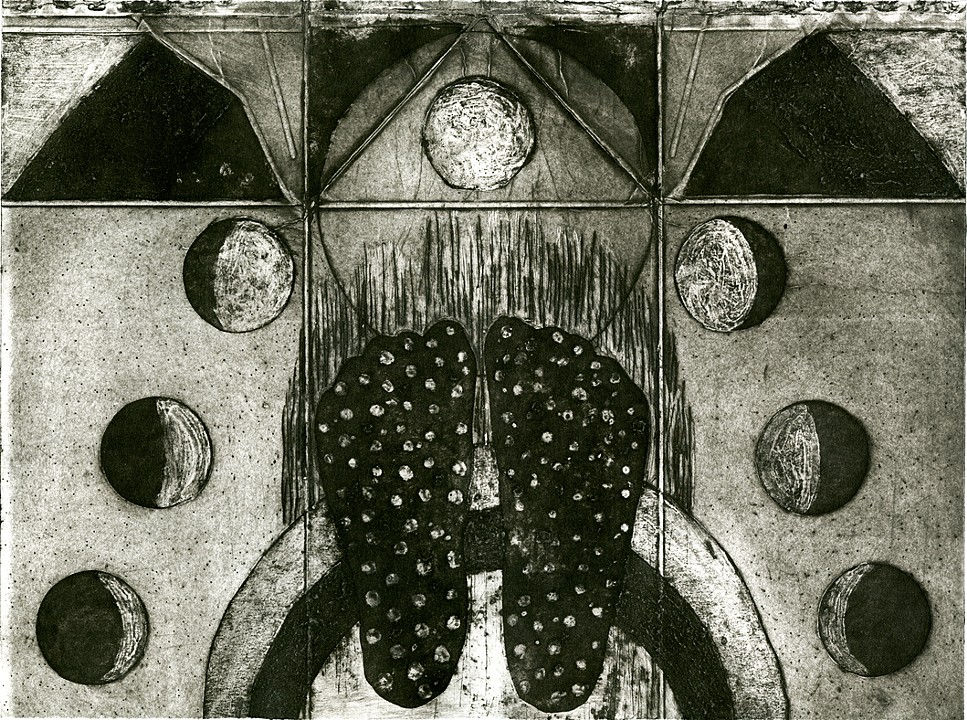
Phases, Drypoint and acrylic medium in beverage carton printed on Magnani Incisioni, 15″x11″, 2024
In his ‘Manifesto’s of Surrealism’ André Breton wrote:
“Everything tends to make us believe that there exists a certain point of the mind at which life and death, the real and the imagined, past and future, the communicable and the incommunicable, high and low, cease to be perceived as contradictions.”
More recently, the multi-media artist and printmaker Angela Zammarelli found a way to recycle discarded product packages and use them as a printing plate for unique or limited edition intaglio prints. In 2014 she had been introduced to the concept by the artist Chloe Wilwerding when they both were interns at Zea Mays Printmaking. She tucked it away in her brain while working on other projects. Then in 2018 she really began to dive into the process.
Angela Zammarelli writes: “My materials are gathered from daily occurrences. Be it scraps from jobs or picking through free piles on a walk, I look to some level of chance curating, thriftiness, and ecological concerns to inform my work and material choices.” These ready made materials then serve as a rich resource from which new life and meaning might spring, through careful juxtaposition of materials, such as panels of wood veneer merged with carefully objects knitted carefully in a rainbow of colors.
Sometimes the work explores a darker dimension, for instance in the installation piece ‘Ghostmakers habitat’ which unmistakingingly evokes the look of the kind of camouflaged military shelters that one might find in the war zones of Eastern Ukraine, with all its deadly shock and horror. In spite of the tragic location the ‘Ghostmakers Habitat’ is a surprisingly friendly location (‘you are always welcome’) that is illuminated with candle light and beautified through the careful addition of knitted rainbow circles.

About ten years ago Angela started exploring the use of unusual printing substates when she made works such as the collaged book ‘This will not keep you warm’.
More recently the artist started making use of discarded food cartons and packaging — such as TetraPak milk cartons — in order to clean these up and then use them as a the printing plate for professional intaglio printing, instead of using the traditional and resource intensive materials from copperplate printing. With this new practice of TetraPak printing the emphasis is not on commercial reproducibility of a printed work of art, (think of Rembrandt’s rarified and expensive The ‘100 Guilder Print’, executed in etching and drypoint), but on a private meditation of finely incised drawing into a piece of cast away material, which then comes to life in a single or small number of impressions that the plate can yield.
The artist carefully developed a canon of key elements, images, and symbols, which frequently recur and recombine in collages, books, installation, drawings and printed works. The canon of elements includes: images of moon cycles, hands, eyes, beads, squares and circles, wood veneer, spiders, leaves and flowers and many kinds of repeated forms such as fields of stippled marks, dashes or bundles of lines and accumulations.
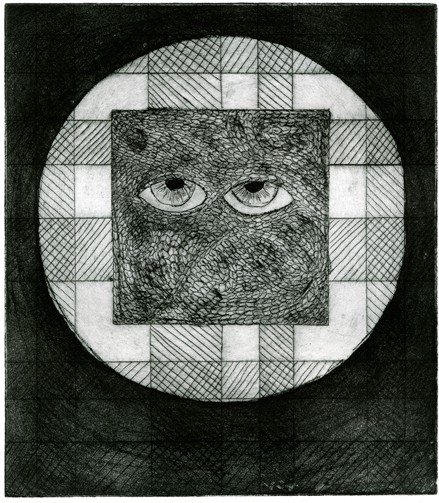
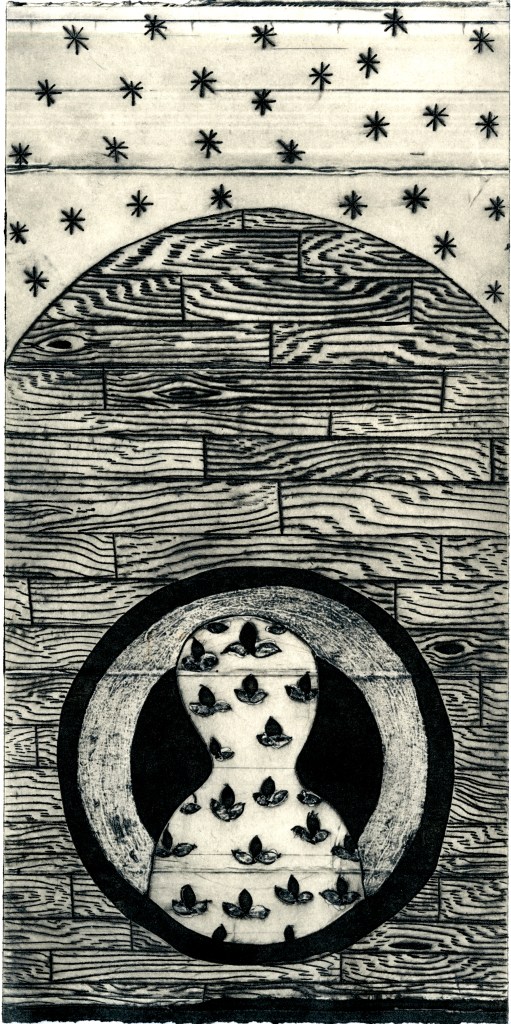
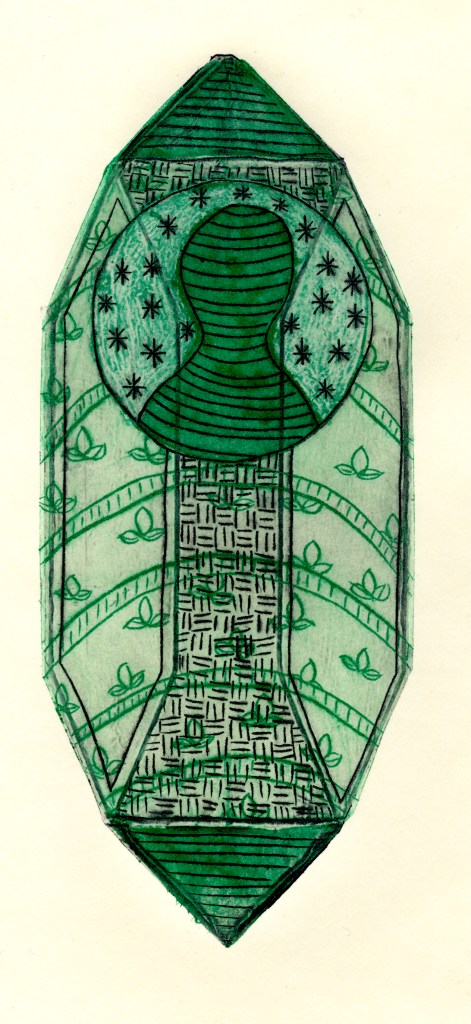
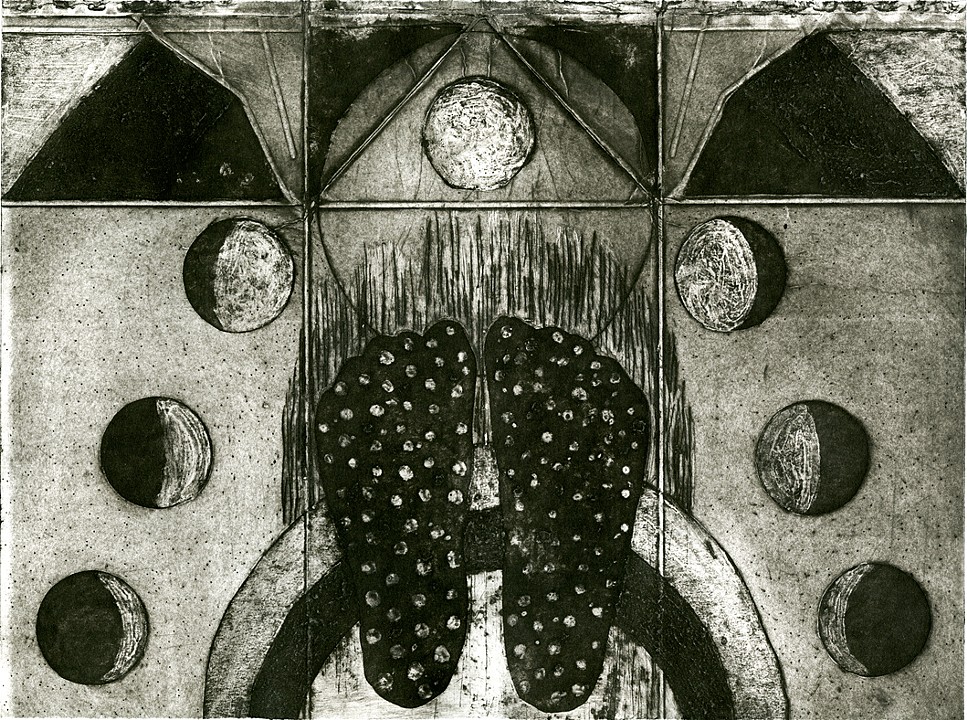
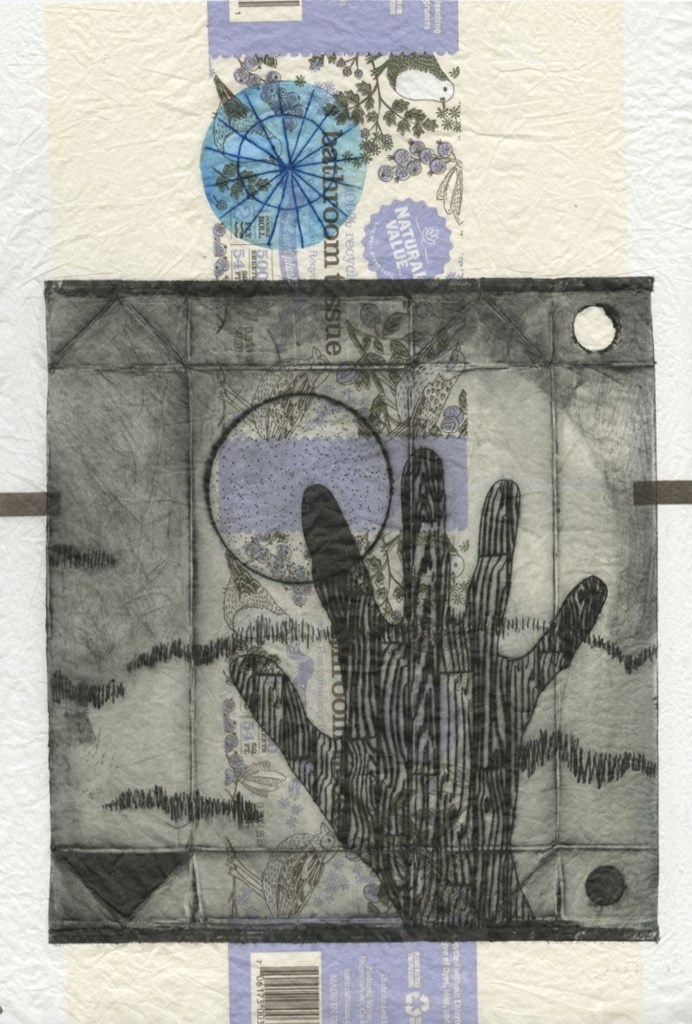

Selected Tetra Pak Intaglio Prints
THE TETRA PAK PROCESS
Angela Zammarelli kindly shared some thoughts on the process of working with product packaging and Tetra Pak plates in intaglio printmaking:
How does one source and prepare the plates from cartons?
Source: I really just use cartons from my family’s recycling bin and trash. I don’t go out of my way to purchase the materials. When looking at layered paperboard packaging I check out what the shape is and how it might have been folded and also what does the coating feel like. Side note: This is why I started really diving into printing with Tetra Pak. My family has access to glass bottles of milk so we don’t very often purchase the disposable cartons (you pay a deposit on the glass bottle and return it for a refund). At the beginning of the Covid-19 Pandemic the company had to pause using the glass and switched over to recyclable/disposable packaging. We also would purchase almond milk in Tetra Pak boxes. I had played with it before but this became a steady stream of good material. I started opening anything that is laminated paperboard to see if it would work. People often save cartons for me, which broadens the type of packaging I come into contact with and is really lovely. I like that they will clean and hold on to their trash in order for me to make a print. *I have not done this because conceptually it is not in line with why I am using the cartons but sometimes a company will have a misprint and I believe it would be possible to source the misprinted material and use it before it has been folded. This would give the artist a larger uninterrupted strata to work with.
Process: I will save pretty much anything with a layered paperboard at least once to see if it is a good match for what I am working on. Coffee cups, chip tubes, food trays, and beverage cartons. My partner Josh often washes the cartons and dries them for me which is just a small testament to how much he supports my practice. Then I will store the materials flat until I am ready to use them. Before I begin to mark up the plate I will give it a good wipe with an all purpose cleaner. Next I will either use the shape of the open carton as is or I will cut it to the shape I want using scissors or an x-acto knife. Sometimes I will transfer a drawing to the surface of the plate. Then I will begin drawing into the plate with an etching needle. I use stencils and steel wool to create midtones and I will delaminate the carton to achieve rich tonal areas. Sometimes I will use mediums to create different tonal qualities, specifically light tonal areas.
Which drypoint tools are suitable ? I mainly use an etching needle tool and steel wool but also will use pins, thin metal, wire brushes and sandpaper. Sometimes I will run the plate through the press to emboss sandpaper shapes and or other sturdy thin items (netting from produce)
How many proof prints can a plate yield? This depends, I have pulled an edition of 27 and a total of 32 prints off of a plate. I was careful how I created the plate though. There are things that will make a plate break down faster which is fine if you are producing monoprints off of the same plate but if you want an edition could be annoying.
What kind of inks and paper do you use? I am using akua intaglio ink and for paper Magnani Incisioni, Arnhem, Kitakata, toilet paper wrappers, I just got a tube of the Cranfield
Do you use low pressure intaglio? I am not quite sure what this means but at the studio I set the pressure on the press the same as for PETG plates which is a hair thicker than the copper we use at ZMP
Do you need a press for printing, or could it be spoon printed, or printed using an Akua pin press? I do use a press since I have access to some at ZMP but you can hand print with a barren or spoon. For hand printing I would suggest using a thin Asian paper or thinner western etching paper. It is amazing what Kitakata and Mitsumata papers will pick up when hand printing.I have never printed with an Akua pin press but from watching videos of people using them I imagine they could work.
Loose thoughts on content: The imagery I pull from is mainly from an imagined domestic space. I think since things are never really posited in a fully fleshed out setting that the pieces are in a morphing state. Just glimpses into space that keeps changing. Disembodied hands, feet, and eyes trying to find a place to be. I use floor boards and braided rugs often for grounding. I think a lot about being on the ground, how things and beings touch the ground.
Angela Zammarelli, Artist Homepage
the artist also works at Zea Mays Printmaking