
book by Keith Howard, NY, 2003
Forword (book extract)
by Friedhard Kiekeben, 2003
Intaglio Manual : Metals | Plate Preparation | Hard Ground | Orono Ground (soft)| Aquatint | Dry Techniques | Intaglio Printing | Collagraph | Acrylic Wash | Mark Making | Preparing for Etching | Stripping | The Acrylic Resist Etching Workshop | Color Printing
Printmaking involves processes. And where there are processes there are always inventors. Printmaking involves technology and where there is technology there is always room for improvement. The history of printmaking is a history of aesthetics, invention, and perfection -not only in technical terms but also conceptually. Whereas a canvas is always a canvas and the actual practice of painting has changed very little in many centuries the practice of printmaking has been accompanied by continuous development, and more recently by major re-invention.
When Rembrandt wanted to etch crisper lines he invented his own mordant. When Goya wanted tonal richness in a print he perfected aquatint. Andy Warhol was innovative not only by choosing a contemporary medium, silk screen printing, but by centering his entire art around the notion of the reproduced image.
Although fusing art and invention, until recently the art of printmaking had an unhealthy association with a whole range of potentially harmful materials and processes. The powerful fumes of acids, varnishes and solvents were the unfortunate byproduct of this artform. Most technical innovations in intaglio printmaking originated in the 16th and 17th century, when Rembrandt, Goya and their contemporaries researched and established the traditional etching materials and processes from resources available to them at the time. These basic ingredients were used in recipes that went unchallenged until the late twentieth century.
Other major forms of printmaking which were devised and developed, including fine art lithography and screen printing, expanded the creative scope of the medium but also contributed more chemical hazards to an already extensive list. The hydrocarbon solvents introduced into printmaking in the mid 19th century as general cleaning and thinning agents became a new and potent health risk. The only real option for safety conscious artist printmakers and professio workshops was to attempt to control the vario hazards by using protective equipment such vapor masks and fume extraction systems. The first significant breakthrough came in mid-eighties when a Swiss manufacturer of a paints developed a screen printing system b entirely on water based acrylic materials whits.; no longer necessitated the use of any organi0 solvents, whilst producing quality results.
Some other manufacturers offered similar systems, in the following decade water based screen; printing found widespread acceptance in art education.
A healthy fusion of art and invention
Keith Howard was the first artist to systematicall investigate alternative methods in intaglio printmaking in the late eighties. After suffering from ill health (attributed to printmaking hazards), Howard realized that Rembrandt’s medium was in urgent need of modernization. Initially he developed a gelatine based alternative to toxic photo etching which gave photo reproductive quality whilst being safe to use. But Keith Howard was aiming to find comprehensive set of all intaglio methods including manual etching, which would eliminating the airborne fumes and other hazards of the old system. He started with the basic assumption that acrylics might make a suitable alternative to solvent based varnishes of traditional intaglio. After experimenting with a range of alternative products Howard found ways to • use these as etching resists for all major processes, such as hard ground, stop out, and aquatint. In 1991 he published his first book ‘Safe Photo Etching for Photographers and Artists’ and embarked on a world wide workshop and lecturing program to outline his innovations.
Keith Howard demonstrated the potential of non-toxic intaglio approach to the Edinburgh Printmakers staff during a workshop in 1994. EPW already had a history in non-toxic developments, as they had been the Pioneers of INTAGLIO TYPE & ACRYLIC RESIST ETCHING and the professional print studio in the UK to embrace water based screen printing. I had just completed a program of research at the RCA in London, and was then invited by Edinburgh Printmakers to become their dedicated research consultant for `Safe Etching’. When I first met Keith Howard during a workshop in Northern England there was a real buzz amongst the participating group. In his enthusiastic Australian manner Howard demonstrated an intaglio method which looked so alien to the usual acid etching approach that I was simply stunned.
Two weeks earlier he had been introduced to an etching resist called `Riston’, a product from the circuit board industry. Instead of using this to etch metal Howard simply exposed the photo-polymer emulsion to a random dot screen and then to a tonal positive, which could be hand drawn or photographic. He then developed the plate in soft water, and produced printed images of stunning clarity directly from the film surface. This was the birth of the ‘non-etch etching’. Arguably, non-etch photo polymer printmaking, or Intaglio-Type as this medium is now called, is one of the great innovations in 20th century intaglio printmaking. This safe and straightforward process greatly expands the creative possibilities of intaglio, and is now used by many artists who are working with photo reproductive and digital approaches, or indeed with direct drawing techniques. Photographic imagery acquires a new dimension through the depth given to it by this new intaglio process.
In my own research program I was aiming to extend the range of acrylic resist mark-making and etching methods, and in collaboration with Keith Howard the generic term ‘Acrylic Resist Etching’ was coined. I was looking for processes that would allow the various intaglio metals to be etched without the hazards of strong acids. Keith Howard had already improved the usability of ferric chloride as an ctchant for copper by using agitated tanks, In 1997 I invented the Edinburgh Etch which solved the sedimentation issue that normally hinders this electrochemical process. Publications in Printmaking Today and in Keith Howard’s seminal manual ‘Non-toxic Intaglio Printmaking’ in 1998 aided the rapid dissemination of the Edinburgh Etch throughout the printmaking world.
Around that time the electro etching expert Cedric Green started to promote a copper sulphate based process, ‘The Bordeaux Etch’, for etching zinc and steel on his web site, and Bader and Semenoff published similar research in 1998. A new copper sulphate based solution, the ‘Saline Sulphate Etch’ is described in this book. The complete system of innovative etching solutions is now called ‘Metal Salt Etching’ and is recommended by the Rochester Institute of Technology chemistry professors Dr Paul Craig and Dr Paul Rosenberg as a contemporary alternative to Acid Etching.
While the acrylic resist etching methodology started as a safer alternative to the traditional methods – which it rivals in terms of quality – it is now widely recognized as a field which actually offers a whole range of new creative possibilities not previously thought possible. This includes a wealth of painterly and textural processes, modulated aquatint and the unique combined intaglio and collagraph approaches. Acrylic resists facilitate a more painterly pictorial language than their oil based counterparts, while also satisfying the needs of line based etchers. Rather than losing some of the essential imaging possibilities of etching, as was initially feared by some printmakers, the new approach has been shown to fully retain the unique vocabulary of intaglio, while extending it and making it a new option for 21st century art.
The need for non-toxic etching materials has also been recognized by the art materials industry, a number of paint and ink manufacturers are now offering acrylic resist etching grounds but still require patience in the inking and wiping process.
The New York artist Susan Rostow was recently awarded a Krasner Pollock award for her innovative ink developments. Her soft, gum based inks allow intaglio plates to be inked and printed with much greater ease than conventional inks.
Innovation can be costly but non-toxic developments have proved to be economically viable too. The initial investment in new or refurbished facilities for acrylic resist etching is often quickly recouped by reduced running costs. An expenditure calculation carried out at EPW in 1996 (after the change to non-toxic processes) showed a 40 % reduction in the annual consumable cost of the print studio, amounting to thousands of pounds worth of savings. Non-toxic practice can also attract new sources of funding; Prof. Susan Grote at the University of Maine received a major increase to her printmaking budget in support of her efforts to reduce health hazards.
Perhaps the most resistance to healthy innovation has come in lithography, but now acrylic resist etching and water based screen printing have shown that the aesthetic qualities of lithography can be easily emulated. The comparative slowness of non-toxic developments in lithography caused many workshops to eliminate Senefelder’s printing chemistry from their program. However, a number of recent innovations now make it possible to practice lithographic printing safely. In 1991 Nik Semenoff refined ‘Waterless Lithography’ in which silicone is used as an ink repelling substrate, but the process required acetone as a solvent. In the spring issue of Printmaking Today 2000 the Tamarind master printer Ross Zirkle reported that waterless lithography used in conjunction with a new kind of water based ink can now be practiced as a non-toxic medium in which no organic solvents are used.
George Roberts, a lithographic artist and university professor, pursued a different line of investigation in the mid 1990s. Roberts was Keith Howard realized early on that new knowledge would have to be shared and communicated as widely as possible for the non-toxic approach to gather momentum. The publication of books, magazine articles, and web sites are all important, but nothing is as effective or persuasive as the practical knowledge gained from hands on demonstrations and teaching sessions.
Intrigued by the polyester plate process widely used in India as a low cost commercial printing option. He managed to develop a system in which polyester plates are used as the matrix in a new lithographic medium he called polyester plate lithography. This process is characterized by three main factors: it is much safer to use than conventional lithography, it fully incorporates the various mark making options typical for the medium, (such as ink washes, lines, and crayon marks), and is much easier to master. It also integrates effortlessly with photography and digital imaging as plates can be produced straight from any laser or inkjet printer. George Roberts summarized his ground-breaking research in his book ‘Polyester Plate Lithography’ in 2001. but sadly died of cancer soon after its publication. A major international exhibition of non-toxic prints ‘Re-Imaging the Multiple’ is currently touring the world in honor of George Roberts.
Encouraged by the success of his travelling workshop sessions Howard set up a professional summer school in, Alberta, Canada, in 1993. (This was also the location of his academic program at the Canadian School for Non-Toxic Printmaking). At the same time I created a UK based program of educational events in collaboration with Robert Adam, then director of Edinburgh Printmakers. Both these programs were well subscribed and proved pivotal in attracting key printmaking educators from around the world to the new methodology. Many participants subsequently changed over their home printmaking departments and became ambassadors for the new approach.
Corrosive Metal Salts – Etching without Acid
In Acrylic Resist Etching, metal plates are etched in metal salt solutions rather than acids. Since the first publication of the Edinburgh Etch process in 1997, I have been able to further develop, test and refine a whole range of new metal salt etching processes forall metals commonly used in intaglio printmaking and for sculptural plate-making, The system comprises specific metal salt solutions for the fast and accurate erosion of copper, brass, zinc, steel, and aluminum. All of the etching processes siven below are compatible with the entire range of acrylic resist mark making methods, such as hard ground, stop out, or aquatint.
The benefits of this new etching methodology over the traditional acid etch approach are compelling, both in environmental terms and in regard to the superior quality of bitten work, Metal salt etching comprises two basic kinds of process: The Edinburgh Etch and The Saline Sulphate Etch. The Edinburgh Etch (© FX. 1997), suitable for copper, brass and steel, consists of solutions of ferric chloride and citric acid or sodium chloride, while the new Saline Sulphate Etch (© F-K. 2002), designed for biting zine and aluminum, comprises solutions of a copper sulphate and sodium chloride mixture. Due to their low hazard rating, the metal salt etching methods are both suitable for use in a professional printmaking environment ‘as well in an artist’s personal studio.
Cause and Effect
Traditional acid etching processes produce significant amounts of toxic fumes. In the commonly used nitric acid etch, for example, the nitrous gases produced are suspected of causing eye, nerve, lung, and kidney. damage, as well as impotence and genetic defects; in contact with chlorine-based cleaning products, nitric acid can even tum into mustard gas! In industry today: regulations prohibit the use of nitric acid wathout fully extracted and filtrated glove units similar to those used in the nuclear industry. Regrettably, despite these compelling facts, many artists, workshops, and printmaking departments maintain that their existing measures provide adequate protection.
Safe and Simple
By contrast the Metal Salt Etching system is free from harmful gas emissions. During etching, the chemical reaction by-products are contained ‘within the etching solution without polluting the ‘workshop atmosphere. The processes are not heat generating, and no vicious reactions can occur uring the etching of a plate. So inert are these processes that extraction and / or containment can be seen as additional safety measures rather than essential requirements. A further benefit is that the superbly accurate etching properties of the metal salt solutions remain constant throughout their usable life, without the gradual deterioration that causes unwanted foul-biting and undercutting ~ a common feature with the use of conventional acid solutions.
Nevertheless, no new printmaking process, however safe or simple, would be worth its salt if the results did not equal or exceed those produced by traditional means. Perhaps, the most exciting fact about the Edinburgh Etch and the Saline Sulphate Etch is that the results are startlingly good — biting plates quickly and cleanly.
Ferric chloride also commends itself because it ives off no tori vapors, neither by itself nor daring eiching; iis low-hazardous in occasional fontact with skin and is not readily volatile if coidentally spilled in the workshop. Why, then, hus ferri not always been used as the prevalent qordant in etching? The answer lies in the speed and ease of biting. The way ferric was used in the past meant that etches of a reasonable depth, as are typically required in the intaglio medium, took a very long time to accomplish, and the methods employed were often cumbersome and inefficient.
Cause and Effect
Traditional acid etching processes produce significant amounts of toxic fumes. In the commonly used nitric acid etch, for example, the nitrous gases produced are suspected of causing tye, nerve, lung, and kidney damage, as well as impotence and genetic defects; in contact with chlorine-based cleaning products, nitric acid can even turn into mustard gas! In industry today, regulations prohibit the use of nitric acid without ‘fully extracted and filtrated glove units similar to hose used in the nuclear industry, Regrettably, despite these compelling facts, many artists, workshops, maintain that their existing measures provide adequate Protection.
Safe and Simple. By contrast, the Metal Salt Etching system is free from toxic gas emissions. During etching, the chemical reaction by-products are contained within the etching solution without polluting the workshop atmosphere. The processes are not heat generating, and no vicious reactions can occur during the etching of a plate. So inert are these processes that extraction and / or containment can be seen as additional safety measures rather than essential requirements. A further benefit is that the superbly accurate etching properties of the metal salt solutions remain constant throughout their usable life, without the gradual deterioration that causes unwanted foul-biting and undercutting — a common feature with the use of conventional acid solutions.
Nevertheless, no new printmaking process, however safe or simple, would be worth its salt if the results did not equal or exceed those produced by traditional means. Perhaps, the most exciting fact about the Edinburgh Etch and the Saline Sulphate Etch is that the results are startlingly good — biting plates quickly and cleanly.
Solving the Issues of Ferric
A solution of ferric chloride salt crystals has long been valued by etchers as the most accurately biting and controllable etchant for copper plates.
Ferric chloride also commends itself because it gives off no toxic vapors, neither by itself nor during etching; it is low-hazardous in occasional contact with skin and is not readily volatile if accidentally spilled in the workshop. Why, then, has ferric not always been used as the prevalent mordant in etching? The answer lies in the speed and ease of biting. The way ferric was used in the past meant that etches of a reasonable depth, as are typically required in the intaglio medium, took a very long time to accomplish, and the methods employed were often cumbersome and inefficient.
Saline Sulphate Etch for Aluminum
Due to its softness and its coarse atomic structure, aluminum is somewhat less suited for intaglio printing than other kinds of metal. However, since aluminum plates are cheaply available from sheet metal merchants, many printmakers use them for straight drypoint work or as a substrate for ImagOn but, formally, the lightweight metal was rarely used for etched intaglio.
Using the following Saline Sulphate Etch solution, however, does provide benefits and features that are unique to aluminum etching. With the exception of copper, all metals build up a certain surface roughness during etching, which translates into more or less printable tones. Usually, aquatint has to be used in order to fill open areas on the plate with durable tones or a black. The Saline Sulphate Etch for aluminum is fundamentally different. During etching, a very distinctive surface roughness occurs in the open areas of the plate which can be compared to a hand-made mezzotint. This crystalline texture can produce a beautiful black on the print all by itself. As a consequence, there is no such thing as ‘open bite” in this process since all bitten areas become carriers for etching ink, thus enhancing the graphic potential of the process:
Unusually, neither of the basic components of this Saline Sulphate etch, i.e. copper sulphate and salt, have any corrosive effect on the metal by themselves. But etching becomes possible in a combined solution containing, at least, double the amount of sodium chloride than the amount of copper sulphate. While all other metals easily erode as long as they are grease free, the surface of aluminum plates also needs to be evenly abraded with fine steel wool to create an etchable surface.
This should be done before any acrylic grounds are applied to the plate. As with the zinc process, the Saline Sulphate Etch for aluminum involves the production of a very loose coppery sediment which floats to the surface and should be removed regularly. However, the continuous rising of quantity of a minute quantity of hydrogen bubbles also indicates that etching is in progress. For disposal, proceed as with the Saline Sulphate Etch for zinc.
Saline Sulphate Etch for Aluminum
[1] 70 gms copper sulphate.
[2] + 140gms sodium chloride (salt).
[3] + 1 litre water.
(Multiply these quantities by the same factor to make up larger amounts.)
TIP: When stripping acrylics off an etched aluminum plate, ensure that plates are not left in the soda ash stripping solution too long as this would result in further corrosion,
Disposal or Recycling of a Saline Sulphate Solution
The liquid component of a spent solution can be neutralized with sodium carbonate, diluted with plenty of water and then discarded. The surplus crystalline residues will remain at the bottom of the tray when the liquid is carefully decanted into another vessel. These can then be collected and kept in a sealed container. Once a container is filled with solid metal compounds it should be disposed off as chemical waste.
A different kind of saline sulphate etch for zine and aluminum was outlined by Semenoff and Bader in the journal LEONARDO, Vol. 31, in 1998, This solution has a small salt content and is acidified with sodium bisulphate. In the same article, the authors suggest that a spent copper sulphate based etching solution such as the Saline Sulphate Etch can be reactivated by mixing it with sodium bisulfate which has a low hazard rating. Over a few days, the bath – which should be occasionally stirred – undergoes a reversed chemical reaction during which a fresh supply of Copper sulphate solution is produced. This blue green liquid can then be decanted and reused for etching.
INTAGLIO-TYP,
By Friedhard Kickeben
Corrosive Painting: Spit-Bite
‘There is an etching technique that does not involve the immersion of the plate in an etching bath, In ‘spit biting’, which is more precisely described as a ‘creeping bite’, an aquatint grain is etched directly into the plate by painting the mordant onto it. In traditional printmaking, this exposed the etcher to extremely volatile fumes. However, using a strong Edinburgh Etch or Saline Sulphate etch solution makes the process safe and controllable as no fumes are produced. Unique flowing, continuous forms, and tones resembling watercolor washes can be conjured up in this way, Initially, an even layer of acrylic spray aquatint is applied to the plate. Areas not meant to etch should be stopped out or masked out with strips of adhesive tape. According to the kind of metal used, a jar filled with a strong solution of the appropriate metal salt solution should be at hand, Edinburgh Etch for copper or brass, or the Saline Sulphate Etch for Zinc. Also needed, are a jug of water and an assortment of soft brushes.
This technique should be executed in the allocated etching area, and gloves and goggles must be worn.
The plate is placed in a tray and, gradually, marks are made by painting directly on the aquatinted surface with the salt solution. The longer the full strength solution remains in one place, the darker the etched tone will be. Sharp edges can be avoided by brushing water around the etched areas; the dilution creates tonal blends. To control the depth of bite, the plate can be intermittently rinsed and inspected before more solution is brushed on, If the etched marks are meant to be more defined, a drop of detergent can be added. A spit bite usually etches quite quickly and dark tones can result from this fine but shallow etch within minutes, In order to make up a spit bite that produces no washes but only sharply defined brush marks the metal salt solution needs to be thickened, for instance, by blending it with cellulose wall paper paste.
By Dr, Paul Craig, PhD & Dr. Paul Rosenberg, PhD.
Art meets Science at R.I.T.
Recently the metal salt etching processes developed by Friedhard Kiekeben have been thoroughly tested by scientists. Dr Paul Craig and Dr Paul Rosenberg, both professors of chemistry at R.LT,, collaboratively wrote the following Tecommendation and safety assessment for the Edinburgh Etch and The Saline Sulphate Etch: ‘The Chemistry of Etching without Acid In the past, metal etching for the purpose of printing or art was typically done with nitric acid, which has harmful vapors and is extremely caustic. In this chemistry lab nitric acid baths are always maintained in enclosed fume hoods with separate ventilation and filtering. Such hoods are often not available in print or art studios, The Edinburgh Etch uses a mixture of ferric chloride and citrate, which circumvents the safety hazards associated with nitric acid baths. The etching of copper with ferric chloride has been well-known for a number of years. However, etching is slow and results in precipitation on the surface of the copper, probably due to the accumulation of insoluble copper salts (perhaps copper hydroxide) on the surface of the copper. If these accumulate, they interfere with the normal oxidation-reduction reaction between the Ferric (Fe3+) and the metallic copper (Cuo). In the equations shown below for this reaction in water, a positive voltage indicates an energetically favorable reaction.
2Fe* + 2e’> 2Fe2+ a =EV +0.771V
Cu0 > Cu2 +e = EV – 0,339V>
2FE3+ Cu0-> 2Fe2+ Cu2 = EV + 0.432V
The Edinburgh Etch adds one new ingredient to the ferric chloride etching bath: citric acid.
Etching in this bath is much more rapid and reproducible than the original ferric chloride etch. This can be attributed to two causes: 1. The citric acid will lower the pH of the bath slightly (making it more acidic). Under these conditions, the Cu2+ is unlikely to form an insoluble salt (such as copper hydroxide —
Cu(OH)2) and thus will be more soluble.
- The Cu2+ will have a tendency to form a complex with citric acid as it is released from the surface of the metal, also increasing its solubility.
The hazards associated with the Edinburgh Etch are dramatically less than those associated with nitric acid. The solution is mildly caustic to the touch and does not emit noxious gases. In fact, the Edinburgh Etch could safely be used in an open studio or laboratory, whereas the nitric acid etch can only be safely used with a fume hood. A small amount of hydrochloric acid may be released as the copper complexes with the citric acid.
This is highly soluble in water and should not pose any serious risk of acid fumes in the lab. Nonetheless, when the Edinburgh Etch is exhausted, it is still recommended that the solution and solids be disposed of as chemical waste, rather than washing down the drain into the sanitary sewer system. High concentrations of iron and copper may interfere with normal bacterial recovery of materials in the sewer system.
The Edinburgh Etch reacts very rapidly with the copper. In our studio, we etched a clean sheet of copper (20.35 cm x 12.85 cm x 0.5 mm thick [127.56 grams including an acrylic backing]) until only the backing remained [10.50 g] in 13 hours. This was not a new etching bath – it had been in use for several months.
The Saline Sulphate Etch
The Saline Sulfate Etch is recommended for etching aluminum or zinc. Use of the Edinburgh Etch with these metals may result in the release of heat, flammable hydrogen gas and acid fumes. The reaction is comparable to the thermite reaction that is used in munitions. The reaction between iron and aluminum (or iron and zinc) is a very high energy reaction (as indicated by the much higher voltage) and should be avoided.
The Saline Sulphate Etch uses the reaction between copper and aluminum, which is quite a bit milder than the reaction between iron and aluminum, as indicated by the lower voltage. The comparable reaction for copper and zinc is also shown.
In the absence of sodium chloride, a copper etch of aluminum or zinc is characterized by high levels of insoluble copper hydroxides in the solution, which may clog the etching process, for reasons like those proposed previously for the Edinburgh Etch.
The chloride in the Saline Sulphate Etch is thought to partially prevent formation of copper hydroxide by competing with the hydroxide ion for binding to the copper. Copper chloride is much more soluble than copper hydroxide.
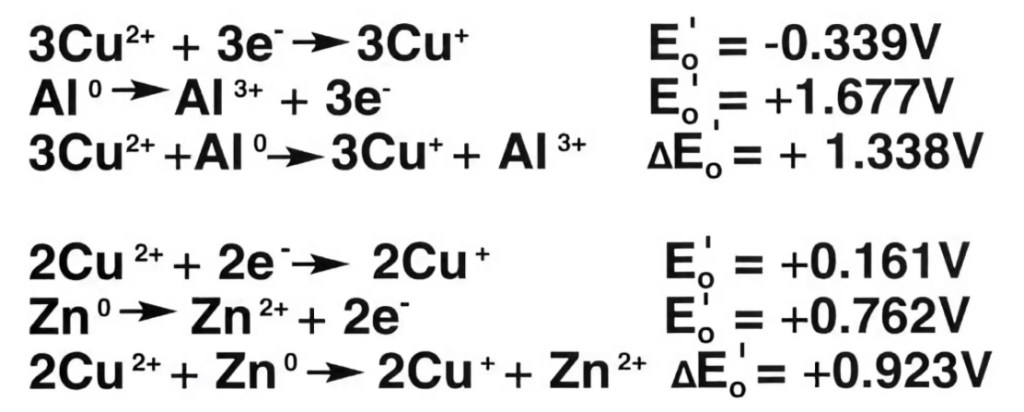
For the printer or artist, both these systems are mild and much safer than the traditional nitric acid bath for etching of metals, especially if proper precautions are taken when designing the reactions (e.g., no etching of aluminum with ferric chloride) and when exhausted materials are disposed of properly.
To the chemist, these are very nice systems, which are highly complex. In the chemistry lab, we usually deal with much more dilute solutions of metal ions and salts than are described here. All would bear some study from the chemistry perspective.
The real issues here are competitive equilibria. Chloro and citrate complexes of these metals are playing a major role in these systems. There is not much published information on these systems. There does not appear to be any significant or major chemical hazards associated with the chemical processes employed here, although a reaction between aluminum and iron could lead to explosive results.
Standard reduction potentials were obtained from Harris, D.C. Quantitative Chemical Analysis, 6th edition, W.H. Freeman and Company, New York, 2003.
© 2003; reprinted 2026